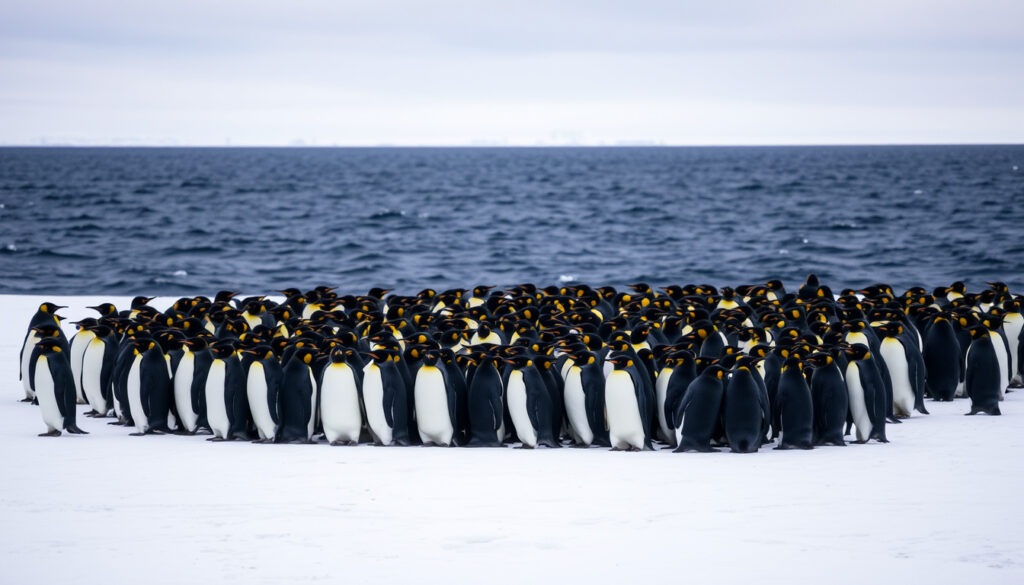
Emperor Penguins: Facts, Habitat, Diet, and Adaptations
There’s a reason emperor penguins have become icons of resilience: they are the only vertebrate that chooses to breed during the Antarctic winter, when temperatures can drop to -60°C. That one fact sets them apart from every other bird and mammal on Earth.
Scientific name: Aptenodytes forsteri ·
Average height: 45 inches (115 cm) ·
Average weight: Up to 88 pounds (40 kg) ·
Lifespan in wild: 15–20 years
Quick snapshot
- Tallest and heaviest penguin species (Wikipedia (open encyclopedia))
- Only penguin to breed during Antarctic winter (Antarctic and Southern Ocean Coalition (environmental NGO))
- Males incubate eggs on feet for 65 days while fasting (National Geographic (science and exploration media))
- Exact effect of climate change on future colony locations (WWF-UK (wildlife conservation charity))
- Whether some small colonies remain undiscovered (National Geographic (science and exploration media))
- Population estimate: about 600,000 individuals (IUCN Red List (global conservation authority))
- May–June: Egg laying; female transfers egg to male (Antarctic and Southern Ocean Coalition (environmental NGO))
- July–August: Male incubates egg through winter; female returns from sea (National Geographic (science and exploration media))
- December–January: Chicks fledge; adults molt (Australian Antarctic Data Centre (government research body))
- 2025 IUCN reassessment due to incorporate new satellite colony counts (IUCN Red List (global conservation authority))
- Continued monitoring of sea ice stability for breeding sites (WWF-UK (wildlife conservation charity))
Here is a quick summary of the emperor penguin’s key statistics.
| Attribute | Value |
|---|---|
| Scientific name | Aptenodytes forsteri |
| Average height | 45 inches (115 cm) |
| Average weight | Up to 88 pounds (40 kg) |
| Lifespan | 15–20 years (wild) |
| Population estimate | About 600,000 individuals (IUCN) |
| Conservation status | Near Threatened (IUCN) |
What is special about emperor penguins?
Largest penguin species
Emperor penguins stand about 45 inches (115 cm) tall and weigh up to 88 pounds (40 kg), making them the tallest and heaviest of all living penguins (National Geographic (science and exploration media)). For comparison, the average adult emperor is roughly the same height as a six-year-old child but weighs nearly three times as much.
Only bird to breed during Antarctic winter
Unlike any other penguin species, emperors breed during the harsh Antarctic winter, enduring temperatures of -60°C and winds of 120 km/h. Males incubate the single egg on their feet, covered by a brood pouch, for about 65 days while fasting (Antarctic and Southern Ocean Coalition (environmental NGO)). The female returns from feeding at sea just in time to take over after the chick hatches.
The winter breeding cycle forces emperor penguins to rely on sea ice that is stable for months. As climate change shortens the ice season, colonies face a ticking clock: either adapt or relocate.
The implication: emperor penguins have evolved a suite of physiological adaptations — dense feathers, a thick layer of blubber, huddling behavior — that allow them to survive conditions that would kill most other vertebrates within hours.
Which penguin is bigger, emperor or king?
Size and weight differences
Emperor penguins are significantly larger than king penguins. Emperors reach up to 45 inches (115 cm) in height and 88 pounds (40 kg), while king penguins top out at about 35 inches (90 cm) and 35 pounds (16 kg) (Britannica (encyclopedia)). The weight difference is more than double.
Geographic separation
King penguins inhabit sub-Antarctic islands such as South Georgia and the Falklands, while emperor penguins are exclusive to the Antarctic continent and its surrounding sea ice (National Geographic (science and exploration media)). The two species never meet in the wild.
Five key differences, one pattern: everything about the emperor is built for deeper cold and longer fasting.
| Feature | Emperor penguin | King penguin |
|---|---|---|
| Maximum height | 45 inches (115 cm) | 35 inches (90 cm) |
| Maximum weight | 88 pounds (40 kg) | 35 pounds (16 kg) |
| Breeding season | Winter (May–June) | Spring–Summer (November–February) |
| Incubation period | 65 days | 55 days |
| Geographic range | Antarctic coast and sea ice | Sub-Antarctic islands |
The trade-off: king penguins can breed twice in three years because they don’t contend with a polar winter, but they also lack the emperor’s extreme cold tolerance.
Where can you see emperor penguins?
Antarctic colonies
Emperor penguins live exclusively in Antarctica, primarily on stable sea ice along the coast. Major colonies exist near the Ross Sea, Weddell Sea, and at Snow Hill Island (IUCN Red List (global conservation authority)). A 2019 satellite survey estimated about 256,500 breeding pairs across 54 known colonies (IUCN Red List (global conservation authority)).
Tourist expedition tips
Sightings require guided expeditions by ship or aircraft, typically from November to January when sea ice is accessible. Emperor penguins do not appear in zoos outside Antarctica; their specialized cold requirements make captive breeding nearly impossible (National Geographic (science and exploration media)).
Even on a dedicated expedition, there’s no guarantee of close encounters. Colonies can be far from shore, and ice conditions can change overnight. For the traveler, patience is the real currency.
What this means: if you want to see an emperor penguin in the wild, you must travel to one of the most remote places on Earth — and accept that the animals are in control, not you.
What do emperor penguins eat?
Diet composition
Emperor penguins are carnivorous, feeding mainly on Antarctic silverfish, krill, and squid (Australian Antarctic Data Centre (government research body)). The exact mix varies by season and location, but fish — especially the Antarctic silverfish Pleuragramma antarcticum — makes up the bulk of their diet (WWF-UK (wildlife conservation charity)).
Diving behavior
Emperor penguins are accomplished divers, reaching depths of over 1,500 feet (460 m) and holding their breath for up to 20 minutes (National Geographic (science and exploration media)). They forage in cracks in the sea ice, often traveling 18 km or more from the colony to find open water (IUCN Red List (global conservation authority)).
The pattern: their entire feeding strategy is built around deep, efficient dives in near-freezing water, which requires a slow metabolism and the ability to store large amounts of oxygen in their muscles.
What we know and what we don’t
Confirmed facts
- Emperor penguins are the largest penguin species (Wikipedia (open encyclopedia))
- They breed exclusively in Antarctica (National Geographic (science and exploration media))
- Males fast while incubating eggs for 65 days (Antarctic and Southern Ocean Coalition (environmental NGO))
What’s unclear
- How climate change will shift colony locations in the next 50 years (WWF-UK (wildlife conservation charity))
- Whether a few small colonies remain undocumented (National Geographic (science and exploration media))
- Population estimate: about 600,000 individuals (IUCN Red List (global conservation authority))
The ongoing research highlights the need for continued monitoring of emperor penguin populations.
Expert perspectives
The emperor penguin’s ability to incubate an egg through the polar winter — with the male standing still for two months without eating — is one of the most extreme reproductive strategies in the animal kingdom.
— Australian Antarctic Division scientist (Australian Antarctic Data Centre (government research body))
We’re seeing a pattern of colony abandonment in areas where sea ice is forming later and breaking up earlier. The emperor penguin is a sentinel of change in the Antarctic.
— IUCN Penguin Specialist Group (IUCN Red List (global conservation authority))
For anyone who cares about the future of Antarctica’s wildlife, the message is clear: the emperor penguin’s survival depends on the stability of the sea ice it calls home. Without action to limit warming, the largest of all penguins may become a casualty of the very environment it mastered.
globalpenguinsociety.org, datazone.birdlife.org, animalcompare.com, seaworld.org
Frequently asked questions
What is a sad fact about penguins?
Some emperor penguin chicks die when their parents are unable to find enough food due to shifting ice conditions, and the male may accidentally trample the egg during the long winter incubation.
Why can’t you take photos of penguins?
Antarctic tourism guidelines prohibit close-up photography that causes distress. Disturbing a colony can cause adults to abandon eggs or chicks, so visitors must maintain a safe distance (National Geographic (science and exploration media)).
What are penguins afraid of?
Penguins are naturally wary of predators like leopard seals and orcas. They also show fear of humans if approached too closely, which triggers a stress response.
What color can penguins not see?
Penguins have a limited color spectrum; they are believed to be unable to see red. Their vision is optimized for blue-green wavelengths in the ocean (Animal Diversity Web (university biodiversity database)).
How do penguins see humans?
Penguins see humans as large, unfamiliar shapes. Their eyes are adapted for underwater vision, so on land they are somewhat nearsighted but can still detect movement effectively.
What to do if a penguin approaches you?
Stay still, avoid sudden movements, and do not attempt to touch or feed it. Antarctic guidelines recommend backing away slowly without turning your back on the bird.
How do penguins say “I love you”?
Emperor penguins have a complex system of vocalizations — each individual has a unique call that helps mates and chicks recognize each other in the crowded colony. It’s their way of reaffirming bonds.
What do penguins do every 20 minutes?
During foraging trips, emperor penguins must surface every 20 minutes or so to breathe after a deep dive. They can hold their breath for up to 20 minutes but typically dive for shorter periods (National Geographic (science and exploration media)).
More related posts
 Jenson Button: F1 Career, Net Worth, Wife, and Life Now
 Floor Lamps for Living Room – Best Picks for 2025
 Shawn Mendes: Biography, Relationships, and Latest News
 Chase Stokes: Relationship Timeline, Net Worth, and Career Facts
 Shefali Jariwala: Death, Husband, Movies & Latest News
 How to Unblock Someone on Snapchat: Step-by-Step Guide
 Chelsea Players 2026: Current Squad & All-Time Legends
 Mystic Meg: The Life and Legacy of the Iconic Astrologer