Roy Lichtenstein: Pop Art Pioneer and His Lasting Impact
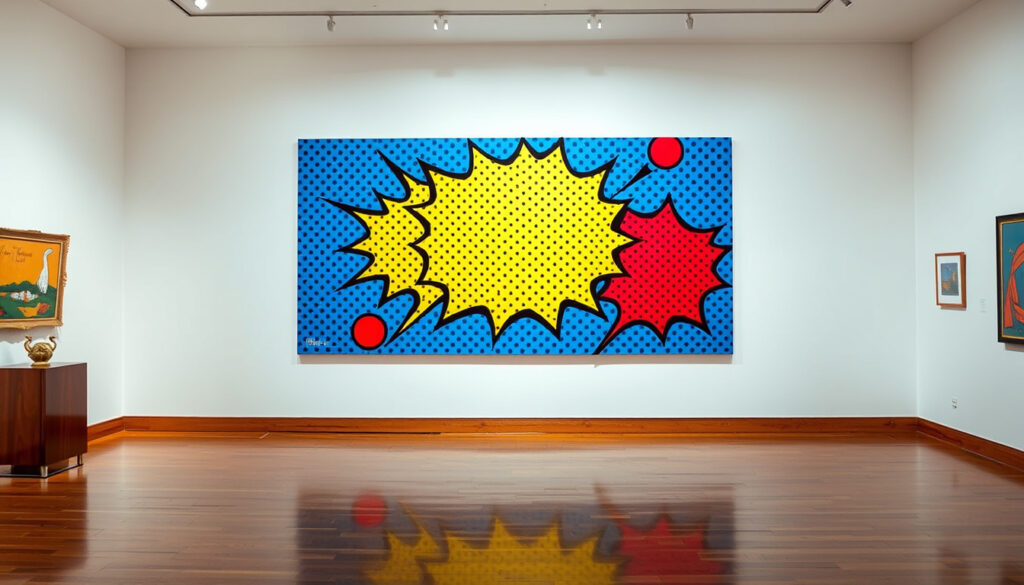
You’ve probably seen his comic-style paintings on a coffee mug or in a textbook — bold outlines, primary colors, and dots that look like they came straight from a comic strip. That’s Roy Lichtenstein, the artist who turned cheap comic book panels into museum masterpieces. His 1963 diptych Whaam! (Britannica, the leading encyclopedia) remains one of the most recognizable works of Pop Art, and it only scratches the surface of a career that challenged what art could be. This article walks through his life, his signature techniques, and why his work still feels immediate today.
Full name: Roy Fox Lichtenstein ·
Born: October 27, 1923, New York City ·
Died: September 29, 1997, New York City (pneumonia) ·
Movement: Pop Art ·
Most famous work: Whaam! (1963) ·
Record auction price: $165 million for Nude with Joyous Painting (2022)
Quick snapshot
- Roy Lichtenstein was born on October 27, 1923 in New York City (Britannica, the leading encyclopedia).
- He earned a BFA (1946) and MFA (1949) from Ohio State University (Smithsonian American Art Museum).
- He died of pneumonia on September 29, 1997 in New York City (Britannica).
- The exact number of works Lichtenstein created. The Broad estimates roughly five thousand, but no comprehensive catalogue exists (The Broad, a major art museum).
- Specific details of his early childhood artistic influences. (The Broad, a major art museum)
- The precise nature of his relationships with fellow Pop artists like Andy Warhol. (The Broad, a major art museum)
- Whether Lichtenstein intended his work as a critique or a celebration of consumer culture. (The Broad, a major art museum)
- 1923: Born in New York City.
- 1963: Created Whaam!, his landmark diptych.
- 1997: Died of pneumonia.
- 2022: Record auction sale of $165 million for Nude with Joyous Painting.
- The Roy Lichtenstein Foundation, established in 2012, continues to authenticate works and support exhibitions (Roy Lichtenstein Foundation, the artist’s official foundation).
- Lichtenstein’s style is widely referenced in digital art, memes, and contemporary design. (Roy Lichtenstein Foundation, the artist’s official foundation)
- Major retrospectives at institutions like SFMOMA and The Broad keep his work in public view (SFMOMA, a leading contemporary art museum).
Six key details, one pattern: Lichtenstein’s entire career centered on turning mass-produced imagery into high art.
| Category | Detail | Source |
|---|---|---|
| Full Name | Roy Fox Lichtenstein | Britannica (first occurrence) |
| Born | October 27, 1923, New York City | Britannica |
| Died | September 29, 1997, New York City (pneumonia) | Britannica |
| Movement | Pop Art | Britannica |
| Notable Works | Whaam!, Drowning Girl, Girl with Ball | MoMA, the Museum of Modern Art; Tate, a major UK art institution |
| Record Sale | Nude with Joyous Painting sold for $165 million in 2022 | Britannica |
What is Roy Lichtenstein’s most famous piece of art?
Exploring Whaam!
- Whaam! is a diptych from 1963 based on a comic panel from DC Comics (Britannica).
- It measures 68 x 160 inches and uses Ben-Day dots and primary colors (Tate).
- The painting captures a fighter plane firing a missile with the onomatopoeic word “Whaam!” – a direct lift from a war comic.
The implication: Lichtenstein transformed a cheap, disposable page into an icon of 20th-century fine art, forcing viewers to ask whether the original or the copy deserved the museum wall.
Lichtenstein’s comic-book borrowings sparked a debate about originality that still echoes in today’s meme culture. When you see a TikTok clip remixed into a new context, you’re watching the same tension he exploited.
TL;DR: Lichtenstein’s Whaam! and Drowning Girl exemplify his method of repurposing comic panels into fine art, generating ongoing debate about originality.
Other iconic works: Drowning Girl
- Drowning Girl (1963) is another iconic work, adapted from DC’s “Run for Love!” (MoMA).
- Both works exemplify Lichtenstein’s blend of popular culture and fine art, using the same Ben-Day dot technique.
What this means: Lichtenstein repeated his formula with minor variations, proving that a single stylistic trick could produce endless variations – and endless market demand.
What are 5 facts about Roy Lichtenstein?
Early life and education
- Born in New York City to Jewish German immigrants (Britannica).
- Studied at Ohio State University, earning a BFA in 1946 and an MFA in 1949 (Smithsonian American Art Museum).
Military service
- Served in the U.S. Army during World War II, stationed in Europe (Smithsonian American Art Museum).
Career breakthrough
- Shifted to comic-style paintings in 1961 after experimenting with Abstract Expressionism (Roy Lichtenstein Foundation).
- His first fully realized Pop paintings used comic strips and advertisements as source material (Roy Lichtenstein Foundation).
Artistic technique
- Used Ben-Day dots, a commercial printing method named after printer Benjamin Day, to mimic newspaper reproduction (Tate).
- Later collaborated with Golden Artist Colors to create a mineral spirit acrylic paint called MSA (Tate).
Death and legacy
- Died of pneumonia on September 29, 1997 at NYU Medical Center (Britannica).
- The Roy Lichtenstein Foundation was established in 2012 to support research and exhibitions (Roy Lichtenstein Foundation).
- In 2022, Nude with Joyous Painting sold for a record $165 million at auction (Britannica).
TL;DR: Lichtenstein’s five key facts span his birth, education, military service, shift to comic style, and death, with a foundation continuing his legacy.
Why is Roy Lichtenstein so famous?
Pioneer of Pop Art
- He helped originate Pop Art by elevating comic book panels to high art (Roy Lichtenstein Foundation).
- MoMA calls him a key figure in Pop Art who grounded his career in imitation (MoMA).
Parody and appropriation
- He challenged the boundaries of originality by appropriating commercial imagery (SFMOMA).
- His large-scale paintings and use of Ben-Day dots became a hallmark of Pop Art (The Broad).
Media and public reception
- He garnered both criticism and acclaim for borrowing directly from mass culture (SFMOMA).
- His works command high auction prices and remain widely reproduced in popular culture.
The pattern: Lichtenstein became famous not despite the controversy over appropriation, but because of it — the debate itself made him impossible to ignore.
Other contemporary artists like Damien Hirst also challenged art conventions in their own ways.
TL;DR: Lichtenstein’s fame rests on his role as a Pop Art pioneer and his provocative use of commercial imagery, which turned controversy into cultural currency.
Who is Roy Lichtenstein?
Background and family
- Full name Roy Fox Lichtenstein, born October 27, 1923 in New York City (Britannica).
- Parents were Milton Lichtenstein (real estate broker) and Beatrice Werner (Britannica).
Education and early influences
- Developed an early interest in art, science, and music.
- Studied at the Art Students League with Reginald Marsh (Smithsonian American Art Museum).
Personal life
- Married three times: Isabel Wilson (1949–1965), Dorothy Herzka (1966–1997), and had two sons.
TL;DR: Roy Lichtenstein was a New York‑born artist with a traditional education, married multiple times, whose early interests shaped his later Pop Art career.
What happened to Roy Lichtenstein?
Later career and continuing success
- Continued to produce art throughout the 1970s–1990s, including public sculptures (Britannica).
- His output included paintings, prints, drawings, sculptures, and murals, totaling roughly five thousand works (The Broad).
Lichtenstein’s late-career shift toward sculpture proved his method could scale from a two-inch comic panel to a fifty-foot public monument without losing its punch. He didn’t run out of ideas — he just ran out of panels.
TL;DR: Lichtenstein expanded into sculpture late in life, demonstrating his style’s scalability, while his posthumous market value cemented his place in art history.
Death
- Died of pneumonia on September 29, 1997 at NYU Medical Center (Britannica).
Posthumous legacy
- His estate is managed by the Roy Lichtenstein Foundation, which supports research and exhibitions (Roy Lichtenstein Foundation).
- In 2022, Nude with Joyous Painting sold for a record $165 million at auction (Britannica).
- His style is frequently cited as an influence on digital artists and meme creators.
The trade-off: Lichtenstein’s posthumous market value — $165 million for a single canvas — confirms that the art world has fully embraced the very commercial techniques he was accused of co-opting.
Timeline
- 1923 – Born in New York City.
- 1940–1943 – Studied at Ohio State University (BFA, MFA).
- 1943–1946 – Served in U.S. Army during World War II.
- 1950s – Experimented with Abstract Expressionism.
- 1961 – Shifted to comic-style paintings.
- 1963 – Created Whaam!; first solo gallery show.
- 1966 – First retrospective at Pasadena Art Museum.
- 1997 – Died of pneumonia.
- 2012 – Roy Lichtenstein Foundation established.
- 2022 – Record auction: Nude with Joyous Painting sold for $165 million.
Confirmed facts
- Full name and birth/death dates are well documented (Britannica).
- Education at Ohio State University (Smithsonian American Art Museum).
- Military service in WWII (Smithsonian American Art Museum).
- Use of Ben-Day dots and comic sources (Tate).
- Cause of death: pneumonia (Britannica).
- Record sale of Nude with Joyous Painting in 2022 (Britannica).
What’s unclear
- Exact number of works he produced (The Broad gives a rough estimate).
- Specific details of early childhood influences.
- Precise nature of his relationships with other Pop artists.
- Whether his work was primarily critique or celebration of consumer culture.
- Which specific artworks he considered his best.
- How much he directly influenced the rise of digital meme aesthetics.
Quotes
“I think the most obvious way that my work differs from the comic strips is that I am using a different format, and I am using a different color scheme, and I am using Ben‑Day dots…”
“He transformed the way we think about visual languages, blurring the boundaries between high art and mass culture.”
Tate curator, as quoted on Tate.org
Lichtenstein’s legacy is not just a set of paintings hanging in museums — it’s a visual language that now feels native to the internet. For any artist or designer working with appropriated imagery today, the choice is clear: either own the borrowing the way Lichtenstein did, or let the original owner define the meaning.
en.wikipedia.org, news.masterworksfineart.com, singulart.com, moma.org, legionofandy.com, japanmorningnews.com
For a closer look at Roy Lichtensteins artistic journey, including his iconic comic-style works and Ben-Day dots, read the full feature on his career.
Frequently asked questions
How did Roy Lichtenstein develop his signature style?
He moved from Abstract Expressionism to a style that mimicked comic strips and advertisements, using bold outlines and Ben-Day dots.
What is the Ben-Day dots technique?
It’s a printing process named after Benjamin Day that uses small colored dots to create shading and color in commercial images. Lichtenstein hand-painted them to replicate mechanical reproduction.
How does Lichtenstein’s work compare to Andy Warhol’s?
Both were Pop Art pioneers, but Warhol used silkscreen to mass-produce images, while Lichtenstein hand-painted his comic-source borrowings with meticulous dots.
What materials did Lichtenstein use for his paintings?
He used oil and synthetic polymer paints on canvas, later working with Golden Artist Colors to develop a mineral spirit acrylic paint called MSA.
Why are Lichtenstein’s paintings so valuable at auction?
Their cultural iconicity, rarity of major works, and the artist’s established place in art history drive high demand. Nude with Joyous Painting sold for $165 million in 2022.
Where can I see Roy Lichtenstein’s art in person?
Major collections include MoMA, the Broad, SFMOMA, Tate, and the Art Institute of Chicago.
Did Roy Lichtenstein ever create sculptures?
Yes, especially later in his career. He produced public sculptures in painted bronze, such as Barcelona Head.
What was Lichtenstein’s relationship with the commercial art world?
He embraced commercial imagery and mass-production techniques, but also critiqued them. His work blurs the line between advertising and fine art.
More related posts
 William Hanson: Etiquette Coach, Podcast Host & TikTok Star
 Sadiq Khan: Biography, Salary, and Political Career
 Who is Ralph Lauren? Bio, Marriages & Cancer Diagnosis
 Touker Suleyman: Net Worth, Brands, and Dragons’ Den Exit
 Anita Rani: Biography, Career, and Personal Life
 Hotels in Edinburgh City Centre – Top 2025 Picks and Guides
 Marcus Wareing: Career, Net Worth, and Gordon Ramsay Fallout
 Bebe Rexha: Biography, Relationships, Health, and FAQs