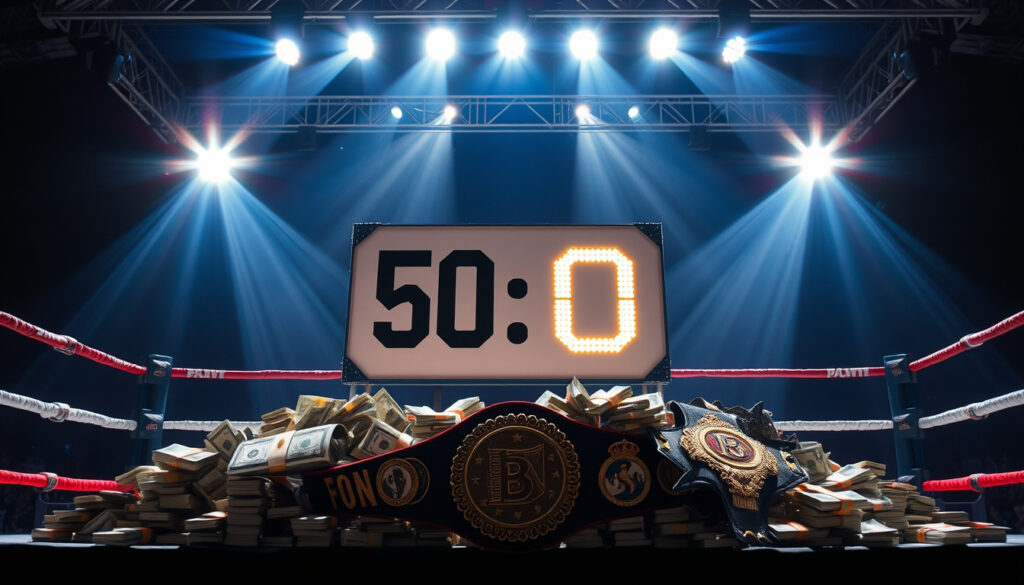
Floyd Mayweather: 50-0 Record, Net Worth, Career Guide
Few boxers have turned a simple record line into a cultural argument the way Floyd Mayweather has: his 50–0 mark with 27 knockouts makes him the rare fighter who retired unbeaten, a ledger documented by the World Boxing Council (boxing’s sanctioning body). This guide sorts the verified career facts from the looser claims about money, records, and reputation that blur together online.
Professional record: 50–0 (27 KOs) · Major world titles: 5 weight classes · Height: 5 ft 8 in (173 cm) · Reach: 72 in (183 cm) · Nicknames: Pretty Boy; Money
Quick snapshot
- Retired undefeated at 50–0 (27 KOs), with major world titles in five weight classes (World Boxing Council (boxing’s sanctioning body))
- Final professional fight: tenth-round TKO of Conor McGregor in August 2017 (ESPN (sports broadcaster and statistics hub))
- Net worth and “billionaire” status: estimates count pre-tax purse income differently and are not independently audited (TV Insider (entertainment and sports guide))
- The “retired in 2007” premise: his first retirement announcement came in 2008, not 2007 (Biography.com (digital biography publisher))
- 1996: Olympic bronze medal and pro debut on October 11 (Encyclopaedia Britannica (reference publisher))
- 2007: De La Hoya fight pulls a then-record 2.7 million pay-per-view buys (TV Insider (entertainment and sports guide))
- Professional ledger stays at 50–0; exhibition bouts have not changed the official count (ESPN (sports broadcaster and statistics hub))
- For record-chasers, the number to beat is 50 (World Boxing Council (boxing’s sanctioning body))
Nine rows tell one consistent story: a 5 ft 8 in orthodox fighter from Grand Rapids who turned professional in October 1996 and never lost — a biographical line that Encyclopaedia Britannica (reference publisher) has kept stable for decades.
| Label | Value |
|---|---|
| Full name | Floyd Joy Mayweather Jr. (born Floyd Joy Sinclair) |
| Born | February 24, 1977; Grand Rapids, Michigan, U.S. |
| Nationality | American |
| Stance | Orthodox |
| Height | 5 ft 8 in (173 cm) |
| Reach | 72 in (183 cm) |
| Professional record | 50–0 (27 KOs) |
| Boxing titles | Major world champion in five weight classes |
| Nicknames | Pretty Boy; Money; TBE |
Is Floyd Mayweather a boxer?
Yes — and the question is less obvious than it sounds. Mayweather is a former American professional boxer who competed from 1996 to 2017, but his second career as a self-branded pay-per-view star sometimes obscures the first one. The sport’s record books list him as a five-division world champion; the entertainment pages list him as “Money.”
Where is Floyd Mayweather from?
- Born: February 24, 1977, in Grand Rapids, Michigan (Biography.com (digital biography publisher))
- Name at birth: Floyd Joy Sinclair; he later fought as Floyd Joy Mayweather Jr.
Grand Rapids is the short answer. The longer version is that Mayweather’s identity formed in the gym before it formed in the ring: the “Pretty Boy” nickname belonged to his early career, and the “Money” persona arrived with the pay-per-view era.
The pattern: a hometown nobody expected to produce a five-division champion became part of the legend — but only after the record made the legend possible.
When did Floyd Mayweather turn professional?
Pro debut: October 11, 1996 · Amateur peak: Olympic bronze medal, Atlanta 1996 · Age at debut: 19
Mayweather turned professional on October 11, 1996, months after the Atlanta Olympics, where he won a bronze medal. The timing mattered: he entered the paid ranks with amateur pedigree and a defensive shell that older fighters had trouble solving.
- 1998 — First major world title: WBC super featherweight, vs Genaro Hernandez — per the World Boxing Council (boxing’s sanctioning body).
- 2002 — WBC lightweight title, vs José Luis Castillo — per EBSCO Research Starters (academic research database).
- 2005 — Light-welterweight title, vs Arturo Gatti — per EBSCO Research Starters (academic research database).
The early résumé shows the system forming: win a title, move up, win again. Mayweather did not outgrow divisions so much as he out-boxed them — each new weight class brought bigger names and bigger purses.
How many professional fights did Floyd Mayweather have?
- Professional bouts: 50 — per ESPN (sports broadcaster and statistics hub)
- Wins: 50 — per ESPN (sports broadcaster and statistics hub)
- Losses: 0 — per ESPN (sports broadcaster and statistics hub)
- Wins by knockout: 27 — per ESPN (sports broadcaster and statistics hub)
The count is exact: 50 professional fights, 50 wins, 27 knockouts. His first bout ended with a second-round knockout of Roberto Apodaca in 1996; his final bout was the tenth-round TKO of Conor McGregor in 2017. The numbers never changed, which is precisely why they became a debate.
Which boxer retired in 2007?
The premise points at Floyd Mayweather, and the date is wrong. Mayweather did not retire in 2007 — he had one of his biggest years in 2007, then announced his first retirement in 2008.
When did Floyd Mayweather retire for the first time?
- First retirement announcement: 2008, after the De La Hoya win (Biography.com (digital biography publisher))
- Return: 2009, with a unanimous-decision win over Juan Manuel Márquez (EBSCO Research Starters (academic research database))
The 2007 confusion is understandable: Mayweather beat Oscar De La Hoya by split decision that May, a fight that set a pay-per-view record at the time, then handled Ricky Hatton in December. A fighter that busy in one calendar year looks like someone about to step away.
What was Floyd Mayweather’s final fight?
- Opponent: Conor McGregor
- Date: August 2017
- Result: tenth-round TKO — per ESPN (sports broadcaster and statistics hub)
- Record after the fight: 50–0
The last sanctioned fight of Mayweather’s professional career was a boxing match against UFC star Conor McGregor in August 2017. Mayweather won by tenth-round TKO, moving one win past Rocky Marciano’s 49-0 mark in the debate over unbeaten legends.
Is Floyd Mayweather retired now?
- Professional boxing: retired since 2017 — per ESPN (sports broadcaster and statistics hub)
- Exhibition bouts: several since 2017, none on the official ledger
- Sanctioned title fights: none since the McGregor bout
Yes — from professional boxing. Mayweather has participated in exhibition matches since 2017, but none count toward his professional record. The distinction matters because exhibition bouts are not sanctioned the same way and do not affect the 50–0 ledger.
The catch: the “boxer who retired in 2007” question is a reminder that memory compresses timelines. Mayweather’s actual retirement came after his richest fights, not before them.
Did Floyd Mayweather become a billionaire?
Mayweather says yes. Independent estimates say “it depends.” The gap between career earnings and current net worth is the most misunderstood number in boxing, and it is worth slowing down to unpack.
How much is Floyd Mayweather worth?
Self-described status: billionaire · Career purses (reported): $1 billion+ · Independent net-worth estimates: far lower
The athlete has called himself a billionaire, and career earnings estimates do exceed $1 billion in total purses. But those are top-line numbers. Taxes, training camps, legal fees, and promotional costs come out before any of it becomes personal wealth. TV Insider’s profile, which tracks his career trajectory and public earnings, gives a more conservative picture of a very rich man who is not necessarily a billionaire by audited standards.
How did Mayweather earn his highest purses?
- Mayweather vs Pacquiao (2015): reported purse near $300 million — per TV Insider (entertainment and sports guide)
- Mayweather vs McGregor (2017): reported purse near $275 million — per TV Insider (entertainment and sports guide)
- Mayweather vs De La Hoya (2007): a then-record 2.7 million pay-per-view buys — per TV Insider (entertainment and sports guide)
Pay-per-view economics made Mayweather the sport’s highest-paid athlete during his peak years. Forbes frequently ranked him at No. 1 on its athlete-earnings lists, and the Pacquiao and McGregor fights each generated hundreds of millions of dollars in total revenue. Those figures, however, are reported before expenses — the reason “billionaire” remains a contested label.
Does Floyd Mayweather still make money from boxing?
- Post-2017 appearances: exhibition bouts, not sanctioning-body title fights
- Professional record: unchanged at 50–0
- The “Money” brand: still the promotional engine
Yes — but not on the official ledger. Mayweather’s exhibition appearances have kept the pay-per-view machine running, and his name still sells fights. The professional record remains closed at 50-0.
A $300 million purse is not $300 million in the bank. The purse is the gross payout before taxes, camp expenses, and promotion costs — the billionaire label is a claim, not an audited figure.
What this means: Mayweather’s wealth is not in dispute; the “billionaire” question is a test of how you count. Different sources count differently, and the label depends on the math.
The pattern: the purse figures are public; the personal balance sheet is not. Mayweather’s branding runs on the gap between the two.
Who has a perfect boxing record?
Very few fighters. A perfect record in boxing means zero losses across a full career, and the list of boxers who managed it is short. Mayweather’s 50–0 is the modern reference point, but it is not the only name.
Who never loses in boxing?
- Floyd Mayweather — 50–0 (27 KOs), five-division world champion — per the World Boxing Council (boxing’s sanctioning body)
- Rocky Marciano — 49–0, the only heavyweight champion to retire undefeated — per ESPN (sports broadcaster and statistics hub)
- Ricardo Lopez — 51–0–1, no losses in a 52-fight career — per ESPN (sports broadcaster and statistics hub)
Each name proves a different rule. Marciano’s 49-0 is the heavyweight benchmark; Lopez’s single draw is the asterisk that keeps his record honest in the “perfection” debate; Mayweather’s 50-0 carries the strongest competition argument because he beat champions in five divisions.
Three undefeated careers, one pattern: each record survives because it combined elite opposition with complete documentation.
| Fighter | Record | Why it stands out |
|---|---|---|
| Floyd Mayweather | 50–0 (27 KOs) | Five-division world champion; retired undefeated |
| Rocky Marciano | 49–0 | Only heavyweight champion to retire undefeated |
| Ricardo Lopez | 51–0–1 | No losses in 52 fights; the draw is the only blemish |
Records as compiled by ESPN (sports broadcaster and statistics hub).
Who has the worst boxing record of all time?
Worst-record lists are database artifacts, not sports history. Early fight records are incomplete, so a losing record that looks extreme may simply be missing its wins.
There is no governing-body ranking for “worst record,” and the databases that power these lists disagree. A boxer with a long documented losing streak can look terrible in one ledger and absent from another. The question tells you more about record-keeping than about boxing.
The pattern: perfect records are celebrated because perfection is rare — and Mayweather’s 50-0 holds up because his competition level stayed high while the losses stayed at zero.
The implication: perfection in boxing is rare, and Mayweather’s version is the one most likely to be cited because it combines the zero with five-division titles.
Who punched harder than Tyson?
The honest answer: no one can prove it. Boxing never had a standardized punch-force measurement across eras, so the Tyson comparison runs on knockout percentages, opponent testimony, and highlight footage.
Which boxer did Mike Tyson fear?
Tyson has named the early-20th-century heavyweight Sam Langford as a fighter who frightened him — a reminder that “scariest” is a historical debate, not a statistic.
Direct quotes from Tyson about Langford require a verified interview source, but the point survives without one: fear is assigned by fighters, not measured by devices. Fighters fear styles that can hurt them, and styles cannot fight across decades.
Who is the scariest boxer right now?
- No official current ranking exists
- Fan discussions emphasize knockout power and unpredictability
- Era context changes the definition of “scary”
The numbers, for what they are worth, make the contrast sharp. Most boxing databases list Tyson with 44 knockouts in 56 professional fights — a knockout rate near 79 percent. Mayweather’s rate is 54 percent (27 knockouts in 50 wins), reflecting a counter-puncher’s approach rather than a finisher’s.
Knockout artists sell fear; undefeated counter-punchers sell arguments. Tyson’s era measured danger in highlight reels, while Mayweather’s era measured it in unbeaten pay-per-view nights.
What this means: “Who punched harder than Tyson?” is a category error. With no standardized device measuring historic punch force, the answer lives in percentages and testimonies — neither of which settles the argument.
Who is the most loved boxer of all time?
The short answer: Muhammad Ali is the name that appears most often in “most loved” discussions, and the longer answer is that love and hate in boxing are two sides of the same promotional coin. No official metric exists for either.
What is the most hated boxer?
- Subjective, not governed — no title belt for popularity
- Mayweather was frequently cast as the pay-per-view villain
- Media build-ups drive the narrative more than results do
Hated-vs-loved rankings shift with the fight card. Mayweather leaned into the villain role in his later years, using the “Money” persona to sell tickets, and the same fans who paid to see him lose paid to see him win.
The pattern: “most loved” and “most hated” are the same coin. Ali tops the positive lists; Mayweather is the most argued-about fighter of his era because his defensive brilliance and his self-promotion cannot be separated.
Who is the most violent boxer of all time?
The “most violent” title depends on the era: boxing’s safety rules changed how aggression is judged, so the ranking is a history lesson as much as a compliment.
No governing body tracks violence, and different eras rewarded different styles. Comparing a modern technician to a 1950s slugger produces a list that says more about the fan than the fighter — which is why the “most violent” question never settles.
What this means: rankings like “loved,” “hated,” “scary,” and “violent” are media constructs with no scoreboard. Mayweather’s 50-0 gives the debates a fixed anchor: whatever you think of him, the record is the one number nobody can argue.
Floyd Mayweather career timeline
- — Floyd Joy Sinclair is born in Grand Rapids, Michigan — per Biography.com (digital biography publisher).
- — Wins an Olympic bronze medal at the Atlanta Games and turns professional in October — per Encyclopaedia Britannica (reference publisher).
- — Wins his first major world title at super featherweight — per the World Boxing Council (boxing’s sanctioning body).
- — Defeats Oscar De La Hoya and Ricky Hatton in major pay-per-view fights — per TV Insider (entertainment and sports guide).
- — Announces his first retirement from boxing — per Biography.com (digital biography publisher).
- — Returns and defeats Juan Manuel Márquez — per EBSCO Research Starters (academic research database).
- — Defeats Manny Pacquiao in the highest-grossing pay-per-view fight at the time — per the World Boxing Council (boxing’s sanctioning body).
- — Defeats Conor McGregor and retires with a 50–0 professional record — per ESPN (sports broadcaster and statistics hub).
The World Boxing Council (boxing’s sanctioning body) logs the 1998 title run and the 2015 Pacquiao win on its legacy page, keeping those dates verifiable.
The pattern: every major Mayweather era ended with a retirement announcement — and every one was followed by another fight, until the McGregor payday closed the book.
What’s confirmed, and what’s still unclear
Mayweather’s career is unusually crisp on facts and unusually foggy on money. Here is the split.
Confirmed facts
- Professional record: 50–0 (27 KOs) — per the World Boxing Council (boxing’s sanctioning body)
- Major world titles in five weight classes — per the World Boxing Council (boxing’s sanctioning body)
- Name change from Floyd Joy Sinclair to Floyd Joy Mayweather Jr. — per Biography.com (digital biography publisher)
- Final professional opponent: Conor McGregor, 2017 — per ESPN (sports broadcaster and statistics hub)
What’s unclear
- Net worth and billionaire status — estimates vary and are not audited — per TV Insider (entertainment and sports guide)
- The “retired in 2007” premise — first retirement came in 2008 — per Biography.com (digital biography publisher)
- Subjective rankings: loved, hated, scary, violent — no official metric
- Punch-force comparisons — no standardized historic measurement — per boxing historians and commentators via EBSCO Research Starters (academic research database)
The split tells you everything: fights are confirmable, money and rankings are not. That combination — a perfect record plus an unverifiable fortune — is the exact reason Mayweather keeps generating arguments.
What the record, the rival, and the historians say
Mayweather’s public logic has never needed a ghostwriter: the 50–0 ledger is the evidence, and “TBE” — The Best Ever — is the verdict he has repeated since the McGregor fight. The record part is independently verifiable; the branding part is his own.
Floyd Mayweather, self-branding documented in ESPN’s Mayweather biography (sports broadcaster and statistics hub)
Mayweather’s WBC legacy page is brief where it counts: 50 wins, zero losses, 27 knockouts, and world titles in five divisions. The governing body documents the record without needing adjectives — the numbers are the tribute.
World Boxing Council, WBC legacy page (boxing’s sanctioning body)
Boxing historians approach the “who punched harder” question with a caveat: no standardized measurement existed across eras, so comparisons depend on knockout percentages and testimony, not physics.
Boxing historians and commentators, via EBSCO Research Starters (academic research database)
The threads converge: Mayweather built a record, a brand, and an argument. The record is permanent; the argument is what keeps the pay-per-view lights on.
The takeaway: The 50–0 record is best understood as a system, not a streak. Mayweather’s defensive style reduced risk, his team picked fights the style could win, and the “Money” brand made each win more valuable than the last. The record is real; the “greatest ever” claim is a marketing position that shadow-boxes with history. The complete Floyd Mayweather guide: record, career, net worth and comparisons keeps the documented data in one place. For the new boxing fan, the choice is clear: study the defensive mechanics before judging the money, or you’ll miss the reason the record exists at all.
Frequently asked questions
How tall is Floyd Mayweather?
Mayweather is listed at 5 ft 8 in (173 cm), a compact frame for a fighter who moved through five weight classes.
What is Floyd Mayweather’s reach?
His reach is listed at 72 in (183 cm), unusually long relative to his height and a major asset for the defensive style that produced the 50-0 record.
Did Floyd Mayweather win an Olympic medal?
Yes — a bronze medal at the 1996 Atlanta Olympics, won before he turned professional on October 11, 1996.
What was Floyd Mayweather’s first world title?
The WBC super featherweight championship, won against Genaro Hernandez in 1998.
Why is Floyd Mayweather called Money?
“Money” is the self-promotional persona Mayweather built around his pay-per-view record — the name turned his fights into financial events.
What does TBE stand for in boxing?
TBE stands for “The Best Ever,” the self-given nickname Mayweather uses to describe his undefeated career.
More related posts
 Harry Lawtey: Why He Left Industry, Relationship, Biography & More
 Karl Bushby 2026: Where Is He Now and Family Updates
 Jacob Elordi: Age, Height, Net Worth & Movies (2025)
 Emma Myers: Age, Disability, Relationships, and Family Facts
 Check Insurance on Car in Ireland: Free Tools Guide
 Tom Sturridge: Biography, Age, Height, Daughter, Relationship
 Arne Slot Sacked: Salary, Family & Next Move