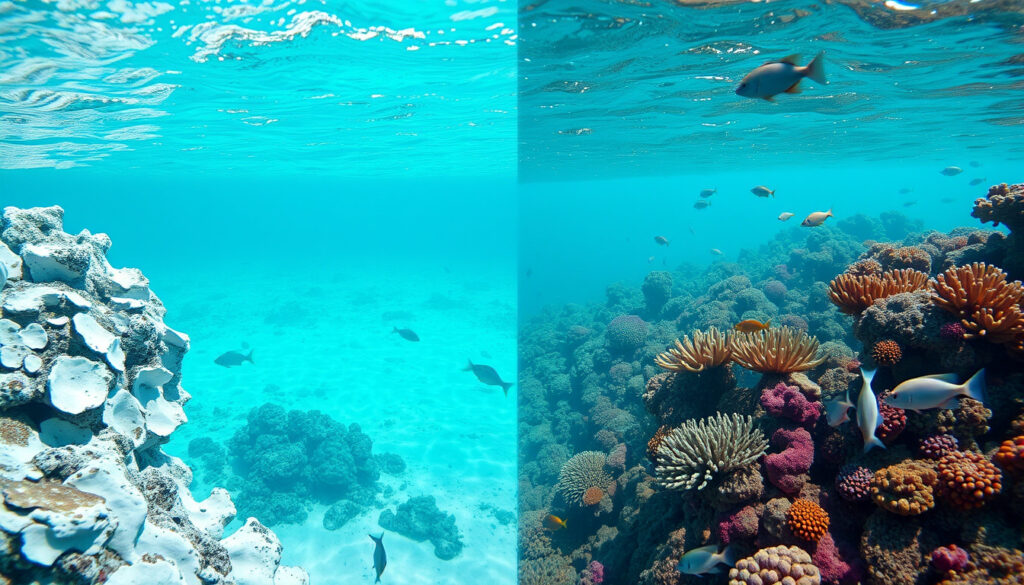
Coral Reef: Definition, Location, and Why They Are Dying
Most people picture coral reefs as sun-drenched tropical gardens teeming with colorful fish. But some of the most fascinating coral ecosystems grow in total darkness, hundreds of meters below the surface off the coast of Ireland. You’ll learn what a coral reef actually is — biologically and geologically — why the ones you can’t see are under serious threat, and what scientists predict for their survival by 2050.
Coral reef coverage: Less than 1% of the ocean floor but support 25% of marine species ·
Estimated loss by 2050: Up to 90% of reefs may be at risk under current warming trends ·
Major threat: Rising ocean temperatures causing mass bleaching ·
Global economic value: Approximately $375 billion per year in ecosystem services
Quick snapshot
- Corals are animals belonging to phylum Cnidaria (NPWS Ireland)
- Reefs are dying due to human-caused climate change (University of Edinburgh research)
- Cold-water coral reefs exist off the coast of Ireland (Lophelia.org)
- Exact percentage of reefs that will survive beyond 2050 depends on emission reductions
- Whether corals might adapt to warmer temperatures over long timescales
- 1980s: First major global bleaching event recorded (NPWS Offshore Habitats)
- 2016-2017: Third global bleaching event hits Great Barrier Reef severely (NPWS Offshore Habitats)
- 2050: Projected loss of 70-90% of reefs if warming continues (NPWS Offshore Habitats)
- Marine protected area expansion in Irish waters (Fair Seas coalition)
- New EU regulations on bottom-trawling in sensitive habitats (Fair Seas coalition)
Cold-water corals off Ireland’s coast are among the most pristine in the North Atlantic, yet they face devastation from fishing gear that drags the seafloor — not from warming waters that dominate headlines about tropical reefs.
Here’s a quick overview of coral reef facts:
| Label | Value |
|---|---|
| Coral reef definition | An underwater ecosystem of reef-building corals held together by calcium carbonate |
| Coral reef location | Found in both tropical and cold waters, including Ireland |
| Biggest threat | Rising ocean temperatures causing bleaching |
| 2050 projection | Up to 90% of reefs may be at risk |
| Do corals feel pain? | No, they lack a brain and pain receptors |
What exactly is a coral reef?
A coral reef is an underwater ecosystem built from calcium carbonate skeletons secreted by colonies of tiny animals called polyps. These polyps — each one a soft-bodied creature no bigger than a pencil eraser — extract calcium ions from seawater and combine them with carbonate to build hard external skeletons. Over centuries, layers upon layers of these skeletons accumulate into massive structures visible from space.
Scientists often call coral reefs the rainforests of the sea because they cover less than 1% of the ocean floor yet host roughly 25% of all marine species. The biodiversity they support rivals any terrestrial ecosystem. But unlike rainforests, reefs are built by living animals, not plants.
How are coral reefs formed?
Every coral reef begins with a single free-swimming coral larva that settles on hard substrate and attaches permanently. That larva metamorphoses into a polyp, which clones itself repeatedly — producing thousands of genetically identical polyps that share tissues and form a colony. Each polyp secretes a cup-shaped calcium carbonate skeleton around its base. As older polyps die, new ones build atop the skeletal legacy.
Reef-building corals depend on a symbiotic relationship with microscopic algae called zooxanthellae that live inside their tissues. These algae perform photosynthesis and supply the coral with up to 90% of its energy needs in exchange for shelter and nutrients. This partnership is why most tropical coral reefs grow in shallow, sunlit waters.
- Coral colonies grow at rates of 0.3 to 2 centimeters per year
- A mature reef structure can take 10,000 years or more to form
- There are over 800 known species of reef-building corals worldwide
When a reef is destroyed, it takes millennia to replace — and the living coral that built it may never return if ocean conditions have changed in the meantime.
The implication: Coral reefs are irreplaceable natural structures that take millennia to form, making their preservation urgent.
What is a coral polyp?
A coral polyp is a soft-bodied animal related to sea anemones and jellyfish, belonging to the phylum Cnidaria. Each polyp has a mouth surrounded by tentacles armed with stinging cells called nematocysts. The polyp uses these tentacles to capture plankton and small prey floating in the water column.
The polyp’s body has only two tissue layers — an outer epidermis and an inner gastrodermis — separated by a jelly-like layer. This simple anatomy is typical of cnidarians and means corals lack organs like hearts, lungs, or a centralized nervous system.
The creature you see waving in the current is essentially a stomach with a mouth and stingers. It’s a colonial animal, not a plant or rock, and each polyp is a distinct individual that shares resources with its neighbors through a common tissue network.
Are there any coral reefs in Ireland?
Yes. Ireland has extensive cold-water coral reefs along its continental shelf, particularly in the Porcupine Bank, Rockall Trough, and the Belgica Mound Province. These reefs grow not in warm tropical shallows but in the cold, dark depths of the North Atlantic — typically at depths of 200 to 1,000 meters, where temperatures hover around 4-8°C.
Cold-water corals have been documented in Irish waters since the 19th century, but large reef structures were only mapped in detail during the 1990s and 2000s using multibeam sonar and remotely operated vehicles. Some of these reefs sit on carbonate mounds that rise up to 500 meters above the surrounding seafloor — taller than many skyscrapers.
What are cold-water coral reefs?
Cold-water coral reefs are formed by coral species that don’t rely on symbiotic algae for energy. The main reef-building species in Irish waters is Lophelia pertusa, which filters food particles from the water instead of depending on sunlight. This adaptation allows it to thrive in deep, dark environments.
These reefs host diverse marine communities. NPWS Offshore Habitats note that cold-water carbonate habitats provide shelter and nursery grounds for commercially important fish species, including orange roughy and tusk, as well as communities of sponges, sea fans, and brittle stars.
- Lophelia pertusa has been found in commercial by-catch in Irish waters
- These reefs grow extremely slowly — roughly 0.1 to 0.3 centimeters per year
- Irish cold-water reefs are protected under EU Habitats Directive as biogenic reef habitat
The catch: Because cold-water reefs are fragile and slow-growing, when fishing gear destroys a hundred-year-old mound, recovery is measured in centuries — not decades. The same qualities that make them unique make them among the most vulnerable marine ecosystems in European waters.
Why are coral reefs dying?
Coral reefs face a convergence of threats — from global climate change to local fishing practices — that together are driving the most rapid decline in reef ecosystems in recorded history. The question is no longer whether reefs are dying, but how quickly and what can be saved.
What is the biggest killer of coral reefs?
Rising ocean temperatures are the single greatest threat to coral reefs worldwide. When water temperatures exceed the coral’s tolerance threshold — typically 1-2°C above the average summer maximum — the coral expels its symbiotic algae in a process called bleaching. Without the algae, the coral loses its primary energy source and its color, turning white. If the blot event is prolonged, the coral starves and dies.
According to NPWS Ireland reef habitat guidance, cold-water corals are described as “particularly susceptible” to anthropogenic impacts because of their sensitivity to physical disturbance. For tropical reefs, heat stress is the dominant driver; for cold-water reefs in Irish waters, trawling is the most immediate threat.
- The first documented global bleaching event occurred in the 1980s
- Mass bleaching hit the Great Barrier Reef severely in 2016 and 2017 — the third global event
- Bleaching does not always kill coral — but recovery takes years, and repeated events compound damage
Tropical reefs die from heat. Cold-water reefs die from nets scraping the bottom. Both face ocean acidification, which weakens the calcium carbonate skeletons that form the reef itself.
The pattern: The same carbon emissions that warm the surface also acidify the deep ocean, meaning no reef is safe from human activity.
How much coral reef will be left in 2050?
If current warming trends continue, scientists project that 70-90% of coral reefs will be at risk of severe degradation by 2050, with some scenarios suggesting up to 90% loss across all global reef systems. The Intergovernmental Panel on Climate Change has projected that at 1.5°C of warming, 70-90% of coral reefs would disappear; at 2°C, virtually all reefs would be lost.
The projection depends heavily on emissions reductions. The University of Galway identifies increasing CO2-driven warming and ocean acidification as “species-specific threats” to cold-water coral habitats, meaning even deep reefs are not safe from climate impacts.
What this means: The fate of coral reefs is no longer a scientific question — it’s a policy choice. The difference between 1.5°C and 2°C of global warming is the difference between some reefs surviving and virtually none.
Do corals feel pain?
No. Corals lack a central nervous system and pain receptors. They have a simple nerve net — a diffuse network of interconnected nerve cells — that allows them to detect and respond to stimuli like touch or chemical changes, but without a brain or spinal cord, they cannot process the experience as pain.
Do corals have a brain?
Corals have no brain. Their nervous system is a decentralized nerve net that coordinates basic reflexes — contraction of the polyp when threatened, movement of tentacles toward prey, and rhythmic opening and closing of the mouth. This is the same basic neural architecture as jellyfish and sea anemones.
Do corals have eyes?
Corals have no eyes or any light-sensing organs. While some reef-building corals host photosynthetic algae and respond to light levels through their symbiotic partners, the coral animal itself lacks photoreceptors. The light sensitivity observed in some coral larvae comes from simple light-detecting proteins, not eyes.
The implication: Touching coral is harmful not because you hurt the animal — but because the protective mucus layer on coral skin is easily damaged, exposing the underlying tissue to infection and stress. The National Parks and Wildlife Service of Ireland notes that “biogenic and geogenic reefs are threatened by physical disturbance” even from casual contact.
Confirmed facts about coral reefs
After reviewing government assessments, academic research, and conservation reports, here are the facts that are firmly established:
- Corals are animals belonging to phylum Cnidaria, related to jellyfish and sea anemones (NPWS Ireland)
- Reefs are dying due to human-caused climate change, especially rising ocean temperatures (University of Edinburgh research)
- Cold-water coral reefs exist off the coast of Ireland in the Porcupine Bank and Belgica Mound areas (Lophelia.org)
- Fishing gear — particularly bottom trawls — physically destroys cold-water coral structures (WWF)
The implication: The evidence base for these facts is strong, drawing on multiple peer-reviewed and government sources.
What remains uncertain
- The exact percentage of reefs that will survive beyond 2050 depends on future emissions cuts — and those are political decisions, not scientific forecasts
- Whether corals might adapt to warmer temperatures over long timescales is unknown; some populations show thermal tolerance, but whether that can keep pace with the rate of warming is debated
- The full extent of cold-water reef damage from fishing is hard to measure — much of the seafloor has not been surveyed in detail
- Ocean acidification weakens coral skeleton growth globally, but the precise threshold for collapse remains uncertain (University of Galway)
- Ireland has designated four offshore Special Areas of Conservation to protect biogenic reef, but enforcement and monitoring gaps persist (Irish River Project briefing)
These unknowns highlight where research and policy attention are most needed.
“Cold-water coral reefs are widely recognized as threatened marine ecosystems because they are slow-growing and easily impacted by mechanical fishing gear.”
“Modern fishing equipment dragged along the seabed had severely damaged cold-water coral reefs along the edge of the European continental shelf, including waters off western Ireland.”
Coral reefs — whether tropical or cold-water — are among the most biologically productive and most threatened ecosystems on the planet. For countries like Ireland that manage some of Europe’s last intact cold-water reefs, the choice is clear: expand marine protected areas and restrict damaging fishing gear, or watch structures that took millennia to grow reduced to rubble in a single trawl pass.
Frequently asked questions
Can coral reefs recover after bleaching?
Yes, if the heat stress is temporary and the water returns to normal temperatures, corals can reabsorb their symbiotic algae and recover. But the process takes months to years, during which the coral is weakened. Repeated bleaching events reduce the chance of recovery.
How long do coral reefs live?
Individual coral colonies can live for centuries, and the reef structures they build are thousands of years old. The oldest known cold-water coral colonies have been dated to over 4,000 years.
What eats coral in the reef ecosystem?
Parrotfish, crown-of-thorns starfish, some sea urchins, and butterflyfish all consume coral polyps or skeleton material. Crown-of-thorns starfish outbreaks can devastate large areas of reef.
How do corals reproduce?
Corals reproduce both sexually and asexually. Sexual reproduction occurs during mass spawning events when corals release eggs and sperm into the water column. Asexually, corals reproduce by fragmentation or budding, creating genetically identical colonies.
What is the difference between hard and soft coral?
Hard corals (scleractinians) secrete a calcium carbonate skeleton that remains after they die, forming the reef structure. Soft corals (alcyonaceans) have small, non-connected calcareous spicules and are flexible, with a more fleshy appearance.
Can I visit coral reefs without harming them?
Yes. Choose reef-safe sunscreen (free of oxybenzone and octinoxate), never touch or stand on coral, maintain buoyancy control while snorkeling, and respect marine protected area boundaries where access is restricted.
Why are coral reefs important for humans?
Reefs protect coastlines from storm surges, support fisheries that feed hundreds of millions of people, generate tourism revenue worth billions, and are a source of medicinal compounds. Their economic value is estimated at $375 billion per year.
More related posts
 Kumail Nanjiani: Biography, Fitness, and Personal Life
 Alya Sometimes Hides Her Feelings in Russian – Plot, Characters, Anime Guide
 Nick Ball: Record, Earnings, Height, and Next Fight
 Letitia Dean: EastEnders exit, wigs, surgery, net worth
 World Book Day 2025: Theme, Date & Celebration Ideas
 Valtteri Bottas: Split, Career, Net Worth, Hamilton Friendship
 Jodie Comer Movies and TV Shows: The Best Ranked List
 Mod Minecraft: Download & Install for Java, Bedrock, PE (2025)