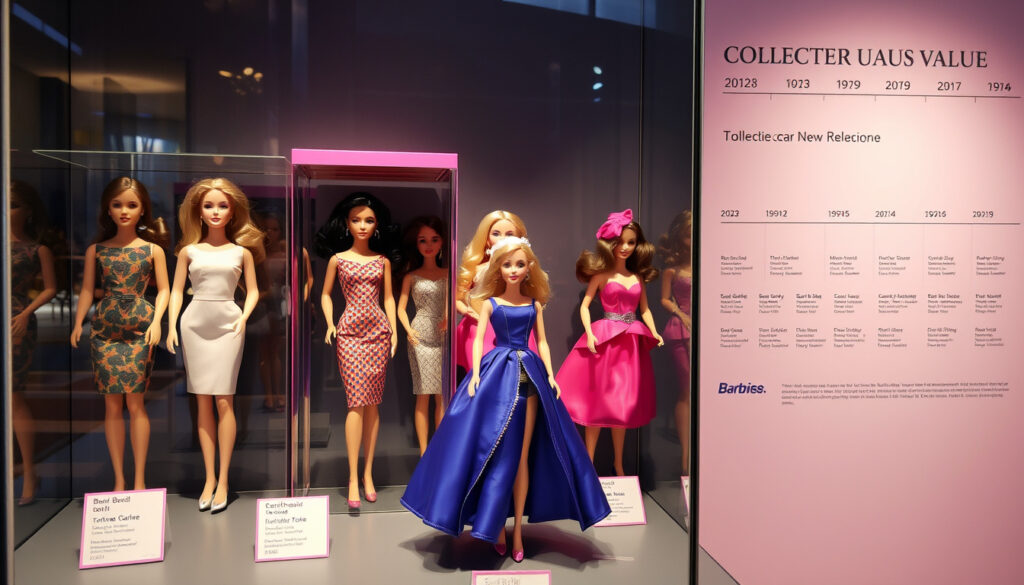
Barbie Doll Value Guide: Worth, History & 2026 New Releases
Some Barbie dolls sell for more than a house; most sell for less than a pizza. The record-holder, a diamond-draped Stefano Canturi Barbie, fetched $302,500 at a Christie’s New York auction in 2010 (MoneyDigest (consumer finance outlet)). Yet for every seven-figure headline, there are millions of mass-produced dolls that trade for pocket change. Knowing which is which separates real collector wins from dollar-store daydreams.
Introduced: March 9, 1959 (Encyclopaedia Britannica) · Original Price: $3.00 (ValueMyStuff) · Most Expensive Sold: $302,500 — Stefano Canturi Barbie · Total Dolls Sold: Over 1 Billion (Encyclopaedia Britannica)
Quick snapshot
- Barbie debuted on March 9, 1959, at the American International Toy Fair in New York (Encyclopaedia Britannica).
- The standard 1959 #1 Ponytail auction record stands at $27,450 (ValueMyStuff).
- The Stefano Canturi Barbie holds the all-time record at $302,500 (MoneyDigest).
- The full 2026 Barbie lineup has not been announced.
- Reported five-figure sales of special editions often lack verifiable auction records.
- Asking prices for common dolls routinely exceed what buyers actually pay.
- 1959 — the debut year collectors anchor to. (MoneyDigest)
- 2010 — the $302,500 record auction (MoneyDigest).
- 2023 — the film brings a new collector wave. (MoneyDigest)
- 2026 releases are expected to expand careers, body types, and sustainability.
- Mattel typically announces major lines at Toy Fair.
- Watch for limited fashion and movie collaborations.
Six data points, one pattern: the dolls with documented auction history set the ceiling, while the mass-produced lines that filled toy boxes set the floor.
| Metric | Data point |
|---|---|
| Creator | Ruth Handler, co-founder of Mattel (MoneyDigest) |
| Standard #1 auction record | $27,450 — 1959 #1 Ponytail, 2006 sale (ValueMyStuff) |
| #1–#3 Ponytail range | ~$8,000–$27,500 depending on condition (Estimonia (collectibles price guide)) |
| 1960s Ponytail | ~$300–$1,200 (ToyShnip (collector market)) |
| Bubblecut Barbie | ~$100–$700 (ToyShnip) |
| Malibu Barbie | ~$20–$50 (ToyShnip) |
Are Barbie dolls worth any money?
Some are, a few spectacularly, and most are not. The gap between a rare early doll and a common 1970s model is not a small spread; it is a chasm.
Why are Barbies so expensive?
Headline Barbie prices are a scarcity story, not a brand story. The $302,500 Stefano Canturi Barbie sold at Christie’s New York in 2010 as a one-of-a-kind charity piece with an exclusive diamond necklace — a very different market from everyday vintage dolls (LoveMoney (collectibles market watcher)).
That distinction matters because most Barbies were mass-produced in numbers that depress collector value. Limited editions and one-off variants push prices into headline territory; the dolls most people actually owned are exactly the ones with the least resale gravity.
- A standard 1959 #1 Ponytail’s record: $27,450, set in 2006.
- Malibu Barbies: ~$20–$50.
- Superstar Barbies: ~$15–$40.
So the expensive Barbies are not the ones in the old photo albums. They are the ones that were bought, boxed, and never touched.
Are 50-year-old Barbies worth anything?
A 50-year-old Barbie can be a five-figure collectible or a $30 shelf toy. The difference is not age — it is condition, rarity, and completeness.
The price-guide ranges for early models assume favorable condition: #1–#3 Ponytail dolls land between roughly $8,000 and $27,500, 1960s Ponytails between $300 and $1,200, and Bubblecut dolls between $100 and $700. A played-with doll with frizzed hair and missing shoes drops out of those tiers entirely.
The rare exceptions get attention for a reason: a 1965 Barbie in Midnight Red reportedly sold at Christie’s London in 2006 for about £9,000 — roughly $17,000 at the time — from a private collection of around 4,000 dolls (Wikipedia (doll history)).
But the same era’s play-line dolls, the ones that actually got played with, fill bins at garage sales for a reason.
What makes a Barbie doll valuable?
- Condition: original box, intact accessories, no marks or frizz.
- Rarity: limited production runs, regional releases, one-off commissions.
- Era: the earliest models, 1959–1966, anchor collector demand.
- Provenance: documented sales history and original packaging.
Collector consultant Kelly Kovack has made the point for years: condition and original packaging are the entire game. A doll missing its earrings or box can fall out of the top price tier completely.
The pattern is consistent. The dolls bought in bulk for childhood play have the least resale gravity; the dolls bought by adults and kept boxed are the ones setting records.
Why is it called Barbie doll?
The name predates the brand by years. Barbie is a family story, not a marketing brainstorm.
Who created Barbie?
- Barbie was created by Ruth Handler, a co-founder of Mattel.
- She debuted at the American International Toy Fair in New York on March 9, 1959.
- The original retail price: about $3.
Handler noticed that her daughter Barbara played with paper cutouts of adult women — not baby dolls — and wondered why no toy let a girl project herself into a grown-up future. Barbie was built on that observation.
Handler named the doll after her daughter, and Mattel gave her the full name Barbara Millicent Roberts (Encyclopaedia Britannica).
What does the name Barbie mean?
Because Barbie carries a real family name, the brand’s emotional value predates its commercial value — and collectors are buying both.
Barbie is not an acronym and not a focus-group invention. It is a nickname for Barbara, the daughter of the woman who created the doll.
What this means: Barbie’s origin explains the brand’s emotional grip. A doll named after a real child does not feel like a product; it feels like a character.
What is the most popular Barbie doll right now?
Popularity splits into two lists — sales volume and collector demand — and they barely overlap.
What is the prettiest Barbie doll ever?
- Bob Mackie Barbies, with their theatrical hand-beaded gowns, are the closest thing to a collector consensus on beauty.
- The Happy Holidays series has a loyal boxed-collector following.
- Silkstone and vintage-reproduction lines attract newer collectors.
Beauty is subjective; collector appetite is less so. The dolls collectors call the prettiest tend to be the ones with distinctive design and limited production — which is also a fair description of the dolls they pay the most for.
What are the best-selling Barbie dolls for 2026?
The 2026 best-seller list is not public yet. Mattel typically previews its coming year at Toy Fair, so the first reliable signal will be an official announcement — not a reseller teaser.
The directional clues are already visible: Barbie Signature dolls for adult collectors, career-themed sets that rotate through STEM and creative professions, and a wider range of body types and skin tones. The 2023 film proved that movie-linked Barbies can generate outsized demand — even cast details like Ritu Arya’s Barbie role drew fan attention.
What is the most sought after Barbie doll?
- The 1959 #1 Ponytail: first-issue mint dolls anchor the top of the market.
- The Stefano Canturi Barbie: one-of-a-kind, sold for $302,500.
- Early #1–#3 ponytails in the $8,000–$27,500 range remain the benchmark.
The 2023 movie added a layer of demand for movie-character dolls and nostalgic reissues, which in turn pushed secondary-market prices up for the dolls tied to the film’s aesthetic.
The trade-off: the most popular Barbies in stores are not the most valuable Barbies in collections. If your goal is appreciation, chase scarcity — not shelf space.
What new Barbies are coming out in 2026?
Mattel has not fully detailed its 2026 lineup, so the honest answer is a pattern read, not a product list.
What is the newest Barbie toy?
- Expect 2026 to keep expanding body types, skin tones, and disability-inclusive designs.
- Career-themed playsets remain the core of the playline.
- Sustainability messaging will continue shaping packaging and materials.
None of this is confirmed until Mattel issues official announcements — which is exactly the point. Collector markets run on confirmation bias, and pre-release hype is the most expensive place to buy a doll.
Are there any Barbie collaborations coming?
Collaboration dolls are reliably pretty and reliably over-hyped. If a 2026 limited edition launches with an “investment” narrative attached, the price you pay is the risk you carry.
Fashion-brand partnerships and movie tie-ins are the established pattern, and heritage labels have used licensed collaborations to stay relevant for decades — the same strategy visible in brands such as Tommy Hilfiger.
The catch: the 2026 news cycle will be full of “collector alert” claims. The only announcement that moves prices is the one that comes from Mattel itself.
What Barbies got discontinued?
Discontinued does not mean rare, and rare does not mean valuable on its own. But some retirements became collector legends.
Why are some Barbies discontinued?
- Controversy: Teen Talk Barbie (1992) was pulled after its voice phrases drew criticism.
- Product positioning: Lingerie Barbie (1997) did not survive the backlash to its design.
- Cult status: Earring Magic Ken (1993) became a collector conversation piece long after its short shelf life.
Mattel also retires dolls when sales dip or when a rebrand changes the lineup — a routine product cycle that collectors sometimes mistake for scarcity.
Which discontinued Barbies are most valuable?
Discontinued dolls gain value when a limited production run meets controversy — but only if surviving examples are mint and complete. The value driver is scarcity of supply, not the scandal.
The 1959 #1 Ponytail was discontinued the way every first run is: it was replaced by the next year’s model. Its value comes from survival, not drama. For every Earring Magic Ken, there are dozens of quietly retired dolls sitting at garage-sale prices.
Remember this: collector stories concentrate on a handful of famous retirements, which inflates the impression that discontinuation equals treasure. In most cases, it simply means out of production.
Pros and cons of collecting Barbie dolls
The auction record table cannot tell you whether to collect. The real variable is what you are buying for: joy or returns.
Upsides
- Mint early dolls have documented five-figure auction records.
- Entry cost is low: many vintage and modern dolls trade under $50.
- A deep enthusiast market supports Signature, Silkstone, and collaboration lines.
- The 2023 movie brought a new generation into the hobby.
Downsides
- Mass-produced dolls rarely appreciate; most trade at or below original retail.
- Condition risk is severe: missing accessories or damaged boxes erase most of the value.
- Asking prices in online listings are not sales; realized auction prices tell the real story.
- Storage and display costs add up for collectors who keep everything boxed.
The pattern: Barbie collecting rewards patience and condition discipline, and punishes anyone who treats a toy aisle like a stock market.
Barbie collector timeline
The product history is public record; these are the moments collectors anchor on.
- 1959 — Barbie debuts at the American International Toy Fair in New York with a $3 retail price.
- 1961 — Ken arrives.
- 1965 — Bendable legs add new poseability.
- 1970s — Career expansion: doctor, astronaut, and a growing range of professions.
- 2016 — Mattel introduces tall, curvy, and petite body types.
- 2023 — The Barbie movie ignites a new wave of collector interest.
Three of these moments — 1959, 2016, 2023 — changed which dolls people want; the others changed which dolls exist.
Confirmed facts vs. collector rumors
Separating verified results from marketplace chatter is the single most useful skill in doll collecting.
Confirmed facts
- Barbie debuted on March 9, 1959, at the American International Toy Fair in New York.
- The Stefano Canturi Barbie sold for $302,500 at Christie’s New York in 2010.
- The standard #1 Ponytail auction record is $27,450, from a 2006 sale.
What’s unclear
- Reported sales above $50,000 for special-edition Barbies, such as the De Beers 40th Anniversary doll, lack verifiable auction-house records.
- The full 2026 lineup has not been announced by Mattel.
- Asking prices for common vintage dolls often exceed what buyers actually pay.
The signal: when a number comes with an auction record, treat it as data. When it comes with a headline, treat it as marketing.
Voices on Barbie’s value
Barbie was designed to allow little girls to dream about the future.
Ruth Handler, creator of Barbie
Condition and original packaging are everything, period.
Kelly Kovack, Barbie collector and consultant
Between them, these two statements describe the whole market: dreaming built the brand, and condition preserves its value.
The Barbie market rewards a specific type of buyer: the one who recognizes that a $3 toy from 1959 became a five-figure collectible only when it survived in mint condition. For casual sellers, the decision is clear: sell the played-with dolls as toys, and stop expecting a college fund from the attic. For serious collectors, the math is equally clear: buy scarcity, condition, and documentation — or wait for the 2026 announcements and let the hype premium fade.
Frequently asked questions
What is the rarest Barbie doll?
The Stefano Canturi Barbie is the extreme case: a one-of-a-kind doll with a diamond necklace, sold at Christie’s New York in 2010 for $302,500. Among standard production dolls, early 1959 #1 Ponytails in mint condition are the most sought after.
How do I know if my Barbie is valuable?
Check condition first: original box, intact accessories, and minimal play wear. Then compare against realized auction results rather than online asking prices — a doll’s true value is what a buyer actually paid (ValueMyStuff).
Where can I sell vintage Barbie dolls?
Auction houses such as Christie’s have handled the highest-dollar sales; for mid-range dolls, online marketplaces and specialist collector sites work well. When you suspect rarity, get an independent appraisal before selling.
Are Barbie dolls a good investment?
For most dolls, no. Mass-produced lines hold or lose value, and condition risk is high. The exceptions are early, mint-condition, low-production dolls with documented sales history. Collect for enjoyment first.
Why is Barbie so popular?
Barbie has stayed culturally present by reinventing itself: more than 200 careers, an expanding range of body types and identities, and a 2023 blockbuster film that brought the doll back into the center of pop culture.
What is the most expensive Barbie ever sold?
The Stefano Canturi Barbie, which sold for $302,500 at Christie’s New York in 2010. That price reflected a one-of-a-kind jewelry piece and charity-auction context, not ordinary vintage scarcity.
More related posts
 Diego Maradona: Biography, Death, Hand of God & Stats
 Eve Myles: Biography, Career, Family, and John Barrowman Link
 One Direction Members: Death, Departures & Solo Careers
 Food Truck UK: Legal Requirements, Best Food to Sell, Locations
 Rosanna Arquette: Biography, Relationships, and Career
 Solar Lights for Garden: Best Picks, Fixes & Maintenance Guide
 Eric Clapton: Health, Family, and Career FAQs
 How to Draw a Cat: 5-Second, Realistic & Doodle Styles