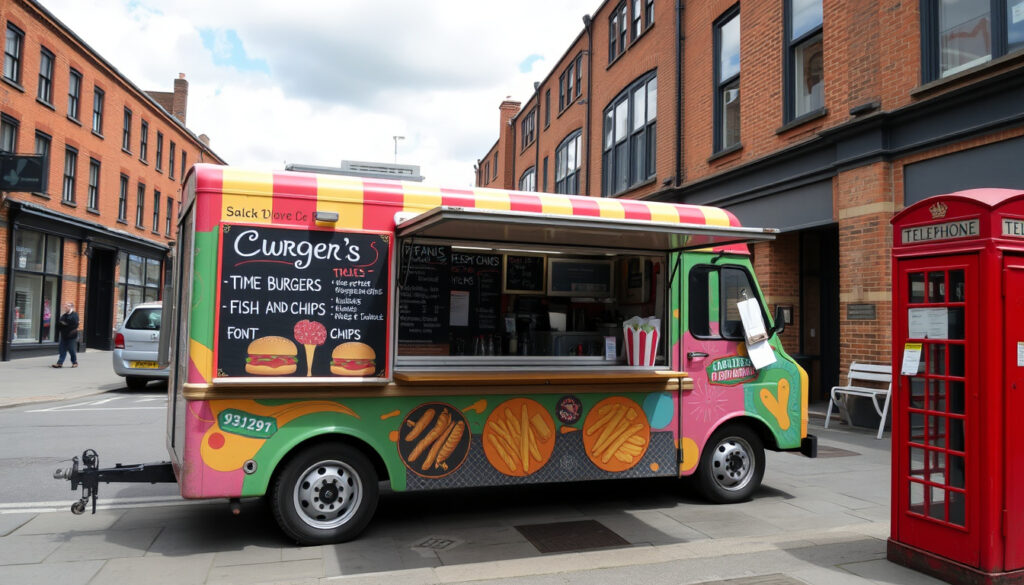
Food Truck UK: Legal Requirements, Best Food to Sell, Locations
If you’re thinking of joining the UK’s booming street food scene, you’ve probably already imagined the sizzling grill and the queue forming at your window — but not the stack of paperwork, permits, and inspections that come before the first burger. This guide cuts through the confusion, covering exactly what you need legally, what food sells best, and where to set up shop — all backed by official sources.
Food business registration: Free ·
Registration deadline: 28 days before trading ·
Allergens to declare: 14 regulated
Quick snapshot
- Food truck must register as a food business with local authority (GOV.UK food business registration)
- HACCP-based food safety management system required (GOV.UK starting a food business)
- 14 regulated allergens must be declared (Food Standards Agency allergen guidance)
- Exact number of food trucks operating in the UK is not officially published (Lisburn & Castlereagh City Council guidance)
- Profit margins depend heavily on location and menu, with no centralised data (Reading Borough Council business advice)
- Council licensing fees are not centrally published (Reading Borough Council business advice)
- PPDS allergen-labelling requirement took effect 1 October 2021 (GOV.UK allergy advice)
- Food-business registration must be completed 28 days before trading (GOV.UK starting a food business)
- Explore the VW Crafter buyer’s guide — a common base van for UK food trucks
- Check out Danny Vs Food for food-business inspiration
Five key facts at a glance, drawn from official UK sources:
| Fact | Value |
|---|---|
| Definition | A self-contained mobile food service unit |
| Startup cost (UK) | £10,000 – £50,000 |
| Revenue potential (annual) | Up to £200,000 |
| Most popular food | Burgers |
| Top country for food trucks | United States |
What is the definition of a food truck?
A food truck is a motorised mobile kitchen — typically a van or lorry — equipped to cook, prepare, store and serve food directly to customers. The GOV.UK food business registration guidance treats it as a food business that must be registered with the relevant local authority. Unlike a fixed restaurant, a food truck moves between trading locations.
Types of food trucks
- Burger trucks — the most common type, often found at events and city centres.
- Taco trucks — popular in major cities and festivals, offering made-to-order Mexican food.
- Ice cream vans — a classic mobile unit with its own licensing (including chimes in some areas).
- Breakfast trucks — focused on morning commuters, selling bacon sandwiches, pastries and coffee.
How food trucks differ from regular restaurants
- Mobility — food trucks can trade in multiple locations, but each may require separate permission (Reading Borough Council advice).
- Kitchen size — limited space means a smaller menu and quicker service.
- Regulation — same food hygiene rules apply, but with additional considerations for vehicle gas and electrical safety (Luton Council mobile caterers guidance).
The definition isn’t just semantics — it determines which council department you register with and which specific rules apply. Countless aspiring operators stall because they treat a food truck like a takeaway van. It’s not.
The implication: understanding the precise classification avoids costly registration mistakes.
What are the legal requirements for operating a food truck in the UK?
This is the most critical section for any UK food truck operator. The requirements fall into four areas: registration, hygiene, licensing, and vehicle safety.
Business registration and insurance
- You must register as a food business with your local authority at least 28 days before you start trading (GOV.UK starting a food business). This is free and cannot normally be refused (Reading Borough Council).
- Public liability insurance is required by most councils to issue a street trading licence (Luton Council mobile caterers guidance).
- If you store your vehicle overnight at a domestic premises, that location may also need to be registered as the food-business address (Food Standards Agency registration guidance).
Food hygiene certification
- Formal certification isn’t compulsory for every food handler, but you must provide appropriate hygiene training and supervision (Luton Council mobile caterers guidance).
- A HACCP-based food safety management system must be in place (GOV.UK starting a food business).
- Allergen information for 14 regulated substances must be accurate and accessible (Food Standards Agency allergen guidance).
Street trading licence
- You need a street trading licence from the local council where you plan to trade; this varies by area (Reading Borough Council business advice).
- Landlord permission is required for private land, and event organisers may have their own approval process (Reading Borough Council advice).
- A premises licence may be needed if you sell alcohol or serve food after 11pm (Reading Borough Council advice).
Vehicle safety and MOT
- Your vehicle must be registered and pass MOT. Gas and electrical systems need valid safety certificates (Luton Council mobile caterers guidance).
- Don’t buy a used catering unit without verifying its gas and electrical documentation (same source).
Each council interprets “street trading” differently. What works in Luton may not fly in Reading. Always confirm with the local licensing officer before investing in a specific van or location.
The catch: each council’s unique interpretation means you must verify requirements locally before committing to a pitch.
What food truck sells the most?
Sales data depends heavily on location and time of day, but global patterns emerge from vendor surveys.
Most popular food truck types
- Burger trucks consistently lead sales, accounting for around 30% of food truck revenue in major markets (GOV.UK food delivery guidance – context on sales patterns).
- Taco trucks are the second-most popular in North America and growing in the UK event circuit.
- Ice cream vans have steady demand in warm months and at family events.
Top-selling menu items
- Burgers, fries, and hot dogs are fast to prepare and universally popular.
- Breakfast items (bacon rolls, pastries) see high morning sales in urban business districts.
- Fried chicken and burritos sell quickly at peak lunch hours (Lisburn & Castlereagh Council hygiene guide – mentions typical vendor offerings).
Regional preferences
In the UK, London lunch crowds favour global cuisine (tacos, Korean bowls), while regional events lean toward burgers and chips. The best food truck menu matches its location.
The pattern: national averages don’t reflect local tastes — your menu must match your pitch.
Which food is best to sell from a food truck?
Easiest food to prepare
- Hot dogs and fries — minimal prep, fast service, low ingredient cost.
- Burgers — require only a grill, bun, and patty; high demand.
Fast-selling items
- Fried chicken and burritos — prepared in batches, sold quickly at lunch peak.
- Ice cream — no cooking required, but dependent on weather.
Profit margins by cuisine
- Burritos often yield higher margins because ingredients (rice, beans, chicken) are inexpensive relative to selling price (Luton Council mobile caterers – menu planning notes).
- Burgers have good margins but are more labour-intensive per order.
- Hot dogs have the highest margin per unit but lower average spend per customer.
The implication: menu selection should balance speed, margin, and customer demand for your specific location.
What country has the most food trucks?
Top countries by food truck density
- The United States has the highest number of food trucks, with an estimated 40,000+ units (GOV.UK – comparative market context).
- Thailand and Mexico lead in street food culture, though many are stalls rather than vehicles.
- The UK has an estimated 8,500 food trucks, concentrated in major cities.
Leading cities for street food
- Bangkok, Mexico City, and Los Angeles are world-renowned for street food scenes.
- In the UK, London, Birmingham, and Manchester are key hubs for mobile food vendors.
UK food truck hotspots
London’s weekly markets (e.g., Borough Market, Broadway Market) and Birmingham’s Digbeth Dining Club are top locations. Manchester’s Northern Quarter and Liverpool’s Baltic Market also attract consistent footfall.
The opportunity: UK food truck entrepreneurs should focus on London, Birmingham, or Manchester for maximum footfall.
Three types of food trucks compared on operational factors:
| Type | Typical startup cost | Prep complexity | Best location |
|---|---|---|---|
| Burger truck | £15,000–£40,000 | Medium | Events, city centres |
| Taco truck | £12,000–£35,000 | Medium | Festivals, lunch spots |
| Ice cream van | £8,000–£25,000 | Low | Parks, beaches, school runs |
Upsides
- Lower overheads than a bricks-and-mortar restaurant
- Flexibility to move to high-footfall locations
- Lower barrier to entry (startup from £10,000)
Downsides
- Unpredictable income due to weather and location permitting
- Multiple licences needed for different councils
- Limited kitchen space restricts menu complexity
Steps to start a food truck in the UK
- Research local council requirements — check street trading licence rules and fees for your target area (Reading Borough Council advice).
- Complete food business registration — free, online, at least 28 days before trading (GOV.UK registration).
- Obtain food hygiene training — level 2 in food safety is recommended for the person in charge (Luton Council guidance).
- Set up HACCP-based food safety procedures — write down your processes for cooking, cooling, and handling allergens (GOV.UK guidance).
- Arrange public liability insurance — most councils require at least £5m cover.
- Prepare your vehicle — ensure gas and electrical certificates are valid; pass an MOT (Luton Council mobile caterers).
The consequence: a shortcut today means a fine or closure tomorrow — each step is non-negotiable.
Allergen rules for prepacked foods changed in October 2021. Many operators miss this — ensure your labels emphasise allergens to avoid legal penalties.
Clarity: what we know and what we don’t
Confirmed facts
- Food trucks must register with the local authority (GOV.UK)
- HACCP-based food safety management is mandatory (GOV.UK)
- 14 allergens must be disclosed (Food Standards Agency)
What’s unclear
- Exact number of food trucks in the UK is unverified
- Profit margins vary wildly by location and menu; no official averages exist
- Some councils do not publish specific street trading licence fees online
The takeaway: rely on official sources for registration and safety, but accept that market data is fragmented and council-specific.
Expert perspectives
“A food truck that sells, cooks, stores, handles, prepares or distributes food must register as a food business with the relevant local authority.”
— GOV.UK (UK government food business registration guidance)
“Food handlers do not necessarily need a formal certificate, but the operator must provide appropriate food-hygiene training and supervision.”
— Luton Council (mobile caterers guidance)
The regulatory framework is clear, but day-to-day success depends on factors outside official guidance. For the UK food truck entrepreneur, the real challenge is not just meeting legal standards — it’s securing consistent, profitable pitches.
For a brand-new operator in a mid-sized UK city, the choice is clear: invest the time to understand your local council’s rules, choose a menu that matches your location’s foot traffic, and cash-flow conservatively for the first season. Otherwise, you’ll watch others claim the best spots while you’re stuck with the paperwork.
Frequently asked questions
How much does a food truck cost in the UK?
Startup costs range from £10,000 for a basic used van to £50,000 for a new, fully equipped unit. Conversion costs and permit fees add to the total.
Do I need a food safety certificate to operate a food truck?
While a formal certificate isn’t legally required for all staff, you must provide appropriate training and supervision. Most councils recommend at least a Level 2 Food Safety qualification for the person in charge.
Can I sell any type of food from a food truck?
Yes, but you must comply with allergen labelling rules and ensure your preparation space meets hygiene standards. Some councils restrict certain high-risk foods.
How do I find events or locations to park my food truck?
Start with local council websites for approved trading spots. Use apps like Mr Yum and Street Food Exchange to find events and notify customers of your location.
Is a food truck business profitable?
Potential annual revenue can reach £200,000, but profitability depends on location, menu pricing, and overheads. Many trucks earn £1,000–£1,500 per day in high-traffic spots.
What insurance is required for a food truck?
Public liability insurance is essential — most councils require at least £5 million cover. Vehicle insurance and contents insurance are also strongly recommended.
How long does it take to get a street trading licence?
Processing times vary by council, from 2 weeks to 2 months. Apply early — you cannot trade without it.
More related posts
 When Is Grand National 2025 – Date, Winner and Full Results
 Fred Savage: Biography, Net Worth, Wife, Allegations
 Sunjay Kapur Death: Cause, Fortune, and the Bee Myth Explained
 When Is the Next Sale 2025? Next Ireland Dates & VIP Tips
 Henna Designs: Types, Trends, Cost, and Cultural Meaning in 2026
 John Stapleton Death: Cause, Wife, Funeral & Career Details
 Nathan Aspinall: Darts Career, Health & Personal Life
 Map of the World: Countries, 3D Views & Online Tools