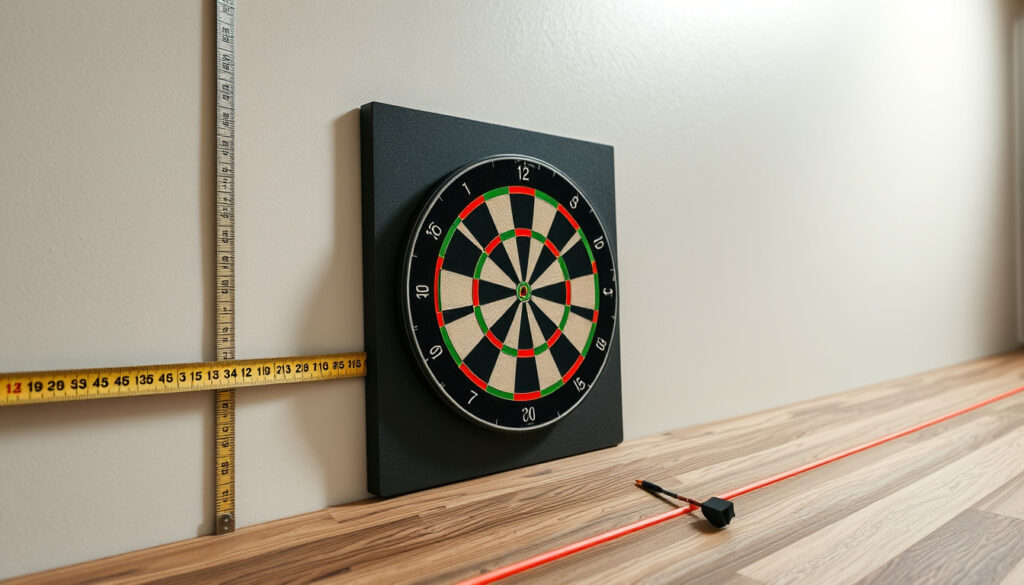
Dartboard Distance: Official Setup & Measurements
Setting up a dartboard requires precise measurements: the official throw line distance is 2.37 meters for steel-tip darts and 2.44 meters for soft-tip, with the bullseye exactly 1.73 meters high. Getting these numbers right transforms practice from guesswork into a reliable routine.
Official throw line distance (steel-tip): 2.37 meters (7 ft 9.25 in) ·
Official throw line distance (soft-tip): 2.44 meters (8 ft) ·
Bullseye height: 1.73 meters (5 ft 8 in) ·
Diagonal to bullseye from throw line: 2.93 meters (9 ft 7.5 in)
Quick Snapshot
- Official steel-tip throw line distance is 2.37 m (7 ft 9.25 in) (GLD Products).
- Official soft-tip throw line distance is 2.44 m (8 ft) (GLD Products).
- Why the precise 2.37 m measurement was originally selected.
- How much board material affects the “official” throw line measurement.
- Modern standards were solidified with the BDO’s formation in 1973.
- Expect continued adherence to the official distances for both home and tournament play.
The table below summarises the core measurements for steel-tip and soft-tip setups.
| Measurement | Steel-Tip | Soft-Tip |
|---|---|---|
| Throw Line Distance | 2.37 m (7 ft 9.25 in) | 2.44 m (8 ft) |
| Bullseye Height | 1.73 m (5 ft 8 in) | 1.73 m (5 ft 8 in) |
| Diagonal to Bullseye | 2.93 m (9 ft 7.5 in) | 2.98 m (9 ft 9.5 in) |
What is the official dartboard distance?
The official distance for steel-tip darts is 2.37 meters, or 7 feet 9.25 inches, from the face of the dartboard to the throw line, known as the oche. This measurement is the standard for all competitive play according to the GLD Products official setup guide. For soft-tip darts, the standard distance extends to 2.44 meters, or 8 feet, reflecting the different nature of the equipment.
This difference is a common point of confusion for players who switch between formats. The extra distance in soft-tip play compensates for the lighter darts and the way electronic boards respond to impacts. As a result, a player moving from steel-tip to soft-tip needs to adjust their stance and throwing power to maintain accuracy.
The implication: if you’re setting up a home board, the most critical choice is knowing which game you’ll play most. This single decision dictates your throw line distance.
How far away from the dartboard do I stand?
The distance you stand from the dartboard depends on the type of darts you throw, and it’s measured from the front face of the board. Here is the breakdown: for steel-tip darts, the throwing line is 2.37 meters (7 ft 9.25 in) away. According to PandaTaps, an official steel-tip thrower stands 2.37 m from the board, while a soft-tip thrower stands 2.44 m away. This is the most critical measurement for your setup.
These measurements are designed to create a level playing field, ensuring that no player gains an unfair advantage based on the venue. But why does a few centimeters matter? The distance changes the angle of entry for the dart, which in turn affects how the dart sticks in the board and how consistently you can group your shots.
The trade-off is clear: using the wrong distance for your dart type not only makes you a less accurate player but can also teach you bad habits that hurt your game in official settings. Practicing from the correct distance ingrains the right muscle memory.
Precision here is about more than just following rules; it’s about building a repeatable throwing motion. If you practice from the wrong distance, your body adapts to the wrong angle. Always verify your setup with a metal tape measure for the most accurate results.
What is the regulation distance for soft-tip darts?
The regulation distance for soft-tip darts is 2.44 meters (8 ft), measured from the front of the board to the throw line. This is a standard clearly stated by PandaTaps in its comparison guide. The increase of 0.07 meters (about 2.75 inches) compared to the steel-tip distance is a direct response to the lighter weight and different flight characteristics of soft-tip darts.
The extra distance helps to level the playing field for players using electronic boards, which often have smaller scoring areas. This subtle shift in distance requires a slight adjustment in throwing power and trajectory. Players often report that the soft-tip game feels quicker, so the slightly longer distance helps to control the pace.
The pattern: for soft-tip, the focus is on adapting to a faster, more electronic-driven game. The distance is designed to maintain a challenging but fair test of skill that aligns with the equipment’s capabilities.
How far is it from the dartboard to the throw line?
The distance from the dartboard’s face to the throw line is the “oche” (pronounced “okee”), and it is a fixed, non-negotiable figure in official play. From the front of the board, the oche sits 2.37 meters away for steel-tip and 2.44 meters for soft-tip. A setup guide from Darts Daily confirms these are the standard distances used in most leagues and competitions.
The key is that the measurement is always taken from the face of the dartboard. As Angle Journal UK points out, measuring from the wall behind the board is a common mistake. If you measure from the wall, you’re adding the bullseye’s extension to the distance, making your setup several centimeters too far.
- Angle Journal UK explains the proper measuring technique from the front face.
The effect: a small error in your reference point for measuring the distance can accumulate. This is why pros always use a tape measure and never assume the wall is the board.
What is the official height and distance for a dartboard?
Official distance for steel-tip and soft-tip
The official height for the dartboard center is standardized. The bullseye’s center must be 1.73 meters (5 ft 8 in) from the floor, a standard confirmed by both PandaTaps and GLD Products. The horizontal distance from the board’s face to the oche is 2.37 meters (7 ft 9.25 in) for steel-tip and 2.44 meters (8 ft) for soft-tip, forming a right triangle.
When understanding this setup, it’s critical to realize that the distance is a horizontal measurement, not a diagonal one. The diagonal measurement from the bullseye to the oche is often cited as 2.93 m (9 ft 7.5 in), but the official rules always reference the horizontal throw line distance. This distinction is what trips up many new players.
The nuance here is about the “false diagonal” many guides state. The diagonal distance is less critical because the height is fixed and the distance is fixed, so the diagonal is what it is. But when setting up, you always measure horizontally from the wall and vertically from the floor.
A common mistake is to measure the diagonal distance from the bullseye to the oche and assume it’s the throw line distance. The diagonal is 2.93 m, but the horizontal distance is 2.37 m. These are different numbers for a reason—don’t mix them up.
What is the dartboard distance for soft-tip darts?
The dartboard distance for soft-tip darts is 2.44 meters (8 ft), a standard specifically detailed in the comparison by Darts Daily. This distance is a full 7 cm (2.75 inches) longer than the steel-tip distance. This isn’t an arbitrary choice; it’s a response to the physics of the game. Soft-tip darts are lighter and often have shorter points, so they don’t penetrate the board as deeply.
The longer distance in soft-tip helps to ensure that the darts stick in the board properly. It also changes the trajectory, making the dart fall at a slightly different angle. Players who are serious about both formats often find they need practice time to adjust their throw between the two distances.
This standardization is the result of careful thought by the game’s governing bodies to ensure fairness and consistency. When you step up to throw from 8 feet, you’re playing the exact same game as a professional in a major tournament.
The result: if you only play casually with friends, you might be tempted to skip the exact distance. However, for anyone serious about improvement, this isn’t just a regulation—it’s a tool. Practicing from 2.44 m will prepare you for any electronic board you might encounter in a bar or league.
How do you measure dartboard distance diagonally?
While the official throwing distance is always measured horizontally, the diagonal measurement is a valuable verification tool. The diagonal distance from the center of the bullseye to the throw line (oche) on a steel-tip board is 2.93 meters (9 ft 7.5 in). This diagonal is helpful for a quick verification, especially in tight spaces or when you don’t trust your initial tape measure run.
For soft-tip, the diagonal distance is 2.98 meters (9 ft 9.5 in), a measurement that ensures the steeper angle of the throw. These figures provide a secondary check that your horizontal distance and height are set in proper relation to each other. If you’ve set the height correctly you can use the diagonal to double-check the corner of your throw line.
Using the diagonal as a primary measurement can be misleading. Since it incorporates both the height and the distance, a wrong height could result in a correct diagonal, masking an error. Always use the horizontal distance as your primary benchmark and the diagonal as a quick check.
What is the official dartboard height in feet?
The official dartboard height is a standardized 5 feet 8 inches, which is precisely 1.73 meters. This measurement is taken from the floor to the exact center of the bullseye. This is a constant that never changes, and the governing body darts guides are consistent on this point. Rather than just a simple height, think of it as the vertical leg of the triangle that defines your throw.
Consistency in height is arguably more important than the distance. A slight error in the height changes the angle of entry for every dart you throw. A board hung even 2 cm too high or too low will subtly alter how your darts land in the scoring bed, causing you to miss the triple 20 when you think you’ve hit it.
The set rule is working in tandem with distance. You should set your board height first, and then measure the distance out to the oche. This sequence ensures that your setup creates the correct diagonal distance for the game.
| Setup Reference Point | Steel-Tip (Meters) | Soft-Tip (Meters) |
|---|---|---|
| Bullseye Height (from floor to center) | 1.73 m | 1.73 m |
| Throw Line Distance (horizontal) | 2.37 m | 2.44 m |
| Diagonal Distance (bullseye to oche) | 2.93 m | 2.98 m |
The pattern is clear: the height remains constant, but the distance scales with the dart type to balance the game’s physics.
Why is darts 2.37 m?
The 2.37-meter distance is the result of a historical standardization that took place decades ago, not a random selection. This measurement has its roots in the evolution of the sport to create a consistent challenge that balances reach and accuracy. The standard’s authority rests with the governing bodies that formalized it, but the distance also dictates a particular style of play that is both fair and exciting.
This distance creates a specific angle to the board that players must account for. It’s far enough to require a focused throw, but close enough to reward accuracy with a high score. This balance keeps the game accessible to new players while still challenging professional athletes. The reason the distance is so precise (7 ft 9.25 in) is due to the imperial system of measurement used when the standard was codified, not a reflection of the metric system.
What it means: the distance is a deliberate compromise between the “too easy” of a closer line and the “too hard” of a farther one. It is a test of skill, but it doesn’t favor power over precision.
Why is the distance measured from the front of the board?
You measure from the front face of the board because that’s where the dart actually lands. The back of the board can vary in thickness depending on the cabinet or mounting system. According to Angle Journal UK, a wall-mounted board might have a thickness of 3-4 cm (including the sisal fibers), which can add up to several millimeters of error if you measure from the wrong reference point. Measuring from the front face ensures that the distance is consistent across all setups.
This is also why the oche is often a raised piece of wood or tape. It marks the physical end of your throw. The official rules state the diagonal distance from the bullseye to the oche is 2.93 meters, which is the hypotenuse of the triangle formed by these two sides.
How does the distance affect your game?
The throw line distance isn’t just a number; it’s a core element of darting physics. A longer throw means a flatter arc — you have to use more power to get the dart to the board, which can make it harder to control. A shorter throw means a steeper angle of entry, which can increase the chance of darts bouncing out.
- This change in distance directly alters the angle of entry for the dart.
- It forces players to adjust their throwing power and velocity for steel-tip versus soft-tip games.
The practical takeaway is that the official distance standardization levels the playing field so that players are measured by their skill, not their ability to game the system with a shorter line.
Why is 26 called breakfast in darts?
In our data, the score of 26 is referred to as “breakfast” because a player typically hits a 5, a 20, and a 1. The name originates from the old English tradition where breakfast was a meal of leftovers, much like this score is often a “leftover” result of a poor visit. This term is widely recognized in darts culture and is a fun part of the game’s lexicon. When you hit a 26, you’ve not only scored poorly but also officially used the “breakfast” term.
Do longer darts fly straighter?
There is no official regulation on dart length, and player preference plays a major role. Some players find that longer darts provide a more stable flight path, while others prefer shorter barrels for a compact release. The best approach is to experiment with different lengths and weights to see what works for your throwing style.
What is the standard dartboard distance in the UK?
In the UK, where modern tournament darts was largely codified, the standard distance is the same as the global standard: 2.37 meters (7 ft 9.25 in) for steel-tip. This is specific to the throwing distance from the front of the board, and it’s a unit that every serious player in the UK knows by heart. This ensures that a player practicing in London is practicing on a board that’s set up identically to one in Manchester or Newcastle.
The setup is tied directly to the British Darts Organisation (BDO) standards which later became the global standard. The ruling bodies have maintained the 2.37 m distance for steel-tip games, as it provides the right level of challenge. For soft-tip, the distance gets two distinct new dimensions. When setting up a board at home, using the correct UK standard will help you build the right muscle memory for any competitive event.
Note: For players in the UK, imperial measurements are also critical. You’ll hear “7 ft 9.25 in” as often as you’ll hear “2.37 m.” Knowing both is a sign of a serious player.
What tools do you need to measure dartboard distance accurately?
You don’t need expensive equipment to set up a dartboard correctly. The most reliable tool is a metal tape measure, which won’t stretch over time. A standard retractable metal tape measure is adequate because it allows you to measure the height and then extend it out to the throwing line with precision. Combined with a simple spirit level, you can ensure both the board and the oche are perfectly level.
For marking the oche, many players use a small piece of tape or a wooden plank, but there are also laser level lines that can be projected. Regardless of the tool, the process remains the same. Always mark the point on the floor that is exactly 2.37 meters from the face of the board. If you use a laser level, ensure it is checked against a tape measure, as lasers can sometimes be thrown off by surfaces.
- Metal tape measure: Ensures a straight, non-stretching line for the official distance.
- Spirit level: Essential for confirming the board is plumb and the oche is flat.
- Oche marker: A raised strip of tape or wood to give a tactile reference to your front foot.
What is the correct height to hang a dartboard?
The correct height to hang a dartboard, always measured to the center of the bullseye, is 1.73 meters (5 ft 8 in) from the floor. The measurement is for the bullseye, not the board’s top or bottom edge. This is the most common mistake people make when setting up a board, and it’s also a standard which you must verify with a tape measure.
The height and the distance work together to form a right-angled triangle. At the oche, the bullseye is at a 90-degree angle from the floor at the board. The hypotenuse of this triangle is the diagonal line from the bullseye to the oche, which is 2.93 meters. If you have the height and distance correct, the angle will be automatically correct.
You might be tempted to use a laser to project the exact spot on the floor onto the wall. That works. But keep in mind: the official rule is about the face of the board, not the wall. When you mount the board, you must account for the bracket’s depth.
How to measure dartboard distance accurately
Accurate measurement is the cornerstone of a proper dartboard setup. Here is the step-by-step process.
Tools for measuring
- Metal tape measure
- Level
- Pencil or marker
- Assistant (optional, but helpful)
Common mistakes to avoid
- Measuring from the wall, not the board face.
- Measuring from the floor to the top of the board.
- Forgetting to account for the board’s thickness.
The typical mistake is to measure from the floor to the bottom of the board, then assume that’s the height. Instead you need to find the bullseye. A practical approach is to measure 1.73 m from the floor, which is the height of the bullseye’s center. Then measure the distance from the board’s face to the oche, and you’re done.
The catch with a DIY setup is consistency. The official standards are not a target; they’re a ceiling. Getting the distance right ensures that your practice time is actually productive.
What is the distance from the bullseye to the throw line in cm?
From the bullseye to the throw line is a diagonal measurement, not the horizontal distance. The official diagonal distance for a steel-tip board is 2.93 meters (293 cm), and for soft-tip, it’s 2.98 meters (298 cm). This diagonal distance is often an overlooked part of the official setup guide. It is the “hypotenuse” of a right triangle and represents the furthest distance you can throw from the center point.
You can measure this diagonal distance to double-check your setup. Darting.com rules page states this is a standard way to verify the setup for both formats. Use the diagonal as a secondary check only after you’ve confirmed the horizontal distance (2.37/2.44 m) and the height (1.73 m) are correct.
Why the two-step? Because if you set the distance and height perfectly, the diagonal will naturally fall into place. It’s a great way to catch an error in the early stages.
Distance and Height for Steel Tip vs. Soft Tip
This table shows the key difference: distance changes, height does not. The bullseye is the same height for both games, but the oche is further away for soft-tip.
Where should the throw line (oche) be?
The throw line, also called the oche, should be placed exactly 2.37 meters from the face for steel-tip and 2.44 meters for soft-tip. The oche should be long enough to give you room to align your feet—typically a minimum of 3 feet wide for a comfortable stance, though a standard 3 ft is recommended. It is the most important line on the floor for your setup.
You’ll usually see the oche marked with tape, paint, or a rubber mat in professional setups. The key is that the front edge of the oche is the exact line. A player’s front foot must not cross the line, but they can stand on the line as long as they don’t step over it completely. The crucial detail is that the distance is measured to the back of the oche, not the front.
The pattern you want to see is a clean, straight line. A crooked oche introduces a physical variable into your game, since you have to adjust your throwing position depending on where you step up.
The key to a professional setup is a throw line that acts as a firm foot stop, not just a line on the floor.
GLD Products
Measuring from the wall behind the board is a common mistake that adds several centimetres to the distance.
Angle Journal UK
How to set up a dartboard
Setting up a dartboard takes under 10 minutes if the wall is already in place. Here’s a concise set of steps to get the official lengths right.
- Mount the Board to the Wall – Select your wall location. Find a spot where the height to the bullseye is 1.73 m from the floor. Mark this point on the wall. Then, mount the bracket, making sure the mark lines up with the center of the bullseye bracket.
- Measure the Distance from the Board – Once the board is up, place your tape measure at the front of the board. Then, extend the tape to the floor and mark the spot that is 2.37 m away for steel-tip or 2.44 m for soft-tip. This is where the front edge of the oche goes.
- Lay the Throw Line – Use a straight edge and a marker to place a thick, visible line on the floor at this distance. For a more professional finish, you can install a metal or wooden strip that lies flat on the ground.
How does it compare to other games?
While the dartboard setup is specific, the principle of standardizing a “hallowed” distance is common in sports like shuffleboard or cornhole. The standardized distance isn’t just about the board–it’s about the game being the “same” everywhere.
Do I need a special floor surface for darts?
No specific surface is officially required by the rules, but there are practical considerations. The throw line distance is fixed, but the type of floor is not. As long as the floor is level and the oche is flat, the setup is legal. Concrete, wood, and carpet are all acceptable, but the key is a level surface. If you’re putting a board in a garage, be aware that a sloped floor will directly affect your measurements.
A hard floor is actually a benefit for darts because it allows for a consistent movement of your feet. The most important thing is to ensure your darts won’t be damaged by bouncing off hard concrete.
Why this matters: if you are playing in a space with a sloped floor, the official distance will still allow you to throw straight. The only difference is your comfort, not the game’s integrity.
Be careful with soft darts on hard floors. A dart can bounce and the tip can be damaged more easily than on a resilient mat. Invest in a dart mat to protect both your floor and your darts.
Official Dartboard Setup Guide: Soft-Tip vs. Steel-Tip
| Measurement | Steel-Tip | Soft-Tip (Electronic) |
|---|---|---|
| Bullseye Height (to center) | 1.73 m (5 ft 8 in) | 1.73 m (5 ft 8 in) |
| Throw Line Distance | 2.37 m (7 ft 9.25 in) | 2.44 m (8 ft) |
| Diagonal Distance to Bullseye | 2.93 m (9 ft 7.5 in) | 2.98 m (9 ft 9.5 in) |
This comparison confirms the rules. The height remains constant, and the distance is the only variable set by the governing bodies.
What is the danger of an incorrect dartboard setup?
An incorrect setup isn’t just a matter of making the game too easy or too hard; it fundamentally alters your development as a player. If you practice from a short distance, you’ll adjust your throw to a steeper angle, which might even lead to more bounce-outs on a standard board. Over time, you’ll develop a “dead” arm that throws too loosely (or too tightly) for official play.
This is why the standard distance is critical for fairness. It’s easy to see why a 2.37m distance ensures accuracy is the primary skill, not just reaching the board. The scientific reason is that this distance equalizes the “release point” variance.
The takeaway for your practice is this: measure twice, throw once. A few minutes spent calibrating your setup will have a more significant impact on your average than any new set of darts you might buy.
dartsdaily.net, dartrankings.co.uk, gamedaybeat.com, maximillianogameroom.net, thedartguide.com, darts501.com, cleverdarts.com, cswdarts.co.uk
FAQ
What is the official distance to stand from a dartboard?
The official distance to stand from the face of the dartboard is 2.37 meters (7 ft 9.25 in) for steel-tip darts and 2.44 meters (8 ft) for soft-tip darts. This measurement is to the back of the oche.
Can I use any distance for casual play?
You can, but setting up a shorter or longer line can distort your practice progress. To build reliable muscle memory for competitive play, it’s best to use the official distance at all times.
What happens if my dartboard height is off?
If the height is off, the angle of entry for your darts is wrong. This will make your darts land at a non-standard angle, potentially leading to more frequent bounce-outs and a larger miss radius.
Are there any special setup rules for wheelchair users?
Wheelchair users may adjust the throw line distance slightly for comfort, but the official bullseye height and board dimensions remain the same. The standard oche distance is still recommended for fair competition.
Can I use a laser level to set the throw line?
Yes, but always verify with a metal tape measure. Lasers can drift or be thrown off by reflective surfaces, so the tape measure remains the gold standard for accuracy.
More related posts
 Neil Sean: British Journalist and YouTube Royal Commentator
 William Hanson: Etiquette Coach, Podcast Host & TikTok Star
 Paul Ritter: Cause of Death, Illness, and Tributes from Co-Stars
 Jobe Bellingham: Biography, Stats, Age, Brother Jude 2025
 Sky New Customer Deals: Best TV, Broadband & Mobile
 Lynda La Plante: Biography, Books, TV Shows, Net Worth & Family
 Merritt Wever: Emmy-Winning Actress and Career Highlights
 Randy Orton: Condition, Return, Family & Net Worth and More