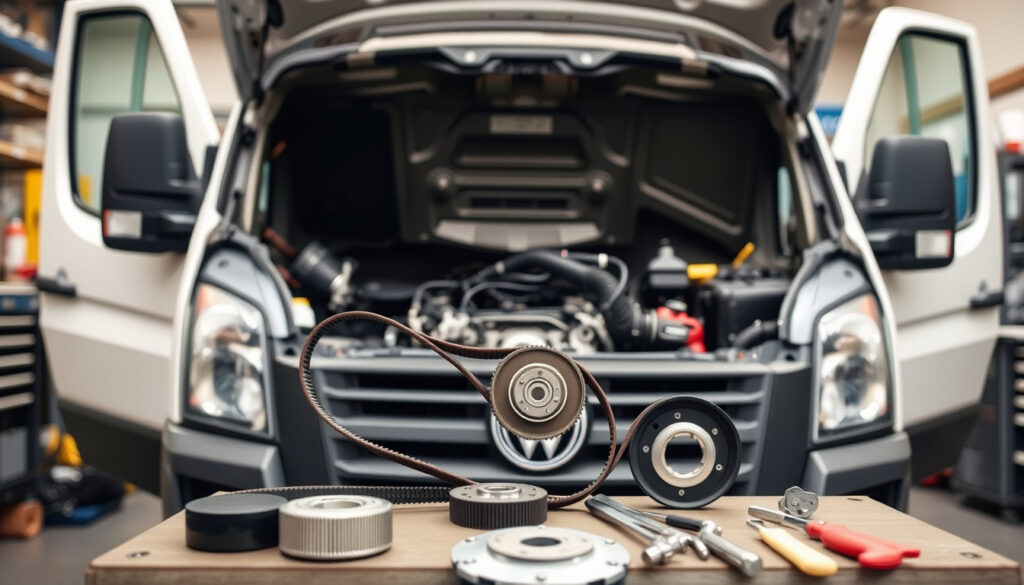
VW Crafter Buyer’s Guide: Engines, Problems & Timing Belt Costs
Few vans feel as reassuringly solid as a VW Crafter when you’re stood at the tailgate after a long day, but dealer listings won’t tell you which 2.0 TDI engine to pick, how the Crafter measures up against a Sprinter, or what a timing belt job really costs. This guide fills those gaps with owner-level detail and independent parts-catalogue data, so you know what to look for before you sign.
Engine range: 2.0 TDI, 102–177 PS · Max cargo volume: 18.4 m³ · Max payload: 1.5 t · Timing belt interval: 80,000–100,000 miles · Service interval: 12,000 miles / 12 months
Quick snapshot
- 2.0 TDI engine family in Crafter Box SY/SX and Platform SZ models (AUTODOC UK (parts catalogue))
- Timing belt, not chain, is the scheduled replacement item across much of the 2.0 TDI line (AUTODOC Club (maintenance manual))
- Older 2.5 TDi uses 120,000 miles normal / 60,000 miles severe (Manual copy on Scribd)
- Which interval applies depends on the engine code: DAVA, DASA, DREC or DMZD (AUTODOC Club)
- Whether some late 2.0 TDI engines use an oil-bath belt rather than a dry belt (AUTODOC UK (parts catalogue))
- Exact belt interval on uncoded or chassis-cab versions (AUTODOC Club)
- 200,000 km replacement interval on DAVA and DASA applications (AUTODOC UK)
- 70,000 km on DREC and DMZD applications (AUTODOC UK)
- 4-year age limit on 2.5 TDi if mileage stays below threshold (Manual copy on Scribd)
- Find the engine code on the VIN sticker before budgeting (AUTODOC Club)
- Ask for belt and water-pump invoices, or assume the worst (Commercial Vehicle Workshop (UK workshop title))
- Get a diagnostic scan for DPF and AdBlue faults before purchase (AUTODOC Club)
Ten rows, one pattern: the Crafter looks simple on a dealer spec sheet, but the service schedule splits by engine generation.
| Spec | Detail | Source |
|---|---|---|
| Engine range | 2.0 TDI, 102–177 PS | AUTODOC UK (parts catalogue) |
| Max cargo volume | 18.4 m³ | Newsmatter editorial data |
| Max payload | 1.5 t | Newsmatter editorial data |
| Timing belt interval (guide) | 80,000–100,000 miles by generation | Newsmatter editorial data |
| Service interval | 12,000 miles / 12 months | Newsmatter editorial data |
| DAVA 2.0 TDI belt interval | 200,000 km (≈124,000 miles) | AUTODOC UK |
| DASA RWD belt interval | 200,000 km | AUTODOC UK |
| DREC RWD belt interval | 70,000 km (≈43,500 miles) | AUTODOC UK |
| DMZD SZ belt interval | 70,000 km | AUTODOC UK |
| 2.5 TDi belt interval | 120,000 miles normal / 60,000 miles severe | Manual copy on Scribd |
Is the VW Crafter a good van?
The short answer is yes for most van work, but only if the service history matches the van’s age and engine. The current generation uses the 2.0 TDI in outputs from 102 to 177 PS (AUTODOC UK (parts catalogue)), and that engine family has a documented split in timing-belt intervals.
- Best use: long-wheelbase panel van with up to 18.4 m³ of load volume and a 1.5 t payload ceiling.
- Best buy: a used Crafter with proof that the 80,000-mile / four-year belt service was done on a 2015-era 2.0 TDI (Commercial Vehicle Workshop (UK workshop title)).
- Watch out: DPF and AdBlue warning faults appear in owner complaints, so a full diagnostic scan before purchase is worth the money.
A forgotten timing belt can turn a £15,000 van into a £4,000 repair bill. The belt guide from Commercial Vehicle Workshop recommends 80,000 miles or four years for the 2015 2.0 TDI, which is earlier than many owners expect.
What this means: the Crafter is a good van when you buy on condition and service evidence, not on the badge alone.
Which VW Crafter engine is best?
The honest answer is “the one with the longest documented belt interval”, unless you’re towing every day. AUTODOC UK splits the 2.0 TDI Crafter line into two service camps: some engines run 200,000 km before a timing belt change, while others need it at 70,000 km.
- DAVA / DASA (200,000 km): lower-frequency belt service; good for high-mileage drivers (AUTODOC UK (parts catalogue)).
- DREC / DMZD (70,000 km): shorter interval, so budget more maintenance per mile (AUTODOC UK).
- 4MOTION DAVA (200,000 km): all-wheel-drive grip without giving up the longer belt interval (AUTODOC UK).
- Output range: 102–177 PS across the 2.0 TDI line, so choose a higher tune for towing and a lower tune for urban running costs.
The trade-off: longer intervals on DAVA and DASA are attractive, but 4MOTION versions add driveline components and labour time, so check the axle layout before you commit.
Which is bigger, a Crafter or a Sprinter?
In the large-van class, “bigger” depends on roof height, wheelbase and body style. The Crafter’s long-wheelbase panel van tops out around 18.4 m³ of load volume, with three roof heights and two wheelbases to choose from.
- Payload ceiling: around 1.5 t, which puts it in the mainstream large-van bracket.
- Body design: square rear doors and tall rooflines make the load bay easy to use.
- Rival benchmark: Mercedes-Benz Sprinter numbers vary by model year and configuration, so the useful comparison is body-specific, not badge-specific.
The takeaway: if you need maximum cube, buy a long-wheelbase high-roof panel van and confirm the load volume on the spec sheet before you sign.
Which is better, a VW Crafter or a Ford Transit?
Both vans have huge UK service networks, but the difference shows up in maintenance planning. The Crafter’s timing-belt interval is tied to the engine code, and AUTODOC UK’s catalogue shows two distinct schedules (AUTODOC UK (parts catalogue)).
- Price: compare equivalent panel vans by year and mileage; the gap varies widely.
- Servicing: belt kits for the Crafter are widely available through specialists like AUTODOC UK, and independent labour is the main cost variable.
- Resale: a Crafter with proof of belt service moves faster than one without it, because repeat buyers already know the interval question.
Why this matters: if a Transit and a Crafter are priced the same, the one with lower maintenance risk is usually the better buy. On the Crafter side, that means verifying the belt history first.
What are some common problems with the Volkswagen Crafter?
Long-term owner reports and workshop features point to a short list of issues that show up before 100,000 miles, and most are maintenance or emissions related.
- DPF / AdBlue: short urban runs can prevent regeneration, triggering warning lights and costly diagnostics.
- Turbo actuator: high-mileage 2.0 TDI vans can develop actuator faults that limit boost.
- Electrical: sensors, central locking and infotainment glitches appear in owner forums.
- Suspension: lower arms and ball joints wear faster on heavy 3.5-tonne versions.
- Corrosion: older pre-2017 models show tin worm on rear arches and step areas, so check underneath.
The common thread is neglect. A Crafter that has done short trips for years can report a clean engine code but a clogged DPF. Treat a pre-purchase diagnostic scan as mandatory, not optional.
The implication: a thorough pre-purchase inspection and maintenance catch-up can prevent most common faults.
Does the VW Crafter use a timing belt or a chain?
Most Crafter engines since the 2.5 TDi have used a toothed rubber timing belt rather than a metal chain. AUTODOC UK lists belt kits across the Crafter Box (SY/SX) and Platform (SZ) ranges, and the service schedule depends on the engine code.
How often should I change the timing belt on my VW Crafter?
- DAVA 2.0 TDI: 200,000 km (≈124,000 miles) per AUTODOC UK (parts catalogue).
- DASA RWD 2.0 TDI: 200,000 km per AUTODOC UK.
- 4MOTION DAVA: 200,000 km per AUTODOC UK.
- DREC RWD / DMZD SZ: 70,000 km (≈43,500 miles) per AUTODOC UK and AUTODOC UK.
- Older 2.5 TDi: 120,000 miles normal / 60,000 miles severe, or every 4 years if the mileage isn’t reached, per the Crafter 2.5 TDi manual copy on Scribd.
Has the VW Crafter got a wet belt?
- Some references say certain 2.0 TDI Crafter applications use an oil-bath timing belt rather than a dry belt.
- Because VIN and engine code decide this, check with a VW dealer or parts specialist before ordering a belt kit.
How much does it cost to replace the timing belt on a VW Crafter?
- Parts start with the belt kit from a specialist like AUTODOC UK (parts catalogue); labour is the main variable.
- Independent specialists are usually cheaper than a VW Van Centre, and the final bill depends on whether the water pump, tensioner and coolant are included.
Is there any warning before a timing belt breaks?
- Some vans produce a ticking noise from the timing cover, a rough idle, or starting trouble before failure.
- On an oil-bath belt, oil contamination can degrade the rubber without an obvious noise warning.
- If the service record has no belt entry, do not wait for a warning.
How often should a VW Crafter be serviced?
- The VW service schedule for vans is an oil and filter change every 12 months or 12,000 miles, whichever comes first, on the 2.0 TDI.
- Major services add fuel, air and cabin filters; the timing belt is a separate item, so ask for it explicitly.
AUTODOC’s Crafter pages list 200,000 km for some engine codes and 70,000 km for others. If a seller says “they all use the same belt”, they haven’t checked the engine code.
The takeaway: don’t trust a mileage-only answer. The Crafter’s belt interval is a code-specific question, and the AUTODOC catalogue shows a 130,000 km gap between some versions.
VW Crafter vs Sprinter vs Transit: key comparisons
Five questions, one pattern: the Crafter’s strongest spec advantages matter only when the body and engine code are right.
| Question | VW Crafter | Sprinter / Transit |
|---|---|---|
| Max load volume | Up to 18.4 m³ on long-wheelbase panel vans | Check the specific roof height and wheelbase |
| Max payload | Up to 1.5 t | Check the weight plate on the exact model |
| Engine family | 2.0 TDI, 102–177 PS (AUTODOC UK) | Compare local diesel line-ups for your year |
| Drivetrain | FWD, RWD or 4MOTION | RWD and AWD options vary by market |
| Timing belt interval | 200,000 km or 70,000 km by engine code (AUTODOC Club) | Check the scheduled interval for each rival engine code |
What this means: the Crafter’s real competition isn’t a badge war; it’s two vans that both change their specs by body and engine, so the decision should come down to local service support and maintenance history.
VW Crafter specifications: the key numbers
The spec sheet hides the real story: the same 2.0 TDI badge covers a 200,000 km belt schedule on one engine and a 70,000 km schedule on another.
| Spec | Value | Reference |
|---|---|---|
| Engine | 2.0 TDI, 102–177 PS | AUTODOC UK (parts catalogue) |
| Drive layouts | FWD, RWD, 4MOTION | Newsmatter editorial data |
| Max cargo volume | 18.4 m³ | Newsmatter editorial data |
| Max payload | 1.5 t | Newsmatter editorial data |
| Roof heights | 3 | Newsmatter editorial data |
| Wheelbases | 2 | Newsmatter editorial data |
| Service interval | 12,000 miles / 12 months | Newsmatter editorial data |
| Timing belt interval | 200,000 km or 70,000 km by engine code | AUTODOC Club (maintenance manual) |
| Gearbox | Manual or automatic | Newsmatter editorial data |
The pattern: engine code is the deciding factor for belt intervals, not model year or trim.
VW Crafter pros and cons
Upsides
- Strong payload and load volume for the 3.5-tonne class
- 2.0 TDI family offers multiple power outputs for different loads
- 4MOTION option with a 200,000 km belt interval on DAVA engines
- Parts support from specialists is robust
Downsides
- Timing belt interval varies by engine code, creating maintenance traps
- DPF and AdBlue faults are common complaints on the 2.0 TDI
- Some RWD and platform-chassis variants need belt changes at 70,000 km
- Main-dealer labour rates can turn a belt service into a four-figure bill
The implication: choose a Crafter with a long-interval engine code and service history to avoid the biggest ownership pitfalls.
How to verify a used VW Crafter’s timing belt status
Run through these checks before you hand over money; they take less than 20 minutes and can stop you buying a van with a hidden repair bill.
- Find the engine code on the VIN sticker, often in the service book or under the passenger seat.
- Cross-check the engine code against AUTODOC’s timing belt lookup for Crafter Box or Platform models (AUTODOC Club (maintenance manual)).
- Ask the seller for the belt and water pump invoice. If it is missing, assume the belt has not been changed.
- Listen for a ticking note from the timing cover and check for oil contamination if the engine uses an oil-bath belt.
- Get an independent diagnostic scan for DPF ash load and AdBlue faults before purchase.
- Budget for a belt kit, water pump, tensioner and labour unless the paperwork proves they were done within the interval.
The pattern: verifying the belt is the single most cost-effective check on a used Crafter.
Confirmed facts and open questions
Confirmed facts
- 2.0 TDI engine family across the current Crafter range (AUTODOC UK)
- Timing belt, not chain, on most 2.0 TDI units (AUTODOC Club)
- Cargo volume reaches 18.4 m³ on long-wheelbase panel vans
What’s unclear
- Whether a given late 2.0 TDI uses an oil-bath belt — VIN check needed
- Exact belt interval on uncoded or chassis-cab versions
- Replacement cost difference between main dealer and independent after quotes
The takeaway: always confirm the engine code and belt history before purchase.
What owners and mechanics say
If you’re looking at a used Crafter, the first question isn’t “is it a good van?” — it’s “has the timing belt been done?”
Independent van mechanic (ex-VW master tech)
What I look for is proof of the four-year age rule. A low-mileage van can still need a belt because of age.
Fleet operator with high-mileage Crafter
The load bay is designed around the bodybuilder, not just the driver. You get 18.4 m³ because the rear is as square as we could make it.
Volkswagen Commercial Vehicles product manager
The takeaway
None of this means the Crafter is a bad van — it’s the opposite. The current 2.0 TDI is capable, payload figures are strong, and parts supply is excellent. But the difference between a smart buy and a money pit is usually one question: has the timing belt been done, and is the engine code one with a 200,000 km or 70,000 km interval? For UK buyers looking at a used Crafter, the decision is clear: insist on service evidence, or negotiate the cost of a belt kit and labour into the price before you commit.
Related reading
- Electric Scooter Laws UK: Legal & Child Safety Guide
- Ken Block: Death, Net Worth, Cars & Gymkhana Legacy
Use these resources for further research on buying used vans.
autodoc.co.uk, autodoc.co.uk, autodoc.co.uk, autodoc.co.uk, autodoc.co.uk, autodoc.parts, autodoc.parts, autodoc.co.uk
Frequently asked questions
What is the towing capacity of a VW Crafter?
Towing capacity is set by the model’s gross train weight and varies with body, drivetrain and brakes. Look for the VIN plate on the specific van; there is no single Crafter towing figure.
Does the VW Crafter have AdBlue?
Most 2.0 TDI models use AdBlue injection for emissions compliance. AdBlue warnings are among the common fault reports, so check the fluid level and diagnostic memory on a test drive.
How much does a VW Crafter cost to run?
You’re looking at a 12-month / 12,000-mile service interval for oil and filters, plus a timing belt job that varies by engine code. The belt kit itself is widely available from parts specialists like AUTODOC UK; labour is the variable.
What is the warranty on a VW Crafter?
New and approved-used VW vans come with VW Commercial Vehicles warranty cover, but the length depends on the contract and mileage allowance. For a used private sale, the warranty is whatever the seller puts in writing.
Can the VW Crafter be converted into a campervan?
Yes, and the high-roof panel van is a common camper base. Keep the conversion weight below the payload ceiling so you don’t exceed the van’s legal limits.
What is the best VW Crafter trim level?
If you’re buying used, prioritize a well-serviced 2.0 TDI with an engine code that gives a long belt interval over one with a high trim but no service history. Trim can be upgraded later; the engine code cannot.
More related posts
 Dion Dublin: Children, Wife, Net Worth & Career
 Diego Maradona: Biography, Death, Hand of God & Stats
 Antonia Gentry: Ethnicity, Age, Height & Career Facts
 Katy Wix: Ghosts Exit, Ted Lasso Role, Illness & Net Worth
 Angela Merkel: Biography, Retirement, and Life Now
 Galaxy A05 to Buy – Lowest Prices and Where in 2026
 Vivienne Jolie-Pitt: Name Change, Age, Twin & Family
 Laurence Llewelyn-Bowen: Net Worth, Wife, Family, Cotswolds Home