What Is a Hybrid Car? How It Works, Pros, Cons & Myths
If you’ve ever stood on a car lot wondering what exactly makes a hybrid different from a regular petrol car, you’re not alone. The term gets thrown around constantly, but the mechanics behind it remain a mystery to many buyers. Here’s the straightforward answer: a hybrid combines a traditional gasoline engine with an electric motor and a battery that recharges itself while you drive. The Toyota Prius popularized this technology in the late 1990s, and today the approach powers everything from city sedans to SUVs.
Power sources: Gas engine + electric motor · Charging needed: Typically no, self-charges · Key maker example: Toyota · Battery role: Assists engine, stores regen energy
Quick snapshot
- Hybrids combine gas and electric power (Pulse Energy)
- Regen braking converts motion into battery charge (Pulse Energy)
- Exact battery lifespan varies by manufacturer
- Real-world fuel economy differs from EPA estimates
- Toyota Prius launched hybrid tech in 1997
- Major adoption across brands continues in 2020s
- Plug-in hybrids offer 20–50 miles electric-only
- Full EVs moving toward mainstream adoption
Five core facts define how these vehicles operate and why they matter for everyday drivers.
| Label | Value |
|---|---|
| Definition | Vehicle with gas engine and electric motor |
| Charging | Usually not required |
| Petrol use | Yes, combined with electric |
| Battery fail | Drivable on gas |
| Example source | Toyota hybrids |
What is a hybrid car and how does it work?
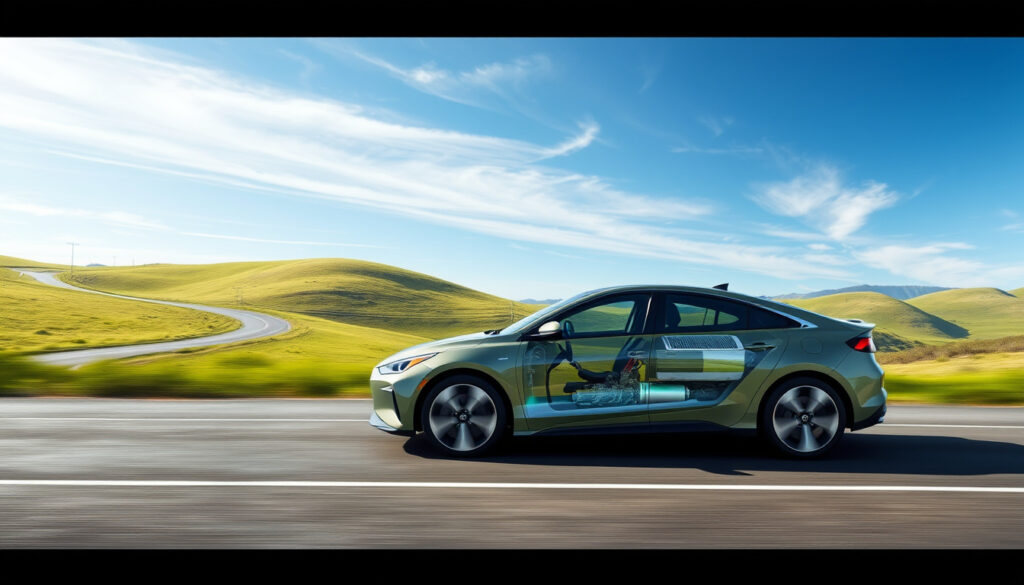
A hybrid car pairs a traditional gasoline engine with an electric motor and a battery pack. The two power sources work together through a computer-controlled system that decides which to use at any given moment, according to Consumer Reports. When you accelerate or climb hills, both sources deliver power. When you coast or brake, the system captures energy that would otherwise be wasted.
Types of hybrid vehicles
Three main configurations exist. Full hybrids can run on electric power alone for short distances—typically a few miles, per Subaru UK. Mild hybrids use electric power only to assist the gas engine, never running solo. Plug-in hybrids (PHEVs) carry larger batteries that can be charged from an external outlet, delivering 20 to 50 miles of electric-only range before the gas engine takes over.
The average U.S. driver covers about 31 miles daily—well within most PHEVs’ electric range, Car and Driver reports. But without regular charging, owners essentially pay for a larger battery they rarely use.
Powertrain components
The internal combustion engine in a hybrid isn’t just along for the ride. It generates electricity to charge the battery when levels drop, Pulse Energy explains. A power control unit manages the rapid switching between electric and combustion propulsion—sometimes several times per minute. This coordination lets manufacturers use smaller gas engines than they would otherwise need, the U.S. Department of Energy notes.
The implication: the electric motor doesn’t replace the gas engine—it reduces how hard the gas engine has to work.
Do hybrid cars use petrol?
Yes, all self-charging hybrids carry a petrol or gasoline engine. That’s the whole point—you get the range flexibility of liquid fuel with some electric assistance. The engine runs most of the time, particularly on highways where sustained speed demands more energy than batteries can provide.
Role of petrol engine
In stop-and-go city traffic, hybrids often rely solely on the electric motor, Subaru UK confirms. The petrol engine kicks in during harder accelerations or when the battery runs low. Think of it as a helper that keeps the electric system charged and ready.
Fuel efficiency
Self-charging hybrids achieve better fuel economy than conventional gasoline vehicles because the electric motor handles low-demand situations where engines are least efficient, Pulse Energy states. The engine can also shut off completely when stopped, eliminating idle waste.
The trade-off: hybrids cost more upfront, so the fuel savings take time to offset the purchase premium.
Do hybrid cars need charging?
For traditional self-charging hybrids, no—you never plug in. The battery recharges through regenerative braking, which captures kinetic energy from deceleration and converts it to electricity stored in the battery, Toyota Malta clarifies. The petrol engine also generates charge when the battery depletes.
Self-charging mechanism
Every time you slow down, the electric motor reverses role and acts as a generator. In the Toyota RAV4 hybrid, for example, the motor “turns kinetic energy from the wheels into electricity,” Findlay Toyota Prescott explains. Descending hills or approaching red lights both feed power back to the battery.
Vs plug-in hybrids
Plug-in hybrids have much larger batteries that require external charging—but once depleted, they function exactly like standard hybrids, Car and Driver reports. If you never plug in a PHEV, you’re essentially hauling around extra battery weight with no benefit.
What this means: the “self-charging” term isn’t marketing spin—it’s an accurate description of how the system actually works.
What is the downside to a hybrid car?
Higher purchase price leads the list. The dual powertrain adds complexity and cost that manufacturers pass to buyers. Battery replacement down the road carries a real price tag, though warranties typically cover the first eight to ten years.
Maintenance costs
Hybrid batteries are susceptible to degeneration if left standing for long periods without use, Toyota Malta warns. Batteries will self-discharge if not used regularly, potentially losing the ability to hold charge effectively. Regular driving keeps the system healthy.
Complexity issues
Having two propulsion systems means twice the potential repair scenarios. The power control unit that manages switching between sources adds another layer of technology that can fail. For owners keeping cars past 150,000 miles, this matters.
Why this matters: the fuel savings rarely fully compensate for the purchase premium over a vehicle’s lifetime—but resale values and reliability records have improved significantly.
Can you still drive a hybrid car if the battery dies?
Yes. This is one of the most persistent myths—hybrid cars will not operate if the hybrid battery goes flat. This is false, Toyota Malta explicitly states. The petrol engine will kick in and charge the battery while providing propulsion.
Gas-only mode
A hybrid with a depleted battery continues driving on petrol. The engine directly powers the wheels and simultaneously recharges the battery. Once enough charge builds up, electric assistance resumes. The experience feels no different from a conventional car.
Run out of gas scenario
If you run out of petrol, the hybrid behaves like any other car—you stop. The battery alone cannot sustain highway speeds for any meaningful distance in a self-charging hybrid. PHEVs offer limited electric-only range but will eventually stall without fuel, Car and Driver confirms.
The bottom line: don’t fear battery failure as a breakdown scenario. The petrol engine has your back.
Upsides
- Better fuel economy than conventional cars
- No charging infrastructure needed for self-charging models
- Smoother, quieter electric-only operation in city traffic
- Reduced tailpipe emissions compared to gas-only vehicles
- Petrol engine backup ensures long-range capability
Downsides
- Higher upfront purchase cost than comparable gas models
- Battery replacement can be expensive after warranty expires
- More complex than single-powertrain vehicles
- Higher maintenance costs for dual systems
- Battery degrades faster if vehicle sits unused for extended periods
Hybrid electric vehicles cannot be plugged in to charge the battery; instead, the battery is charged through regenerative braking and the internal combustion engine.
Some PHEVs can regain one to four miles of pure electric range while descending a long, steep grade.
— Car and Driver automotive editors
In stop-start driving in towns, a hybrid car will rely only on the electric motor.
Hybrids cannot run on electric power alone for long distances; the engine must engage to maintain charge and propulsion.
— Toyota Malta hybrid specialists
For buyers choosing between a self-charging hybrid and a plug-in model, the decision hinges on charging habits. Someone with daily access to a plug can exploit PHEV capabilities fully. Everyone else pays for battery capacity they won’t use.
Related reading: fuel prices near me · UK driving license renewal
maplewoodtoyota.com, podenergy.com, youtube.com, energysage.com
Frequently asked questions
Is a hybrid car an electric car?
No. A hybrid car has both a petrol engine and an electric motor, while a pure electric car runs solely on battery power with no combustion engine. Hybrids use electricity to assist the gas engine, not replace it.
What is a hybrid car example?
The Toyota Prius is the most recognizable example—it popularized self-charging hybrid technology when launched in the late 1990s. Other examples include the Toyota RAV4 Hybrid, Honda Insight, and Hyundai Ioniq Hybrid.
What is a hybrid car price?
Hybrid prices vary by model and manufacturer. Most hybrid sedans start around $25,000–$30,000, while hybrid SUVs typically begin near $35,000. Prices generally run $2,000–$5,000 higher than comparable gas-only models.
What is a hybrid car Toyota?
Toyota offers one of the widest hybrid lineups, including the Prius, Camry Hybrid, RAV4 Hybrid, and Highlander Hybrid. Their hybrid system charges automatically while driving with no need to plug in.
How does a hybrid car work with petrol?
The petrol engine and electric motor work together through a computer-controlled system. The engine provides primary propulsion, charges the battery when needed, and can directly power the wheels or assist the electric motor during high-demand situations.
What’s the difference between hybrid pros and cons?
Key advantages include better fuel economy and reduced tailpipe emissions for urban drivers who don’t want to plug in. Main disadvantages involve higher purchase costs and added complexity that can mean pricier repairs after the warranty expires.
Can you still drive a hybrid if you run out of gas?
No. While the electric motor can propel a hybrid short distances, the battery alone cannot sustain normal driving. Running out of petrol leaves you stranded just as with any conventional vehicle.
More related posts
 Idi Amin: Rule, Atrocities, and Legacy of Uganda’s Dictator
 John Stapleton Death: Cause, Wife, Funeral & Career Details
 Kal Penn: From Hollywood Actor to White House Staffer and Author
 Labi Siffre: Biography, Parents, and Kanye West Sample
 Julius Caesar: Life, Assassination, and Legacy of the Roman Dictator
 Melissa McCarthy Weight Loss: Journey, Methods, Current Look
 Angus Cloud: Cause of Death, Real Name, and Euphoria Reactions