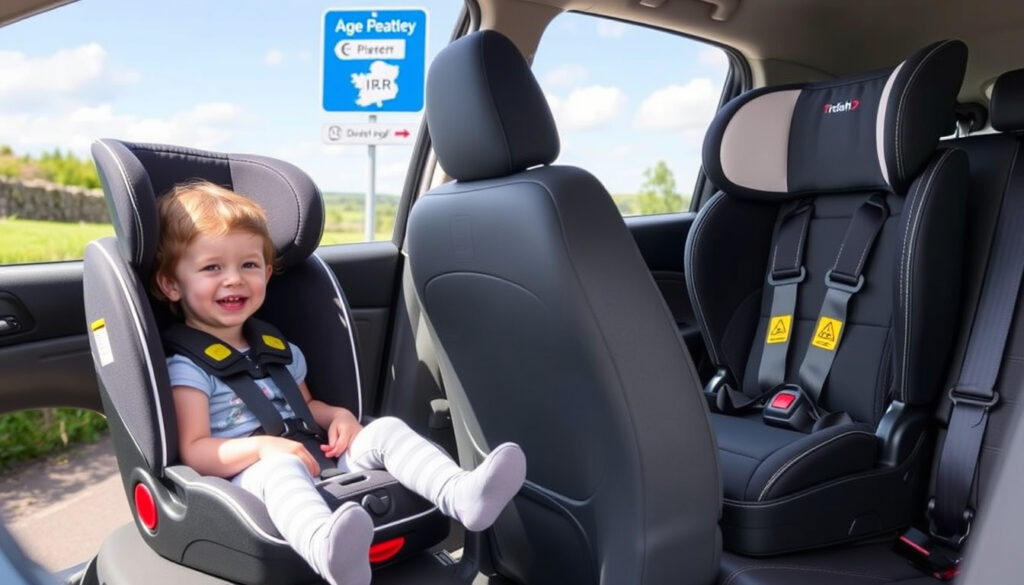
Booster Seat Age & Irish Rules: High-Back vs Backless
Few questions spark as much debate among Irish parents as when exactly a child can move to a booster seat. Is it age, weight, or height that matters? The answer isn’t as simple as a birthday number, and getting it wrong can mean breaking the law or compromising safety. This guide cuts through the confusion with official Irish regulations and practical advice.
Irish legal height limit for child restraint: 150 cm ·
Irish legal weight limit for child restraint: 36 kg ·
Common minimum age for booster seat: 4 years ·
Booster seat types: High-back and backless
Quick snapshot
- Irish law: children under 150 cm or 36 kg must use a child restraint system (HSE – Ireland’s health authority)
- Booster seats must comply with ECE R44 or R129 standards (Tusla – child safety agency)
- Exact age to switch from harness to booster depends on child’s size and car seat limits – no single age works for all (AIG Ireland – insurance & safety expert)
- Safety impact of prolonged booster use beyond legal minimum is not conclusively measured (Aviva Ireland – insurer & road safety contributor)
- No fixed age milestone – use height (150 cm) and weight (36 kg) as the legal triggers (HSE – Ireland’s health authority)
- Typical booster seat use spans from about 4 to 12 years old (Smyths Toys – car seat retailer)
- Once child reaches 150 cm or 36 kg, they can legally use an adult seatbelt without a booster (AIG Ireland – insurance & safety expert)
- Continued use of a booster beyond the legal minimum may improve safety (AIG Ireland – insurance & safety expert)
| Attribute | Value |
|---|---|
| Minimum age (typical) | 4 years |
| Maximum height (Ireland) | 150 cm |
| Maximum weight (Ireland) | 36 kg |
| Types | High-back and backless |
| Required safety standard | ECE R44 or R129 |
| Legal until child reaches | 150 cm or 36 kg |
What age should a child be on a booster seat?
Age guidelines for booster seat use
- Most children start using a booster seat around age 4, but size matters more than years (Aviva Ireland – insurer & road safety contributor).
- Tusla advises against using age alone to choose a seat – always check weight and height (Tusla – child safety agency).
- A child aged 3 or over who is under 150 cm and under 36 kg must use the correct child seat, booster seat, or booster cushion (Tusla – child safety agency).
Weight and height minimums
- Most booster seats require a minimum weight of 40 lb (about 18 kg) (Smyths Toys – car seat retailer).
- Height is the primary legal measure in Ireland: 150 cm is the upper bound for mandatory restraint use (HSE – Ireland’s health authority).
- Children up to about 11 to 12 years old will generally fall under the 150 cm or 36 kg rule (Tusla – child safety agency).
Signs of readiness for a booster
- The child has outgrown the height or weight limit of their forward‑facing car seat with harness.
- The child can sit properly in a booster without slouching or playing with the seatbelt.
- The vehicle’s lap‑sash belt fits correctly – low on the hips, not the stomach, and the shoulder belt crosses the chest, not the neck.
Age 4 may be a common starting point, but Irish parents must use height and weight as the real benchmarks. A 4‑year‑old who weighs 20 kg and is 110 cm tall may be ready – but only if they also meet the maturity test.
What age can a child go to a backless booster seat?
Backless booster age and weight requirements
- Backless boosters are generally recommended from age 4–5 and a minimum weight of 40 lb (18 kg) (Smyths Toys – car seat retailer).
- Irish law does not set a separate age for backless boosters – the same 150 cm / 36 kg rule applies (HSE – Ireland’s health authority).
When is a high‑back booster needed?
- A high‑back booster is essential if the vehicle seat lacks a headrest, because the booster itself provides head and side support.
- For cars with adjustable headrests, a backless booster may be used, but the vehicle headrest must be at the right height.
- High‑back boosters tend to offer better side‑impact protection and are often recommended for younger children.
Safety considerations for backless boosters
- Backless boosters are more portable and cheaper, but they do not provide lateral support for the head.
- They rely entirely on the vehicle’s seatbelt and headrest for restraint.
- A backless booster is only safe if the child can sit still and the belt fits correctly.
A backless booster may save space and money, but it shifts more responsibility onto the vehicle’s safety features. If your car lacks a headrest or the child is prone to slouching, a high‑back booster is the safer bet.
What are the rules for booster seats in Ireland?
Irish law on child restraints
- All children under 150 cm in height or under 36 kg in weight must use a correct child restraint system – this includes booster seats and booster cushions (HSE – Ireland’s health authority).
- The law applies to private vehicles, but taxis are exempt in the same way (HSE – Ireland’s health authority).
- Children can legally sit in the front seat of a car in Ireland if they use the correct restraint for their size (HSE – Ireland’s health authority).
Height and weight limits: 150 cm / 36 kg
- Once a child reaches either 150 cm or 36 kg, they can legally use an adult seatbelt without a booster (AIG Ireland – insurance & safety expert).
- AIG Ireland notes that continued use of a booster beyond the legal minimum may improve safety until the child is taller or heavier (AIG Ireland – insurance & safety expert).
Where to buy compliant booster seats in Ireland
- Approved retailers include Smyths Toys, Halfords, and Bellababy – all sell seats that meet ECE R44 or R129 standards.
- Smyths Toys provides a detailed buying guide with size bands (Smyths Toys – car seat retailer).
- Always verify that the seat carries the official ECE approval mark.
What we know for sure
- Children under 150 cm or 36 kg must use a child restraint system in Ireland (HSE – Ireland’s health authority).
- Booster seats must comply with ECE R44 or R129 standards (Tusla – child safety agency).
What remains unclear
- The exact age for switching from a harness to a booster varies widely based on the child’s size and the car seat’s limits – no single number fits all (AIG Ireland – insurance & safety expert).
Does my 4 year old need a car seat or booster?
4‑year‑old car seat vs booster
- Most 4‑year‑olds still meet the weight and height limits for a forward‑facing car seat with a 5‑point harness (Aviva Ireland – insurer & road safety contributor).
- A booster seat may be appropriate if the child has outgrown the harness limits – typically 18 kg for many forward‑facing seats.
- Check the manufacturer’s specifications for your specific car seat – they list maximum weight and height.
Weight and maturity factors
- Weight is more reliable than age: a 4‑year‑old who weighs 20 kg may still be within the harness limit of some seats, while a smaller 5‑year‑old might need to move earlier.
- Maturity matters – a child who fidgets or unbuckles the seatbelt may be safer in a harness.
When to keep using a 5‑point harness
- Keep the harness as long as the child is below the seat’s height and weight limits – it provides the best protection.
- Once the child exceeds the limits, it’s time to transition to a booster – typically around 18 kg or when the tops of the ears reach the top of the car seat shell.
High‑back vs backless booster: which one should I choose?
Comparison of safety features
| Feature | High‑back booster | Backless booster |
|---|---|---|
| Head support | Integrated headrest | Relies on vehicle headrest |
| Side impact protection | Built‑in side wings | None |
| Seatbelt guide | Yes – helps position belt | Yes – some models include clips |
| Portability | Bulky, heavier | Lightweight, easy to move |
| Cost | €50–€150 | €15–€50 |
Compatibility with vehicle seats
- High‑back boosters work in cars without headrests or with low seat backs.
- Backless boosters require the vehicle to have a headrest at the correct height – if not, choose a high‑back.
- Both types need a lap‑sash seatbelt – a lap‑only belt is not safe for a booster.
Portability and cost differences
- Backless boosters are ideal for families who switch cars often or need an extra seat for carpooling.
- High‑back boosters are heavier but offer better protection and are often preferred for primary vehicles.
- The cost difference is significant, but safety should guide the choice.
Pros and cons of each type
Upsides
- High‑back: superior head and side protection
- High‑back: works in vehicles without headrests
- Backless: lightweight and highly portable
- Backless: lower cost
Downsides
- High‑back: bulkier and heavier
- High‑back: more expensive
- Backless: no side impact protection
- Backless: requires vehicle headrest
How to choose the right booster seat: a step‑by‑step guide
- Measure your child’s height and weight – compare against the 150 cm / 36 kg legal limits.
- Check your vehicle – does it have headrests in all seating positions? If not, you need a high‑back booster.
- Assess your child’s maturity – can they sit upright for the whole journey without slouching?
- Decide on type – high‑back for primary car, backless for occasional use.
- Look for the ECE R44 or R129 approval mark – mandatory for legal use in Ireland.
- Install the booster and test the seatbelt fit – the lap belt should lie low on the hips, the shoulder belt across the chest.
Irish parents face a clear trade‑off: backless boosters save space and money, but high‑back models add protection. For younger or smaller children, the extra support is worth the expense. For older, disciplined riders, a backless booster may be sufficient.
The safest place for children to travel is in a properly fitted car seat or booster seat in the back seat of the car.
HSE – Ireland’s health authority
Age should not be used as the guide for choosing a child seat; weight and height should be used instead.
Tusla – child safety agency
For Irish parents, the choice between a high‑back and backless booster comes down to vehicle compatibility, budget, and the child’s size. The legal test remains simple: under 150 cm or 36 kg, a booster is required. Once your child passes either threshold, the booster can be left behind – though safety experts advise keeping it a little longer if possible.
Related reading: booster seat Ireland age guide · child car seat safety height and weight rules
Frequently asked questions
Can a 3‑year‑old use a booster seat?
Irish law requires children aged 3 or over to use a child restraint system if they are under 150 cm or 36 kg. However, most 3‑year‑olds are still better protected in a forward‑facing car seat with a 5‑point harness. A booster seat should only be used when the child has outgrown the harness limits.
Is it safe to buy a second‑hand booster seat?
Second‑hand car seats may have unknown crash history or missing parts. The HSE advises against buying second‑hand unless you can verify the seat has never been in an accident and has all parts, labels, and instructions. Check the expiry date too.
How long can a child use a booster seat?
A child can use a booster seat from about age 4 until they reach 150 cm in height or 36 kg in weight – this is the legal requirement in Ireland. Many children need a booster until age 11 or 12.
Do booster seats need to be ISOFix?
No, booster seats do not require ISOFix. They are held in place by the child’s weight and the vehicle’s seatbelt. However, some high‑back boosters offer ISOFix connectors for added stability – check the manufacturer’s instructions.
What is the weight limit for a backless booster?
Most backless boosters have a maximum weight limit of 36 kg (the same as the Irish legal upper bound). Always check the specific seat’s label – some models have lower limits.
Do booster seats have an expiry date?
Yes, booster seats have an expiry date, usually 6 to 10 years from manufacture. The date is printed on the seat. Over time, plastic degrades and can become brittle. Never use an expired seat.
Can I use a booster seat without a back?
Yes, backless boosters are legal and safe when used correctly – provided the vehicle seat has a headrest and the child meets the height and weight requirements. Without a headrest, a high‑back booster is required.
More related posts
 Dee Williams: Career, Age, Real Name, Current Life (2025)
 Sarah Graham: British Photorealist Painter and Botanical Artist
 Anna Friel: Career, Relationships, and Why She Walks with a Limp
 Chrissy Teigen: Family, Sobriety, and Public Apology
 Prince Andrew 2025: What Happened, Finances, and Future
 Idi Amin: Rule, Atrocities, and Legacy of Uganda’s Dictator
 Lucy Pargeter: Children, Partner, and Emmerdale Role
 Julie Ming Case: How a Mother Changed Double Jeopardy Law