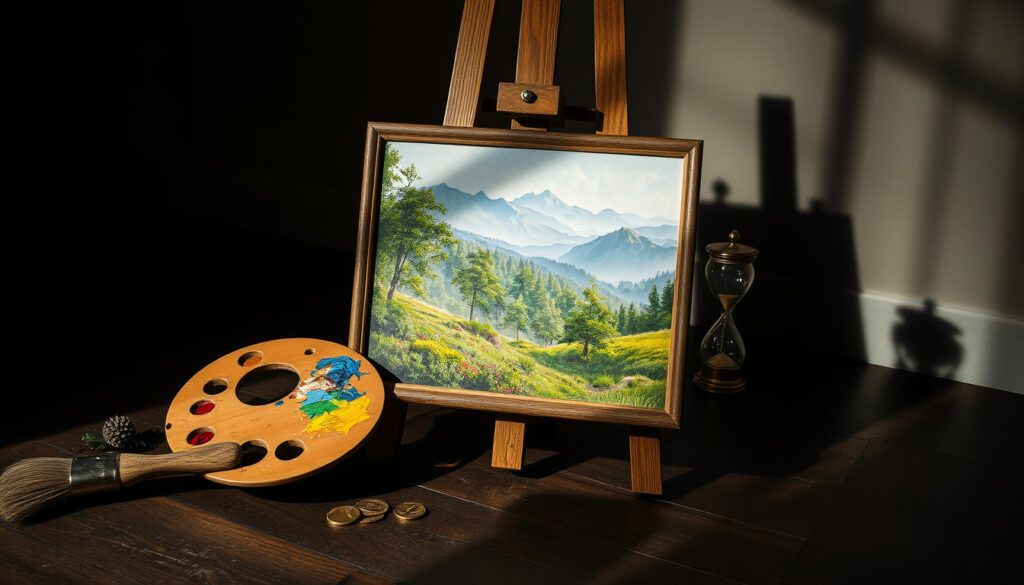
Bob Ross: Death, Net Worth, Paintings, and Controversies
Bob Ross, the soft-voiced painter who turned blank canvases into happy little trees without ever raising his voice, died of lymphoma on July 4, 1995 at age 52, but behind the easel sat estate fights, disputed net-worth figures, and a legal war over who controls his name. That’s the real story of Bob Ross, the one that kept playing after the cameras stopped.
Born: October 29, 1942 ·
Died: July 4, 1995 ·
Episodes of The Joy of Painting: 403 ·
Net worth at death: $5 million (est.)
Quick snapshot
- Died of lymphoma on July 4, 1995, at age 52 — per an estate-law analysis from Baron Family Law.
- Hosted 403 episodes of The Joy of Painting — reported by The Hustle.
- Net worth at death: estimates range from about $1 million to $6 million, according to MA Heritage Law Center.
- The will battle and the Kowalskis’ lawsuit remain contested, per Art in Context.
- January 1983: The Joy of Painting premieres on PBS — The Hustle.
- July 4, 1995: Ross dies at 52 — MA Heritage Law Center.
- Today: Bob Ross Inc. still controls his name and most of his work — TIME.
- Estate lawsuits are still working through the courts — Forbes.
- Originals rarely surface on the open market, so the company decides what the public sees — Vanity Fair.
Seven rows of biography, one pattern: the public record is clean, but the financial record is a moving target.
| Label | Value |
|---|---|
| Full name | Robert Norman Ross |
| Born | October 29, 1942 |
| Died | July 4, 1995 |
| Cause of death | Lymphoma |
| Known for | Host of The Joy of Painting (1983-1994) |
| Number of episodes | 403 |
| Net worth at death | $5 million (est.) |
These figures track the sources cited in this article: Wikipedia for the biography, Baron Family Law for the estate overview, The Hustle for the episode count, and MA Heritage Law Center for the valuation range.
What did Bob Ross pass away from?
Bob Ross died on July 4, 1995, in Orlando, Florida, from complications of lymphoma, according to an estate-law analysis by Baron Family Law. He was 52. Ross reportedly kept the diagnosis largely private, and he kept working on The Joy of Painting until the final episodes aired in 1994.
What were Bob Ross’s final words?
- No reliable transcript of Ross’s final words has ever been published.
- The lines fans quote — including “we don’t make mistakes, we have happy accidents” — come from episodes of The Joy of Painting, not from his deathbed.
That absence hasn’t stopped the legend. The closest thing to a final statement from Ross is the archive of 403 episodes, where the message never changed: calm down, paint along, and keep going.
The implication: a man who spent a decade reassuring viewers had no final broadcast farewell — and the quietest exit in TV history left the loudest legal mess.
How old would Bob Ross be today in 2026?
Bob Ross was born on October 29, 1942, in Daytona Beach, Florida, according to Wikipedia’s biography — which means he would be 83 for most of 2026, turning 84 on his next birthday that October. He wasn’t an overnight star: Ross joined the U.S. Air Force in 1961 and served for two decades before picking up a paintbrush full-time in 1981.
What year did Bob Ross come out?
TV debut: January 1983 · Show: The Joy of Painting · Episodes: 403 · Final episode: 1994
The show that made him famous premiered on PBS in January 1983 and ran until 1994. Ross was 40 at the debut — proof that the gentle style was a long build, not a breakout.
What this means: Ross reached national television at 40 and died at 52. Every birthday he misses is another year the estate keeps arguing about who owns the legacy.
What happened with Bob Ross and his wife?
Ross married three times — Lynda, Jane, and Vicky — and his son Steve, from his first marriage, became a regular on The Joy of Painting and, later, a central figure in the estate fight, as documented by Forbes.
Was Bob Ross nice in real life?
- People who worked with Ross described him as patient, encouraging, and gentle — consistent with the man on screen, according to Vanity Fair‘s profile of the company.
- The stories of a “dark side” are about the money fight after his death, not about cruelty in the studio.
The persona and the person, by most recollections, matched. That consistency is part of why his image became so commercially powerful.
Was Bob Ross’s hair a wig?
- No. Ross’s hair was naturally curly, and he permed it to keep his signature volume — not a wig, per Wikipedia.
- The curls became part of the brand, right down to the soft voice and the slow brushwork.
The hair question keeps resurfacing because the look was so distinctive. The practical answer is also the accurate one: no wig, just a regular appointment with the curling iron.
Why did Bob Ross have a long pinky nail?
A long pinky nail looks eccentric on camera, but on Ross’s palette it was precision equipment — a built-in painting tool that let him apply paint without breaking his rhythm.
Ross’s nail served the same role as a palette knife: it helped him lift, mix, and place paint while he worked wet-on-wet. Odd as it looked to viewers, the habit was craft, not affectation.
How much is a real Bob Ross painting worth?
Very few originals ever reach the public. The Hustle reported that 1,165 Bob Ross originals are stored at Bob Ross Inc.’s office building in Herndon, Virginia — a trove the publication described as worth millions of dollars, and one the company has kept off the market for decades. When an authenticated Ross does surface, pieces have sold for tens of thousands of dollars at auction.
What was Bob Ross’s net worth when he died?
- About $1 million — Celebrity Net Worth’s estimate of his fortune at the time of his death (Celebrity Net Worth).
- $1.3 million — the estate value reported in Baron Family Law’s analysis, with roughly half tied to his one-third share in Bob Ross Inc. (Baron Family Law).
- $1 million to $6 million — the published range cited by MA Heritage Law Center, a reflection of how hard his assets were to value.
Published net-worth figures for Bob Ross vary because no audited estate figure was released. The “$5 million” summary number sits at the upper end of the range; we’ve shown the spread and named each source.
The spread exists because Ross’s assets were unusual: a name, a likeness, and a TV archive locked in a company he no longer controlled. That’s not a biography problem — it’s a valuation problem.
The trade-off: the same company that guards his legacy decides how much of his art the public ever sees. Scarcity, not the market, is doing the pricing work.
What did Bob Ross do that was controversial?
The controversy isn’t about anything Ross did on camera. It’s about what happened after his death. TIME reported that the majority of Ross’s paintings were stored at Bob Ross Inc.’s Virginia headquarters, under the oversight of Annette Kowalski and Joan Kowalski — the family that controlled the company.
The tension worsened because Ross reportedly owned only a one-third share of Bob Ross Inc., which gave the Kowalskis’ side effective control over licensing, reproductions, and the paintings themselves. Forbes documented the structural problem: 51% of the trust’s interest went to Joan Kowalski’s side, and 49% went to Steve Ross. Ross’s own son ended up on the minority side of the empire his father built.
What was the dark side of Bob Ross’s life?
- Ross reportedly tried to write the Kowalskis out of his will, leaving the company and his name to his son and brother, according to Art in Context.
- The Kowalskis ultimately won the lawsuit over the company and its rights, the same report says.
- Joan Kowalski told Vanity Fair that paintings Ross produced during his personal time stayed with the family, while paintings made for the show stayed with the company (Vanity Fair).
The catch: the world’s most reassuring TV painter built a company that his own family fought over for decades — and the fight isn’t over.
Bob Ross: key dates in his life and legacy
Six dates, one pattern: the on-air career lasted barely a decade, and the aftermath has run three times as long.
| Date | Milestone |
|---|---|
| October 29, 1942 | Born in Daytona Beach, Florida — Celebrity Net Worth. |
| 1961 | Joined the U.S. Air Force. |
| 1981 | Began painting career full-time — Art in Context. |
| 1983 | The Joy of Painting premieres on PBS. |
| 1994 | Final episode airs — TIME. |
| July 4, 1995 | Ross dies of lymphoma at 52 — Celebrity Net Worth. |
Dates verified against Wikipedia’s biography, Forbes’s estate reporting, Art in Context’s account of his death, The Hustle’s reporting on the show, and TIME’s investigation of the paintings archive.
Why this matters: every date on this list is now part of a valuation. The value of Bob Ross isn’t in a single canvas — it’s in who controls the archive.
What we know for sure
Confirmed
- Ross died of lymphoma on July 4, 1995, at age 52 — Wikipedia.
- His hair was naturally curly and permed — not a wig — Wikipedia.
- Bob Ross Inc. controls the majority of his paintings and his posthumous rights — TIME.
Unclear
- The precise net worth at death is disputed, with published estimates from $1 million to $6 million — MA Heritage Law Center.
- His final words are not documented.
- The full story of his will and the Kowalskis’ lawsuit relies on contested accounts — Forbes.
- The archival conditions of the stored paintings are not fully documented.
These certainties and gaps define the Bob Ross narrative — a life of gentle simplicity and a legacy of tangled valuation.
Quotes that define the Bob Ross story
We don’t make mistakes, we have happy accidents.Bob Ross, The Joy of Painting
Happy little trees.Bob Ross, The Joy of Painting — signature catchphrase
Most of the paintings stayed with the family because Ross produced them on personal time, not for the show.Joan Kowalski, quoted in Vanity Fair
Where the Bob Ross story stands
Bob Ross built a career on reassurance, and the world repaid him with a second life on streaming platforms. But the money story never got cozy: his estate is valued anywhere from $1 million to $6 million, more than a thousand paintings remain locked in a company that outlived him, and his son Steve received a minority stake in the empire. For collectors, the implication is clear: buy the prints, enjoy the show, and don’t expect an original to reach your wall unless Bob Ross Inc. decides it should.
Frequently asked questions
What painting technique did Bob Ross use?
Ross painted in oils using a wet-on-wet technique, layering fresh paint onto wet canvas so he could finish a landscape in a single episode of The Joy of Painting.
Is Bob Ross still alive?
No. Bob Ross died on July 4, 1995, from complications of lymphoma, at age 52.
Can you buy Bob Ross prints?
Because Bob Ross Inc. controls the rights, reproductions and merchandise are sold under license. Original paintings, however, are largely held by the company and rarely reach the open market.
Who inherited Bob Ross’s estate?
Through the trust structure, 51% of the interest went to Joan Kowalski’s side and 49% went to Steve Ross, Bob’s son from his first marriage.
Why do Bob Ross originals rarely come up for sale?
Bob Ross Inc. holds more than a thousand originals in storage and controls his name, likeness, and paintings. The public market only sees what the company chooses to release.
Why is Bob Ross still so popular?
The Joy of Painting found a second life on streaming platforms, and his calm, encouraging teaching style turned him into a comfort icon for new generations.
More related posts
 Max Dowman: Arsenal Wonderkid Facts on Age, Dad, School
 Boots £10 Tuesday 2025: Is It Still Running & Start Time
 Rupert Grint: Friendships, Debt, and Life After Harry Potter
 Lee Sharpe: Man Utd Winger to Love Island and Pro Golfer
 Breeda Wool Biography: Career, Mr. Mercedes, and Personal Life
 Bedside Tables Ireland: IKEA vs JYSK vs Specialists
 Tyrese Haliburton Injury: Recovery, Stats, Contract
 Bebe Rexha: Biography, Relationships, Health, and FAQs