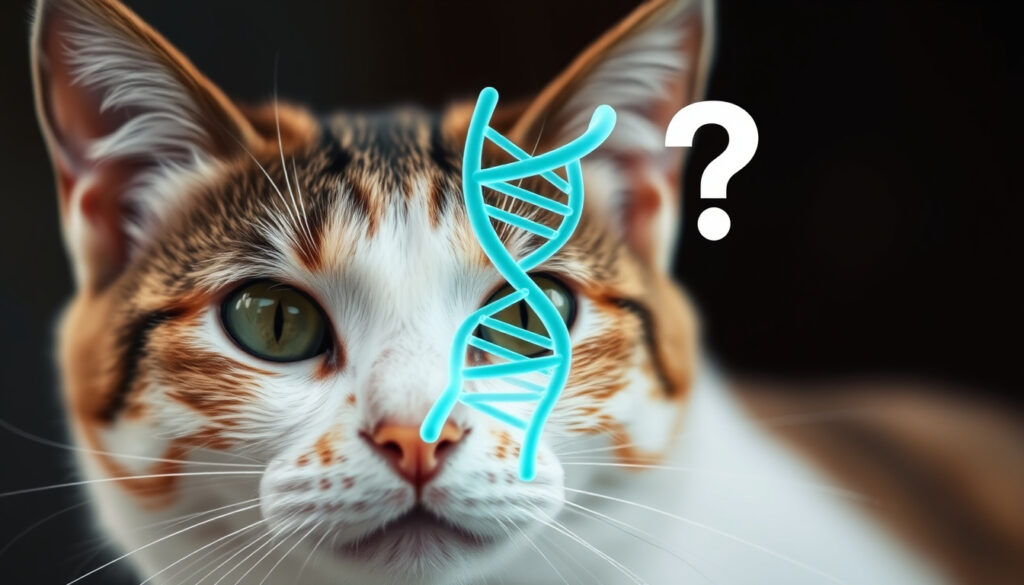
Can a Cat Have Down Syndrome? Myth v Reality
You’ve probably seen the photo: a sweet-faced cat with a flat nose, wide-set eyes, and a caption calling it a “Down syndrome cat.” The internet adores these images, but the genetic reality is far different from the viral label, as cats carry 19 pairs of chromosomes compared to our 23, making the specific trisomy that causes human Down syndrome impossible in felines.
Human chromosomes: 23 pairs ·
Cat chromosomes: 19 pairs ·
Down syndrome cause in humans: extra copy of chromosome 21 ·
Cats with true Down syndrome: 0 (impossible) ·
Cats with similar symptoms (estimated): unknown, but rare
Quick snapshot
- Cats cannot have human Down syndrome due to different chromosome count (Hill’s Pet Nutrition).
- Viral “Down syndrome cats” actually have other conditions (TomVets).
- Commonly misattributed features: flat face, wide-set eyes, poor coordination (Pewaukee Veterinary Service).
- Cerebellar hypoplasia, blindness, deafness, mobility issues are common special needs conditions (Hill’s Pet Nutrition).
- Many special needs cats adapt well with supportive care (Pewaukee Veterinary Service).
- Always consult a veterinarian for diagnosis (TomVets).
- Repetitive actions, social withdrawal, lack of response to stimuli may indicate underlying issues (Hill’s Pet Nutrition).
- Could indicate pain, neurological damage, or sensory loss (Pewaukee Veterinary Service).
- Early veterinary evaluation improves outcomes (TomVets).
- The exact prevalence of conditions that mimic “Down syndrome” in cats is unknown. (Hill’s Pet Nutrition)
- Whether some cats experience a syndrome similar to Down syndrome from a different chromosomal anomaly is not established (Hill’s Pet Nutrition).
The data points confirm a clear pattern: every number points to the same conclusion.
| Fact | Value |
|---|---|
| Human chromosome count | 23 pairs |
| Cat chromosome count | 19 pairs |
| Cause of human Down syndrome | Triplication of chromosome 21 |
| Cat equivalent possible? | No, because chromosome 21 does not exist in cats |
| Viral “Down syndrome cat” explanation | Likely a cat with cerebellar hypoplasia, head injury, or congenital infection |
What this means: The chromosomal gap between species is not a minor difference — it is the reason a “cat with Down syndrome” cannot exist, no matter how convincing the viral photo looks.
Can a cat have Down syndrome?
Why cats cannot have Down syndrome
- Down syndrome is caused by an extra copy of human chromosome 21, and cats do not have chromosome 21 in their genome (TomVets veterinary team).
- Cats carry 19 pairs of chromosomes (38 total), whereas humans carry 23 pairs (46 total) (Pewaukee Veterinary Service).
- The veterinary community does not recognize feline Down syndrome as a diagnosable condition (Hill’s Pet Nutrition).
Without a chromosome 21 equivalent in the feline genome, the specific trisomy that defines human Down syndrome is structurally impossible in cats. Even rare chromosomal abnormalities reported in cats — such as a 1975 case in the American Journal of Veterinary Research describing a male cat with a Klinefelter-like condition (Hill’s Pet Nutrition cites the study) — do not produce a Down syndrome-like presentation. Those are different anomalies entirely.
The implication: Every cat labeled with Down syndrome instead has a real, often treatable medical condition that deserves proper veterinary attention.
Every viral “Down syndrome cat” you have seen has a real medical story — just not the one the caption claims. The animal likely has cerebellar hypoplasia, a congenital infection, or another neurological condition that a veterinarian can identify.
What causes Down syndrome in humans
- Down syndrome is a condition exclusive to humans, defined by the presence of an extra full or partial copy of chromosome 21 (TomVets).
- This extra genetic material alters the course of development and produces the characteristic physical and cognitive features associated with the syndrome.
- Because cats do not possess chromosome 21, they cannot develop the specific trisomy that causes human Down syndrome (Hill’s Pet Nutrition).
The implication for cat owners is straightforward: if your cat has an unusual appearance or developmental delays, the cause is something else — and that “something else” is often treatable or manageable with proper veterinary care.
What are the behaviors of cats with Down syndrome?
Common symptoms mistaken for Down syndrome
- Behaviors attributed to “Down syndrome cats” include flat face, wide-set eyes, poor muscle tone, coordination problems, and cognitive delay (Pewaukee Veterinary Service).
- Internet images of cats with unusual facial features and awkward movements have gone viral and are routinely mislabeled as “feline Down syndrome” (TomVets).
- The misconception is often fueled by resemblance-based storytelling rather than confirmed genetic diagnosis (TomVets).
Real conditions that cause those behaviors
- Those signs can stem from cerebellar hypoplasia (underdevelopment of the cerebellum), head trauma, or infection in utero (Hill’s Pet Nutrition).
- Cerebellar hypoplasia causes intentional tremors, unsteady gait, and poor coordination — symptoms that closely match what is often mistaken for Down syndrome in viral videos.
- Veterinary diagnosis is essential for any cat with unusual development or behavior (TomVets).
The pattern: Across case after case, what looks like “Down syndrome” in a cat is almost always a different neurological or congenital condition that requires a veterinarian’s expertise to identify.
Can a cat be special needs?
Types of special needs in cats
- Cats can be special needs due to blindness, deafness, mobility issues, or neurological conditions (Hill’s Pet Nutrition).
- The term “special needs cat” is used for cats with behavioral or physical abnormalities that may mimic signs people associate with Down syndrome (Hill’s Pet Nutrition).
- Special needs cats may display physical or behavioral traits that observers mistakenly associate with Down syndrome, but the underlying causes are developmental, congenital, or neurologic (Hill’s Pet Nutrition).
Calling a cat “special needs” is far more accurate than labeling it with a human-specific condition — and it opens the door to proper medical care rather than viral misinformation.
How to care for a special needs cat
- Special needs cats often require modified environments, patience, consistent routines, and veterinary support (Pewaukee Veterinary Service).
- A blind cat needs furniture kept in the same place; a deaf cat needs visual cues; a cat with mobility issues may need ramps or modified litter boxes.
- Many special needs cats live full, happy lives with proper care and a committed owner (Hill’s Pet Nutrition).
The trade-off: The care commitment is higher, but the reward of giving a vulnerable animal a good life is substantial.
Can cats have autism?
Autism in animals: what science says
- Autism spectrum disorder is a human diagnosis with specific diagnostic criteria that have not been validated in cats (Hill’s Pet Nutrition).
- No scientific evidence supports a diagnosis of autism in cats. The behavioral criteria used in humans do not translate across species.
- Some animal behavior research explores repetitive behaviors in other species, but these are not equivalent to human autism.
Why autistic-like behaviors in cats are different
- Cats may show repetitive behaviors, social avoidance, or unusual vocalization due to stress, pain, environmental factors, or medical issues (Hill’s Pet Nutrition).
- A cat that hides constantly, circles repetitively, or vocalizes at odd hours could have hyperthyroidism, cognitive dysfunction (feline dementia), or chronic pain — not autism.
- Labelling a cat as “autistic” without veterinary investigation can delay treatment for conditions that are actually treatable (Pewaukee Veterinary Service).
The catch: Applying human neurodevelopmental labels to cats feels intuitive but is scientifically unsupported and can lead to missed diagnoses. A veterinarian, not a viral post, should be the one assessing your cat’s behavior.
How can I tell if my cat is special needs?
Signs to watch for
- Symptoms include clumsiness, poor coordination, lack of response to sounds, vision problems, and developmental delays (Pewaukee Veterinary Service).
- A cat that bumps into furniture, does not startle at loud noises, or has difficulty jumping may have a sensory or neurological issue.
- Unusual facial structure — a very flat face, wide-set eyes, or a turned-up nose — can indicate a breed characteristic or a congenital condition, but not Down syndrome (TomVets).
When to consult a veterinarian
- A full veterinary exam, including neurological tests, can identify underlying causes of unusual appearance or behavior (TomVets).
- Some conditions are manageable with medication, physical therapy, dietary changes, or environmental accommodations (Hill’s Pet Nutrition).
- The earlier a condition is diagnosed, the better the outcome — delaying care because “it’s just a Down syndrome cat” harms the animal (Pewaukee Veterinary Service).
The decision: For owners who suspect their cat might have special needs, schedule a veterinary visit rather than searching for labels online. The right diagnosis changes everything.
Confirmed facts
- Cats do not have the genetic apparatus for Down syndrome (Hill’s Pet Nutrition).
- Cats with flat faces, wide-set eyes, and coordination issues usually have other medical conditions such as cerebellar hypoplasia or congenital infection (Pewaukee Veterinary Service).
- A veterinarian should evaluate any cat with unusual development or behavior (TomVets).
What’s unclear
- The exact prevalence of conditions that mimic “Down syndrome” in cats is unknown.
- Whether some cats experience a syndrome similar to Down syndrome from a different chromosomal anomaly is not established (Hill’s Pet Nutrition).
“Down syndrome is a condition exclusive to humans. Cats cannot have human Down syndrome because they do not have chromosome 21.”
TomVets veterinary team
“The veterinary community does not recognize feline Down syndrome as a veterinary condition. Cats can have rare chromosomal abnormalities, but these are not the same as human Down syndrome.”
Hill’s Pet Nutrition veterinary team
“Special-needs cats may display physical or behavioral traits that observers mistakenly associate with Down syndrome. These traits do not indicate Down syndrome and may instead reflect a different genetic or neurological issue.”
Pewaukee Veterinary Service
The “Down syndrome cat” is a myth born from well-meaning but misinformed social media posts. Behind every viral photo is a real cat with a real medical story — cerebellar hypoplasia, a congenital infection, a neurological condition, or simply a unique face. For owners who suspect their cat has special needs, the path forward is not found in internet labels but in a veterinarian’s exam room. The choice is clear: invest in a proper diagnosis, or let a myth delay the care your cat actually needs.
For a deeper look at the science behind these viral videos, see our detailed breakdown of myths and vet facts about cats with Down syndrome.
Frequently asked questions
Can a cat have a genetic disorder similar to Down syndrome?
Cats can have rare chromosomal abnormalities, but these are not the same as human Down syndrome. A 1975 case in the American Journal of Veterinary Research described a male cat with a Klinefelter-like condition, but that produces different physical and developmental features (Hill’s Pet Nutrition cites this research).
What is cerebellar hypoplasia in cats?
Cerebellar hypoplasia is a neurological condition where the cerebellum does not fully develop, causing intentional tremors, a wobbly gait, and poor coordination. It is often mistaken for Down syndrome in viral videos but is a distinct and non-progressive condition (Hill’s Pet Nutrition).
How do I care for a cat with special needs?
Special needs cats often require modified environments — keep furniture in consistent places for blind cats, use visual cues for deaf cats, and provide ramps for cats with mobility issues. A veterinarian can recommend specific accommodations based on the cat’s condition (Pewaukee Veterinary Service).
Do cats with flat faces have health problems?
Brachycephalic (flat-faced) cat breeds like Persians and Exotic Shorthairs can have breathing difficulties, dental issues, and tear duct problems due to their facial structure. These are breed-related health issues, not signs of Down syndrome (TomVets).
Can a cat have mental disabilities?
Cats can have cognitive dysfunction (similar to dementia in humans) and developmental delays caused by neurological conditions or brain injuries. These are not mental disabilities in the human sense but do require veterinary assessment and management (Hill’s Pet Nutrition).
Why does my cat walk unsteadily or fall over?
Unsteady gait can result from cerebellar hypoplasia, ear infections, head trauma, toxins, or vestibular disease. A veterinarian should perform neurological tests to determine the cause (Pewaukee Veterinary Service).
What should I do if I think my cat has a developmental disorder?
Schedule a full veterinary exam including neurological evaluation. Bring video recordings of the concerning behaviors and a detailed history. Do not rely on internet labels — a proper diagnosis is essential for effective care (TomVets).
Are Persian cats more likely to have health issues that look like Down syndrome?
Persian cats have brachycephalic facial structure that can resemble the flat face associated with Down syndrome, but this is a breed trait. They are prone to respiratory and eye issues, but these are not related to any chromosomal syndrome (Hill’s Pet Nutrition).
More related posts
 Ademola Lookman: Career, Controversies & Current Club
 UK Driving License Renewal Fines – Avoid £100 Penalties & Points
 Billy Ray Cyrus: Family Rift, Net Worth, Divorce, Trump Support
 Rag’n’Bone Man – Age, Family, Career and Biggest Hits
 Anne Bancroft: Mrs. Robinson and Life with Mel Brooks
 What Happened to Jimmy Uso? Wife, Absence, and Family Update
 Shea Charles: Transfer Fee, Nationality, and Family Ties
 Silver Surfer: Hero or Villain? Powers, Weakness & 2025 Guide