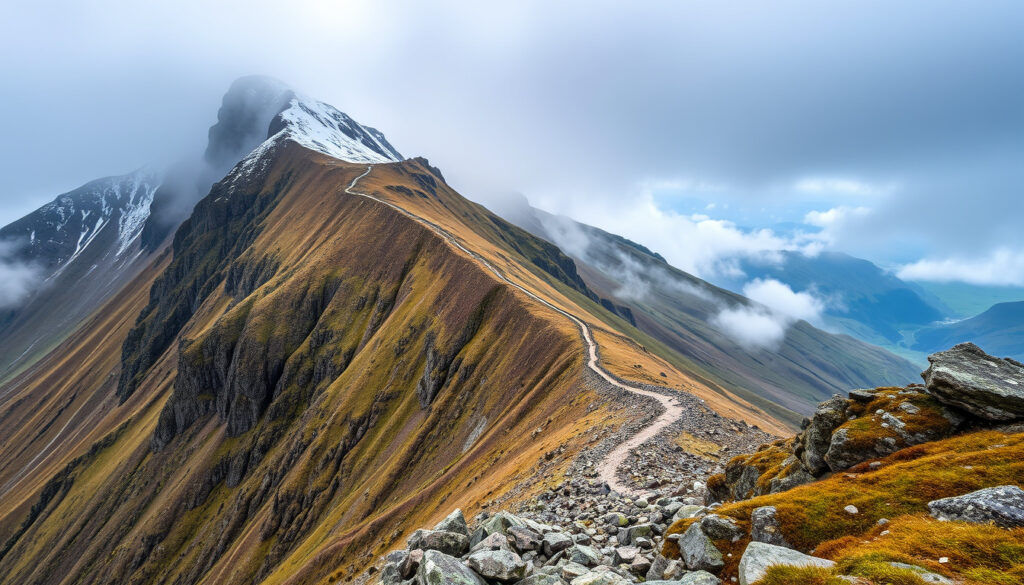
Ben Nevis Mountain: Climb, Difficulty, Death Rate & Records
Most Ben Nevis walkers need 7–9 hours for the 17 km Mountain Path round trip; race runners cover the same ground in 1:25:34. The mountain hosts more than 150,000 visitors a year, and that gap between tourist pace and record pace is the real planning fact: Ben Nevis rewards preparation, not impulse.
Height: 1,345 m (4,413 ft) · Location: Fort William, Scotland, UK · Annual visitors: 150,000+ · Typical round trip: 7–9 hours · Mountain Path distance: 17 km (10.5 miles) · Race record: 1:25:34 (Kenny Stuart, 1984)
Quick snapshot
- 1,345 m (4,413 ft) — highest point in the British Isles (Mountaineerin (climbing guide))
- Standard route: the Mountain Path from Glen Nevis (Ben-Nevis.com (Ben Nevis specialist))
- First recorded ascent in 1771 by James Robertson (Mountaineerin (climbing guide)) (Mountaineerin (climbing guide))
- The exact meaning of the Gaelic name Beinn Nibheis is debated
- No official annual death-rate statistic exists
- The verified age of the oldest climber is not centrally confirmed
- 1771 — first recorded ascent (Mountaineerin (climbing guide)) (RAW Adventures (hillwalking outfitter))
- 1883–1904 — summit observatory operated (RAW Adventures (hillwalking outfitter))
- 1984 — Ben Nevis Race record: 1:25:34 (Ben-Nevis.com (Ben Nevis specialist)) (RAW Adventures (hillwalking outfitter))
- Plan a 7–9 hour day on the Mountain Path (RAW Adventures (hillwalking outfitter))
- Check the mountain forecast before setting out
- Train with weighted hill walks first
Seven rows, one pattern: every planning fact about Ben Nevis points in the same direction — this is a serious mountain day, and the data rewards preparation.
| Height | 1,345 m (4,413 ft) |
| Location | Fort William, Scotland, United Kingdom |
| Mountain range | Grampian Mountains |
| Status | Highest mountain in the British Isles |
| First recorded ascent | 1771 by James Robertson |
| Main route | Mountain Path from Glen Nevis |
| Annual visitors | More than 150,000 |
How long does it take to climb the Ben Nevis?
The honest answer is a full day. Most guide authors frame the Mountain Path as a full-day commitment rather than a half-day hike (Press Hive (adventure features)), and the arithmetic backs them up: the round trip is roughly 17 km (10.5 miles) of walking with about 1,345 m of ascent. According to RAW Adventures (hillwalking outfitter), most walkers finish in 7 to 9 hours including stops.
- Round-trip distance: 17 km (10.5 miles)
- Total ascent: 1,345 m (4,413 ft)
- Typical round trip: 7–9 hours
- Fastest competitive round trip: 1:25:34
What is the quickest time someone has climbed Ben Nevis?
- The Men’s Ben Nevis Race record is 1:25:34, set by Kenny Stuart in 1984 (Ben-Nevis.com (Ben Nevis specialist)).
- The record is a competitive benchmark for fell runners, not a target for ordinary walkers.
The gap between 1:25:34 and a typical summit day shows how wide the difficulty band on Ben Nevis really is: the same mountain can be an athlete’s time trial or a first-timer’s full-day challenge, depending entirely on who is walking it.
Every hour saved on the way up is borrowed from somewhere else in the day: later starts mean less margin for weather and daylight, so plan a 7–9 hour block, not a summit sprint.
The implication: a realistic plan treats the ascent as a full-day block with a hard turnaround time.
Is Ben Nevis a difficult climb?
Ben Nevis is a strenuous hillwalk, not a technical rock climb: in good summer weather, the Mountain Path needs no ropes and involves no scrambling (Along Dusty Roads (travel blog)). What makes it demanding is the profile — 17 km of ground, 1,345 m of climbing, and upper slopes covered in loose stone. Travel guide Love from Scotland (travel guide) puts it plainly: moderate to strenuous rather than easy.
Can a beginner walk up Ben Nevis?
- Yes — with training, proper boots, a clear forecast, and enough daylight, a fit beginner can summit in summer via the Mountain Track (Press Hive (adventure features)).
- Hiking blog Trekking the Dream (hiking blog) goes further: the Mountain Track is the only route suitable for beginners.
- Most reasonably fit people who prepare properly can complete the climb (Love from Scotland (travel guide)).
Can a 60 year old climb Ben Nevis?
- Fit 60-year-olds climb Ben Nevis regularly; age alone is not a disqualifier.
- Guide authors note the walk is manageable for people who are mobile and adequately fit (Along Dusty Roads (travel blog)).
Can someone unfit climb Ben Nevis?
- An unfit walker should treat Ben Nevis as a training goal, not an impulse decision — distance, steepness, and rocky terrain can overwhelm novices even when the route itself is straightforward (Wandersomewhere (travel guide)).
Who is the oldest person to climb Ben Nevis?
Oldest-climber claims circulate online, but no central register verifies a record holder — treat any headline as anecdote, not data.
The identity and verified age of the oldest person to climb Ben Nevis are not centrally confirmed. The one precisely documented record on the mountain is the race clock: 1:25:34, set in 1984.
The pattern behind the difficulty answers is consistent: Ben Nevis sorts people by preparation, not by age label. A trained 60-year-old can enjoy the day; a strong but untrained 25-year-old can be humbled by it.
The implication: pick the Mountain Path, train for distance and ascent, and the difficulty question becomes a planning question.
Why is Ben Nevis so famous?
Ben Nevis is the highest mountain in Scotland, the United Kingdom, and the British Isles — there is no higher summit on the island group. That status alone would draw visitors; the mountain then added a scientific chapter when a working observatory opened at the summit in 1883 and operated until 1904. It also happens to be geologically dramatic: the peak is the remains of an ancient collapsed volcano (Press Hive (adventure features)).
- Height: 1,345 m (4,413 ft) — highest in the British Isles
- Location: western end of the Grampian Mountains, near Fort William (Mountaineerin (climbing guide))
- Annual visitors: more than 150,000
- Classification: a Munro — a Scottish peak over 3,000 feet
What type of mountain is Ben Nevis?
- Geologically, Ben Nevis is an ancient collapsed volcano, not a fault-block or fold mountain.
- It is a Munro, and the highest of Scotland’s Munros — which is why it holds a special place in Scottish hillwalking culture.
What country is Ben Nevis in?
- Ben Nevis is in Scotland, part of the United Kingdom.
- The Mountain Path starts in Glen Nevis, just outside Fort William, and is the route used by most walkers.
What this means for planning: the summit sits deep in the Highlands, so the climb should be the main event of a dedicated trip, not a casual add-on to a city break. The reward for making that commitment is the highest viewpoint in the British Isles.
Why is Ben Nevis called the venomous mountain?
The name comes from Scottish Gaelic, and one of the most repeated translations is “venomous mountain.” Whether that translation is actually correct is a separate question — the meaning of Nibheis is debated, and more than one interpretation is in circulation.
What does the Gaelic name Beinn Nibheis mean?
- In Scottish Gaelic, beinn means “mountain.”
- Nibheis is often translated as “venomous” or “malicious” — the source of the venomous mountain label.
- Another common interpretation is “mountain with its head in the clouds.”
- The precise etymology is uncertain, so both readings should be treated as possibilities, not settled fact.
The implication for visitors: if a guide tells you Nibheis definitely means “venomous,” enjoy the folklore — but know the translation carries a question mark. What is not in dispute is the mountain itself: 1,345 m of ground that rewards the same preparation whether you call it venomous or not.
What is the annual death rate on Ben Nevis?
Straight answer: no single official annual death-rate statistic is published for Ben Nevis. Deaths are rare relative to the 150,000+ visitors who climb each year, but they occur in most years, and the hazards show up in the same places: steep rocky ground, sudden weather change, cold exposure, and medical emergencies far from help.
- Slips and falls on steep, rocky sections
- Sudden weather deterioration and cold exposure
- Medical emergencies while several hours from the valley
Is Ben Nevis risky?
- On a clear summer day, the Mountain Path is manageable for a prepared walker.
- In winter, in cloud, or after a late start, the same path becomes a serious undertaking.
The variable that decides which Ben Nevis you get is the weather — and the mountain’s weather does not wait for permission.
Why is Ben Nevis so dangerous?
- OutdoorSCOT (hillwalking blog) warns that weather can deteriorate in minutes and that the summit plateau has steep cliff edges on three sides, invisible in cloud — even the main tourist path is not exempt from this risk.
Which mountain has killed most climbers?
- Mount Everest has the highest recorded death toll in absolute numbers.
- Annapurna and K2 are known for very high fatality rates relative to summit attempts (OutdoorSCOT (hillwalking blog)).
The takeaway for a Ben Nevis decision is not a death-rate headline — it is that conditions on the plateau are the one variable you cannot control, and the only reliable defense is preparation, good timing, and an early turnaround point.
The summit plateau looks flat on a map and feels flat underfoot — exactly what makes its cliff edges so brutal when the cloud drops to the ground.
The decision rule: if the plateau is in cloud or the forecast is unstable, treat the summit as optional.
How Ben Nevis’s risk compares with other famous peaks
Four mountains, one pattern: expedition peaks kill by altitude and objective danger, while the risk on Ben Nevis lives in weather and walker error — a distinction OutdoorSCOT (hillwalking blog) makes explicit in its safety analysis.
| Mountain | Profile | Risk context |
|---|---|---|
| Ben Nevis | Highest peak in the British Isles; standard walk-up via the Mountain Path | Around 150,000 visitors a year; deaths are rare relative to visitor numbers but occur in most years |
| Mount Everest | World’s highest peak; expedition climb | Highest recorded number of deaths in absolute terms |
| Annapurna | High-altitude expedition peak | Very high fatality rate relative to summit attempts |
| K2 | High-altitude expedition peak | Very high fatality rate relative to summit attempts |
What this means: comparing Ben Nevis to Annapurna or K2 is comparing different sports. The relevant benchmark for a walker is not altitude or expedition logistics — it is the gap between a clear forecast and a sudden change in the mountain’s mood.
Ben Nevis route specification: the Mountain Path
Ten rows, one pattern: everything a first-timer needs to visualize sits on a single path — no ropes, no scrambling, just a long day that needs legs and judgment.
| Route name | Mountain Path (also called the Tourist Path or Pony Track) |
| Start point | Glen Nevis, near Fort William |
| Distance (round trip) | 17 km (10.5 miles) |
| Total ascent | 1,345 m (4,413 ft) |
| Typical time | 7–9 hours including stops |
| Technical difficulty | No ropes or scrambling required in summer |
| Main hazards | Loose stones, steep upper slopes, rapid weather change |
| Summit remains | Ruins of the 1883–1904 observatory |
| First recorded ascent | 1771 by James Robertson |
| Race record | 1:25:34 by Kenny Stuart (1984) |
The implication: this is a route with a friendly name and an unfriendly profile — the Mountain Path is forgiving in its line, unrelenting in its totals.
Upsides and downsides of climbing Ben Nevis
Upsides
- No technical climbing, ropes, or scrambling in summer
- Maintained path with zig-zags that ease the steep sections
- Realistic summit goal for a reasonably fit walker who trains
- The reward is the highest viewpoint in the British Isles
Downsides
- 17 km and 1,345 m of ascent make it a serious leg workout
- Weather turns dangerous quickly, even on the main path
- A full 7–9 hour commitment before you add travel time
- The summit plateau hides cliff edges in cloud
The trade-off: Ben Nevis gives you a genuine mountain day without requiring mountaineering skills — but it charges that simplicity in distance, ascent, and weather that refuses to negotiate.
How to prepare for a Ben Nevis climb
- Train on hills, not treadmills. Build toward the distance and ascent of the Mountain Path itself — 17 km and 1,345 m — with a loaded daypack, and practice sustained climbing.
- Choose a clear-weather day. Check the mountain forecast, not just the Fort William town forecast, and be ready to cancel if cloud and wind are forecast on the plateau.
- Pack for four seasons. Waterproofs, warm layers, hat and gloves, map, compass or GPS, headtorch, food, and water for a 7–9 hour day.
- Start early and set a turnaround time. Agree in advance on the latest time you will turn back, and stick to it.
- Tell someone your plan. Leave your route and expected finish time with a contact in the valley — mountain rescue relies on that information.
Why this matters: every step on this list is cheap compared with the cost of a callout — preparation is the difference between a good story and a rescue statistic.
Ben Nevis timeline: four dates that shaped the mountain
Four dates, one pattern: Ben Nevis became famous for science and sport long before it became a bucket-list walk.
- — James Robertson makes the first recorded ascent (Mountaineerin (climbing guide))
- — Ben Nevis Observatory opens at the summit (RAW Adventures (hillwalking outfitter))
- — The summit observatory closes (RAW Adventures (hillwalking outfitter))
- — Kenny Stuart sets the Ben Nevis Race record of 1:25:34 (Ben-Nevis.com (Ben Nevis specialist))
The implication: the observatory years, not the height, are what turned Ben Nevis into a scientific landmark — and the race record keeps the mountain in the sporting calendar a century later.
Confirmed facts vs what’s unclear
Confirmed facts
- Ben Nevis is 1,345 m high and is the highest mountain in the British Isles (Mountaineerin (climbing guide)).
- The standard route is the Mountain Path from Glen Nevis (Ben-Nevis.com (Ben Nevis specialist)).
- The first recorded ascent was made in 1771 (Mountaineerin (climbing guide)).
What’s unclear
- Whether Nibheis truly means “venomous” — the translation is debated.
- Whether any official annual death-rate figure exists — no single statistic is published.
- Who holds the verified record for the oldest person to climb Ben Nevis — no central registry exists.
- Whether the Mountain Path counts as “easy” or “moderate to strenuous” — the answer depends on your fitness and the forecast.
The reading that reconciles both lists: the confirmed facts tell you what Ben Nevis is; the unclear items tell you which claims deserve skepticism — starting with the “venomous” translation and ending with any authority quoting a precise death rate.
What the experts say
The Mountain Track is moderate to strenuous rather than easy, and yet most reasonably fit people who prepare properly can finish the climb.
— Love from Scotland (travel guide)
In good weather the route is straightforward and needs no specialist gear — the challenge is the distance and the constant climb.
— Along Dusty Roads (travel blog)
Novices may still struggle with the day because distance, steepness, and rocky terrain take a toll even when the path is clear.
— Wandersomewhere (travel guide)
The Mountain Track is the beginner’s route, and the other ascents of Ben Nevis are a different league entirely.
— Trekking the Dream (hiking blog)
The pattern worth remembering: every one of these sources agrees the path is walkable — and every one adds a condition about fitness, weather, or distance. That combination is exactly what a first-timer should plan for.
The takeaway
Ben Nevis, at 1,345 m, is a challenge that respects preparation: train on hills, choose a clear-weather day, start early, pack for a day that feels like winter at the top, and set a hard turnaround time. For a first-timer in Fort William weighing whether to go for it, the decision is clear: invest a few weeks in leg fitness and a gear check, or treat the summit as a goal for next season — the mountain will still be there.
Related reading: Ben Nevis for Beginners · How Dangerous is Ben Nevis
scotlandlessexplored.com, lovefromscotland.co.uk, tripadvisor.com
Frequently asked questions
What should I pack for a Ben Nevis hike?
Waterproof jacket and trousers, warm layers, hat and gloves, sturdy boots, food and water for a 7–9 hour day, a map and compass or GPS, a headtorch, and a fully charged phone. The summit can feel like a different season from the valley, so pack as if winter might arrive by lunchtime.
Do I need a guide to climb Ben Nevis?
In summer, a guide is not required on the Mountain Path; the route is well defined and busy in season. A guide adds real value in winter conditions, for navigation practice, or if you are walking solo and want extra security.
What is the best time of year to climb Ben Nevis?
Late spring to early autumn gives the longest daylight and the mildest conditions. The real gatekeeper is the mountain forecast, not the calendar.
Can you climb Ben Nevis in winter?
Yes, but winter turns the Mountain Path into a serious mountaineering day: ice, snow, short daylight, and harsh wind. An ice axe, crampons, and navigation experience become necessary, and many walkers wisely choose a guided day instead.
How do I train for a Ben Nevis climb?
Train by walking hilly terrain with a loaded daypack, building toward the distance and ascent of the Mountain Path itself — 17 km and 1,345 m — and practice on shorter Scottish hills before committing to the full route.
Where does the Ben Nevis Mountain Path start?
At Glen Nevis, just south of Fort William. The path follows the glen before beginning its long zig-zag climb to the summit, and walkers should start early — the route is busiest on fine weekends.
More related posts
 Lee Byung-Hun: Squid Game, Scandals, Wife, Languages
 Derek Martin obituary: EastEnders actor dies aged 92
 Jane Leeves: English Actress – Biography and Career After Frasier
 Piper Rockelle: Age, Real Name, Rare Allergy, Nose Surgery, OnlyFans
 George Farmer: Former Parler CEO, Family, Net Worth & Biography
 Hayden Christensen: Why He Stopped Acting & Returned
 Benny Andersson’s Life After ABBA: Music, Marriage, and More