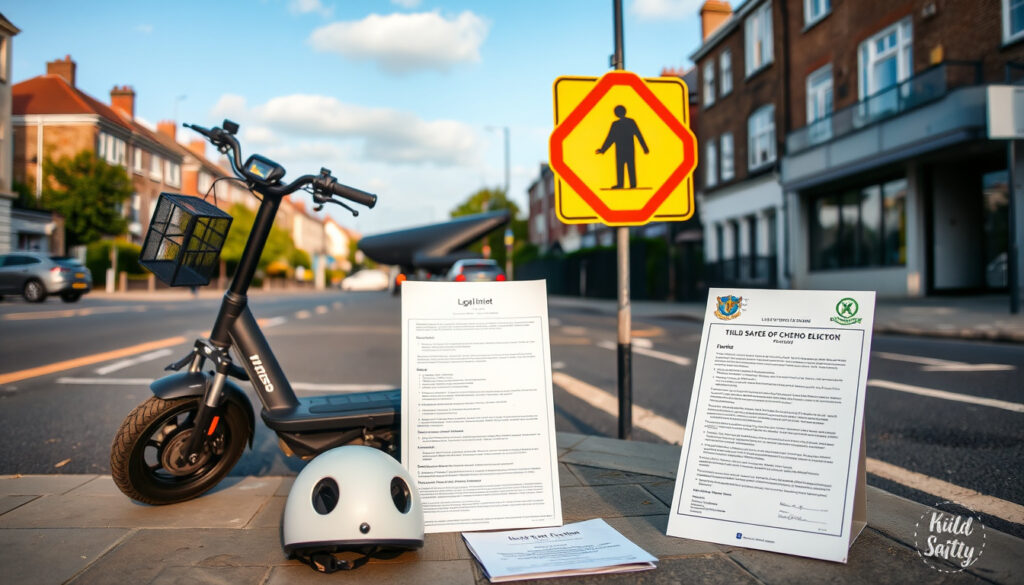
Electric Scooter Laws UK: Legal & Child Safety Guide
Any parent who has watched a 12-year-old race past on a rental scooter has probably wondered whether the law is on that kid’s side — or whether their own child would be safer on one. The honest answer is complicated: private e-scooters are illegal on UK roads, rental schemes carry strict age and licence rules, and Manchester’s children’s hospital recorded 477 e-scooter injuries in children between 2019 and 2024 (Manchester University NHS Foundation Trust (children’s hospital network)).
E-scooter seizures (London 2022): over 10,000 · Child share of e-scooter injuries: 30% (RoSPA) · Minimum rental age in the UK: 16 · Rental speed cap: 15.5 mph
Quick snapshot
- Private e-scooters are illegal on UK roads and in public spaces (UK Parliament (written answers))
- Rental schemes require riders to be at least 16 with a full or provisional licence (BBC News)
- Police warn that buying a private scooter enables a child to break the law (Hampshire & Isle of Wight PCC (police oversight body))
- Whether private e-scooter legalisation will ever arrive in the UK
- Long-term health effects of e-scooter vibrations on young joints
- Insurance coverage specifics for imported models like Kugoo and Ladped
- 2019–2024: child e-scooter injuries at one Manchester NHS trust rose from under 10 to almost 150 a year (Manchester University NHS Foundation Trust)
- November 2024: Parliament restates that private e-scooters remain illegal in public spaces (UK Parliament) (Manchester University NHS Foundation Trust)
- Until the law changes, private e-scooters stay off public roads and cycle lanes for all ages
- For legal road commuting, an e-bike becomes the better option from age 14
- Private e-scooter legalisation remains an open political question in the UK
Nine facts, one pattern: private and rental scooters sit on opposite sides of the law, and the penalties don’t care how old the rider is.
| Fact | What you need to know |
|---|---|
| Legal status of private scooters | Illegal on roads, pavements and public spaces (UK Parliament) |
| Where private scooters can be used | Private land only, with the landowner’s permission (BBC News (UK public broadcaster)) |
| Age for rental e-scooters | 16+, with a full or provisional driving licence (BBC News) |
| Rental speed limit | 15.5 mph under UK trial rules |
| Child injuries 2019–2024 | 477 at one Manchester NHS trust, rising from under 10 to almost 150 a year (Manchester University NHS Foundation Trust) |
| Common police action | Vehicle seizure and penalty points (Metropolitan Police, 2022) |
| Buying vs using | Legal to buy; illegal to use on public land (Hampshire & Isle of Wight PCC) |
| Primary buyer concern (search data) | Legality and child safety for ages 7–14 |
| Who is liable | The rider, regardless of age; parents may face legal responsibility (police guidance) |
Can I Legally Ride an Electric Scooter in the UK?
Start with the distinction that trips up most families: the private scooter you bought online is not the same as a rental scooter from a government-backed trial. The first is effectively an unregistered motor vehicle on public land; the second is a regulated service with insurance, age checks and speed limits built in.
- Private e-scooters are banned on public roads, pavements and cycle lanes; they can only be used on private land with the landowner’s explicit permission (BBC News).
- Buying a private e-scooter is legal; using it on a road or in a public space is not, because insurance is required and currently unobtainable for private devices (Hampshire & Isle of Wight Police and Crime Commissioner (local police oversight)).
- Rental e-scooters from approved trials may be used on public roads and cycle lanes, but only inside trial areas, and riders must be at least 16 with a full or provisional licence (BBC News).
Is it illegal for a 14 year old to ride an electric scooter?
- On private land, UK law sets no minimum age for riding a private e-scooter (Euronews (European news outlet)).
- On public roads, a 14-year-old on a private e-scooter is breaking the law in exactly the same way as an adult (UK Parliament).
- Rental schemes are off-limits: the minimum rental age is 16 (BBC News).
What happens if a child is caught on an electric scooter?
- The UK has no child exemption: a 14-year-old caught riding a private scooter on the road faces the same enforcement route as an adult, including penalty points and seizure (police enforcement guidance).
- Parents who bought the scooter can face legal responsibility for enabling the offence.
- Police and crime commissioners have issued explicit warnings, including a Hampshire campaign titled “Don’t buy an e-scooter and enable your child to break the law” (Hampshire & Isle of Wight PCC).
The pattern: the law draws a hard line between private and rental scooters — and age offers no protection once a scooter touches public land.
Will Police Stop Me on an Electric Scooter?
Enforcement is not theoretical. Metropolitan Police officers seized more than 10,000 e-scooters in London in 2022 (Metropolitan Police statement, 2022), and forces across the UK have said they actively target private riders on roads and pavements.
- Riders of private e-scooters risk a fine of up to £300, six penalty points on their driving licence, and the seizure of the scooter (police enforcement guidance).
- Rental e-scooters used outside approved trial areas lose their legal status and face the same enforcement (Hampshire & Isle of Wight PCC).
- Children are not exempt: the same laws apply to under-16s, and parents may be held responsible.
What are the penalties for riding an illegal e-scooter?
- Fine: up to £300
- Driving licence: six penalty points
- Vehicle: seized at the roadside
The Royal College of Emergency Medicine (UK emergency doctors) has also stated that private e-scooters are currently illegal for adults and children unless used on private land with the landowner’s permission.
Police don’t need a crash to act. With more than 10,000 e-scooters already seized in London in 2022, the officer’s decision on a first stop is usually seizure over warning.
Why this matters: the “harmless” five-minute ride to a friend’s house is exactly the scenario that ends with a seized scooter and a penalty notice.
What Is the Safest Electric Scooter for a 12-Year-Old?
Safety starts before the purchase. The safest e-scooters for a 12-year-old share three features: a top speed of 12–15 mph, dual braking, and 10-inch pneumatic tyres (child-safety buying guidance). The right model also keeps control in a parent’s hands.
- Head injuries are the most common injury among children using e-scooters, according to a 2023 report by the Child Accident Prevention Trust (child safety charity).
- The injury trend is moving the wrong way: analysis from Euronews reported the number of e-scooter injuries involving children soared 15-fold.
- Brands like Ladped sell scooters explicitly labelled for ages 7–14, but a label is not a safety certificate — parental supervision and speed restriction are strongly recommended.
Is it safe for a 13 year old to have an electric scooter?
- A 13-year-old cannot legally use a rental e-scooter; the minimum age is 16 (BBC News).
- UK law sets no speed limit and no safety-equipment requirement for private e-scooters, so the whole safety decision falls on the parent (BBC News).
- If the scooter stays on private land, the priorities are protective gear and a locked speed cap — not range or colour.
The safest scooter for a 12-year-old is the slowest one you can live with. With head injuries the most common child e-scooter injury, a speed limit you can actually lock is the closest thing to a safety net.
The trade-off: brands can label a scooter “7–14”, but no UK authority certifies those labels. The label is a starting point, not a safety certificate.
Should a 7 Year Old Have an Electric Scooter?
RoSPA’s guidance is unambiguous: children under 8 should not ride e-scooters because they are not yet able to judge speed and distance accurately. For most families, that rules out a 7-year-old on any powered scooter.
- If you are considering one for an 8-year-old, the spec sheet must include a low maximum speed (6–10 mph), a wide base, and a simple throttle mechanism (child-safety buying guidance).
- The Ladped LP80 is the model most searched for this age group, with adjustable speed settings.
- For a 7-year-old, a non-electric scooter remains the developmentally appropriate alternative.
What is the best electric scooter for an 8-year-old?
- Top speed: 6–10 mph — anything faster is effectively an adult scooter.
- Deck: wide enough for both feet with room to spare.
- Throttle: simple, and tuneable so the scooter does not leap when a child twists it.
- Speed settings: adjustable, so a parent can lock in a low ceiling (the Ladped LP80 offers this).
- Brakes: dual braking, because stopping distance matters more than top speed.
An 8-year-old on a scooter with adult speeds is predictable in the worst way. A 6–10 mph ceiling is the difference between a wobble and a hospital visit.
The implication: treat age labels as a ceiling. The right scooter for an 8-year-old is the one that forces the child to ride slowly.
Which is Better for Kids, an E-Scooter or an E-Bike?
The legal gap settles this comparison quickly. A private e-scooter cannot legally touch a UK road. An e-bike can, from age 14, if it meets the Electrically Assisted Pedal Cycles (EAPC) power standards. For any family that needs real road travel, the conversation is already over.
Five comparison points, one pattern: the e-bike starts on the road; the e-scooter ends at the garden gate.
| Factor | Private e-scooter | E-bike |
|---|---|---|
| Road legality | Illegal on roads and most public spaces (UK Parliament) | Legal from age 14 if EAPC-compliant (UK EAPC rules) |
| Minimum age | 16 for rental schemes; none on private land (BBC News) | 14 for road riding (UK EAPC rules) |
| Cost and weight | Generally lighter and cheaper | More expensive but road-legal |
| Stability | Smaller wheels, less stable | More stable, better at commuting speeds |
| Insurance and theft | No road insurance available; theft-prone | Insurable as a cycle; bulkier to secure |
Should I get my 12 year old an ebike?
- If the 12-year-old needs to travel on roads, an e-bike is the safer and legally sounder choice than a private e-scooter (child-safety buying guidance).
- The catch at 12: even an e-bike cannot legally be ridden on UK roads until age 14.
- For ages 12–13, the realistic options are a pedal bike, or a speed-capped e-scooter used only on private land.
The pattern: if the destination is down a public road, the e-scooter conversation ends before it starts — the e-bike wins by default.
What Are the Downsides of Electric Scooters?
Beyond the legal problem, e-scooters carry practical downsides that owners discover after the first week. The biggest are battery range, repairs, and theft.
- Range: most budget e-scooters deliver only 10–20 miles of realistic range.
- Repairs: imported brands like Kugoo and Ladped have limited official UK service networks.
- Theft: portability makes them targets, and standard home insurance rarely covers them.
- Legality: they cannot be ridden on the roads where the need is greatest.
Eight spec checks, one pattern: parent-friendly safety features matter more than headline speed.
| What to check | Recommended for children | Why it matters |
|---|---|---|
| Max speed | 12–15 mph for ages 12+; 6–10 mph for ages 7–8 | Matches a child’s ability to judge speed |
| Braking | Dual braking | Shorter stopping distance in emergencies |
| Tyres | 10-inch pneumatic tyres | Better grip and cushioning on uneven ground |
| Throttle | Simple, low-power throttle | Prevents accidental full power |
| Age label | Explicit label, e.g., Ladped LP80 (7–14) | Shows the manufacturer’s intended rider |
| Range | Budget models: 10–20 realistic miles | Sets expectations for actual use |
| App controls | Adjustable speed settings via app (Ladped) | Lets parents set and lock a safe ceiling |
| UK service network | Check for official service centres | Kugoo and Ladped have limited UK repair options |
What’s the best electric scooter you can buy?
- Kugoo models (S1, G4) are popular for range and speed — best for older teenagers riding on private land.
- Ladped scooters often include phone app connectivity, which helps parents set speed limits.
- The best scooter for your family is the one that is age-appropriate, speed-limited, and legally usable where the child will actually ride it.
Upsides
- Lighter and cheaper than e-bikes (buying guidance)
- Good for private-land fun with parental supervision
- Speed-limited models exist for younger riders (e.g., Ladped LP80)
- Portable and easy to store
Downsides
- Illegal on UK roads and most public spaces
- Under-16s cannot use rental schemes
- Limited UK repair networks for Kugoo and Ladped
- Theft-prone and rarely covered by home insurance
The takeaway: private e-scooters are powerful toys with real legal consequences — not commuter tools, until the law changes.
Confirmed facts
- Private e-scooters are illegal on UK roads and in public spaces (Royal College of Emergency Medicine)
- Rental e-scooters require a driving licence and are capped at 15.5 mph (BBC News)
- Police actively seize illegal e-scooters (Metropolitan Police, 2022)
- Children under 16 face the same legal risks as adults on private e-scooters (Royal College of Emergency Medicine)
What’s unclear
- Whether private e-scooter legalisation will arrive in the UK, and under what rules
- The long-term health effects of e-scooter vibrations on young joints
- Insurance coverage specifics for imported models like Kugoo and Ladped
- How consistently different police forces apply seizure and penalty policies
Three voices frame the debate: the regulator, the safety charity, and the police.
“Under the Road Traffic Act 1988, e-scooters used on public roads are treated as motor vehicles, which triggers insurance, licensing and enforcement rules — even when the rider is a child.”
“Children under eight should not ride e-scooters because they cannot judge speed and distance accurately enough to stay safe.”
RoSPA (Royal Society for the Prevention of Accidents)
“Officers seized more than 10,000 e-scooters in London in 2022 and continue to take action against riders using private scooters illegally on roads and pavements.”
Metropolitan Police statement (2022)
For UK families, the real choice is not between scooter brands; it is between legality and convenience. Buy a private e-scooter today and your child can ride it only on private land — anywhere else risks seizure, penalty points, and potentially a hospital visit. For parents who want road-legal electric transport for a teenager, the e-bike is the clear recommendation; for younger children, a speed-capped scooter on private land with a helmet is the compromise. For UK families shopping now, the decision is clear: keep private e-scooters off public roads, cap the speed, and treat the current law as the safety policy it is.
theguardian.com, citedrive.com, medscape.com, eurekalert.org, bbc.co.uk
Frequently asked questions
Do I need a licence to ride an e-scooter in the UK?
For rental e-scooters, yes: riders must be at least 16 and hold a full or provisional driving licence (BBC News). For a private e-scooter used only on private land, UK law does not require a licence.
Can I ride an electric scooter on private land?
Yes, with the explicit permission of the landowner (BBC News). The moment you ride on a public road, pavement, or cycle lane, you are breaking the law (UK Parliament).
What insurance covers an electric scooter?
Rental schemes include third-party motor insurance. Private e-scooters cannot currently be insured for road use in the UK, which is why riding one on public land is illegal (Hampshire & Isle of Wight Police and Crime Commissioner).
How do I lock an electric scooter safely?
Use a hardened D-lock through the frame and the rear wheel, lock the scooter to a fixed object, and take the battery or the scooter inside when you can. Portability makes e-scooters a target, and a flimsy cable lock is not enough — standard home insurance rarely covers theft away from home.
What type of electric scooter is best for a university commute?
If your campus is inside a rental trial zone, a rental e-scooter is the legal option. For private scooters, the honest answer is none — they are illegal on public roads. Students who need road transport should consider an e-bike, which is legal from age 14 under EAPC rules.
Can I road-legalize my private e-scooter in the UK?
Not currently. Using a private e-scooter on a public road requires insurance, and insurance cannot currently be obtained for private devices (Hampshire & Isle of Wight Police and Crime Commissioner). There is no registration or approval route for private e-scooters in UK law.
What is the best helmet for an electric scooter?
Any properly fitted cycle helmet certified to a recognised safety standard. UK trial schemes recommend helmets but do not legally require them (UK Parliament). For children, a helmet plus wrist and knee protection should be non-negotiable.
More related posts
 Chrissy Teigen: Family, Sobriety, and Public Apology
 Vivienne Westwood: Net Worth, Queer Legacy & Controversy
 Arden Cho Movies and TV Shows: Complete Roles List
 Lee Chae-Min: Age, Height, Relationship, and Career Facts
 Rag’n’Bone Man: Biography, Net Worth, Relationship, and More
 Alexander Isak: Biography, Stats, Height, Languages, and More
 Premier African Minerals Share Price: Buy, Sell, or Hold?
 Ghosts Cod: Why Call of Duty: Ghosts Flopped & Who Ghost Is