Mad Hatter: Meaning, Symbolism, and Real Origins
Few characters from children’s literature still spark as much curiosity as the Hatter who never leaves his tea party, yet he gets mentioned alongside a real Victorian workplace illness, a Batman villain, and a costume-shop favorite — which raises an obvious question: who actually is the Mad Hatter? The answer separates the 1865 original from the mercury-poisoning backstory, the movie makeovers, and the DC Comics villain who shares his name.
First appearance: 1865 ·
Original author: Lewis Carroll ·
Looking-Glass name: Hatta ·
Hat card price: 10 shillings, 6 pence ·
Tea-party time: Permanently 6 o’clock ·
DC Comics identity: Jervis Tetch
Mad Hatter: Meaning, Symbolism, and Real-World Origins
Quick snapshot
- The Hatter hosts the Mad Tea-Party in Chapter 7, where it is always tea-time (LitCharts (chapter study guide)).
- Through the Looking-Glass calls him Hatta (SparkNotes (literature study guide)).
- John Tenniel’s original illustration shows a hat card reading 10/6 (Encyclopaedia Britannica (reference publisher)).
- The phrase “mad as a hatter” was already in British culture before Carroll’s book, according to some historical accounts (ebrary.net (online reference library)).
- Whether Carroll modelled the Hatter on a specific real person is not documented (Discover Magazine (science magazine)).
- What answer Carroll intended for “Why is a raven like a writing-desk?” remains unknown (LitCharts (chapter study guide)). (Discover Magazine (science magazine))
- The exact origin of “mad as a hatter” is debated by historians (ebrary.net (online reference library)). (Discover Magazine (science magazine))
- The “true dark meaning” of Alice in Wonderland is speculative — Carroll never stated one (TheCollector (art and culture site)).
- 1865: The Hatter appears in Alice’s Adventures in Wonderland (History.com (history education site)).
- 1871: Through the Looking-Glass calls him Hatta (SparkNotes (literature study guide)). (History.com (history education site))
- 1951: Disney’s animated film makes him a mass-market icon (Disney Wiki (fan wiki covering Disney adaptations)).
- 1958: DC Comics introduces Jervis Tetch as a Batman villain (Encyclopaedia Britannica (reference publisher)). (History.com (history education site))
- 2010: Tim Burton’s film casts Johnny Depp as a sympathetic Hatter (Disney Wiki (fan wiki covering Disney adaptations)). (History.com (history education site))
- The literary Hatter, the DC villain, and the film versions now read as separate characters sharing one name (Encyclopaedia Britannica (reference publisher)).
- Ask “which Mad Hatter?” before assuming a single personality or origin story (TheCollector (art and culture site)).
- The mercury history explains a real workplace illness — it does not define the fictional tea party (History.com (history education site)).
Six facts anchor every conversation about the Hatter, and the pattern is that the two most-quoted details — 10/6 and 6 o’clock — are also the ones people explain wrong.
| Fact | Detail |
|---|---|
| First appearance | 1865 |
| Author | Lewis Carroll |
| Looking-Glass name | Hatta |
| Hat card price | 10 shillings, 6 pence |
| Tea-party time | Always 6 o’clock |
| DC Comics identity | Jervis Tetch |
What does being a Mad Hatter mean?
Being called a “Mad Hatter” usually means someone is eccentric, unpredictable, or creatively unhinged. The idiom “mad as a hatter” was already circulating in British English before Carroll used it, and it was tied to the hat-making trade, where workers handled mercury compounds that could damage the nervous system (History.com (history education site)).
The Hatter in the novel is not a raving madman. He is rude, forgetful, and armed with a twisted internal logic: he asks unanswerable riddles, corrects Alice’s grammar, and treats the Queen’s rules as optional. Character analysis describes him as mentally idiosyncratic rather than clinically defined — his logic is distorted but internally coherent (SparkNotes (literature study guide)).
What is a Mad Hatter personality?
- Talks in non-sequiturs, shifting from tea to time to tarts without warning (SparkNotes (literature study guide)).
- Breaks social rules cheerfully and treats the endless tea party as a perfect arrangement (LitCharts (chapter study guide)).
- Turns personal grievances into cosmic events, as when “Time” refuses to do what he asks (LitCharts (chapter study guide)).
- Reads as cultural shorthand for eccentricity, unpredictability, and unconventional behavior (Encyclopaedia Britannica (reference publisher)).
That last point explains why the personality label stuck. A Hatter-like person is entertaining at a party, terrible with schedules, and impossible to pin down — the opposite of Victorian respectability.
What is Mad Hatter’s full name in Alice in Wonderland?
- No first or last name in Alice’s Adventures in Wonderland — he is simply “the Hatter” (LitCharts (chapter study guide)).
- Through the Looking-Glass calls him Hatta (SparkNotes (literature study guide)).
- The DC Comics version, Jervis Tetch, is a 20th-century invention, not a Carroll name (Encyclopaedia Britannica (reference publisher)).
One possible real-world model is Theophilus Carter, an Oxford furniture dealer known for odd behavior and a habit of wearing a top hat; Carroll reportedly knew him (Discover Magazine (science magazine)). The connection is circumstantial — no letter or diary from Carroll confirms it. Some historical overviews also suggest that the phrase “mad as a hatter” was already present in British culture before the story’s publication, which means Carroll picked up a folk saying and turned it into a character rather than inventing the idiom himself (ebrary.net (online reference library)).
What does “mad hatter” symbolize?
The Hatter symbolizes the refusal of conventional logic. In Wonderland, he does not adapt to the world; the world is supposed to adapt to him. Cultural critics read him as a symbol of Victorian irrationality, nonsense, and the instability of adult logic (TheCollector (art and culture site)).
Who is the Mad Hatter in Alice in Wonderland?
- Host of the Mad Tea-Party in Chapter 7, where it is always 6 o’clock (LitCharts (chapter study guide)).
- One of the few Wonderland residents who openly argues with Alice and mocks her reasoning (SparkNotes (literature study guide)).
- Part of a trio with the March Hare and the Dormouse, sharing one collective “madness” (LitCharts (chapter study guide)).
- Broadly recognized through John Tenniel’s illustration and later Disney designs (Disney Wiki (fan wiki covering Disney adaptations)).
That last point matters for the symbolism. The oversized top hat, the card reading 10/6, and the permanent tea spread are so visually strong that every adaptation — Disney’s animation, Tim Burton’s live-action film, even Halloween costumes — keeps them intact.
What is the Mad Tea Party’s role in Alice in Wonderland?
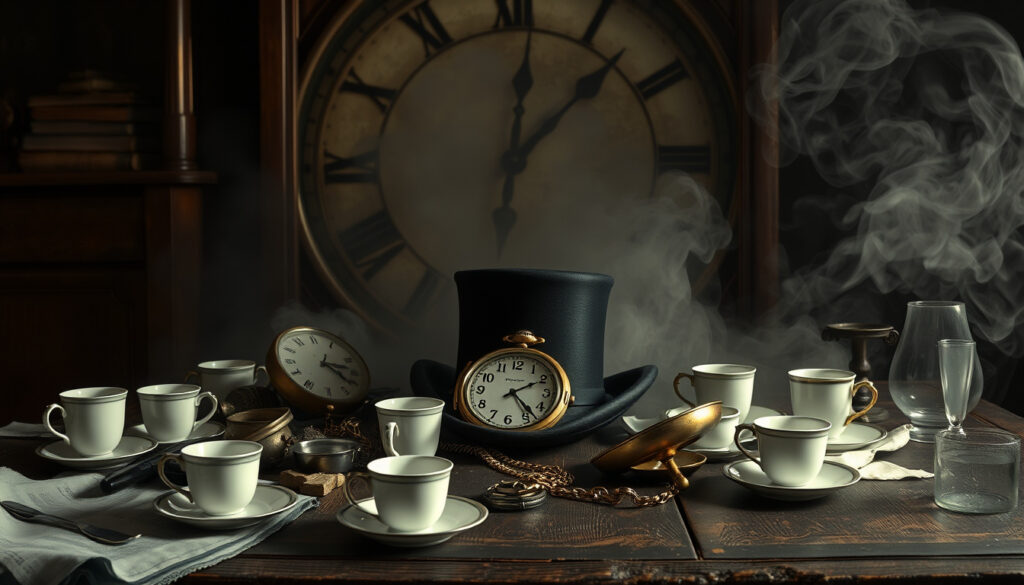
- It is permanently 6 o’clock because the Hatter’s watch is stuck (LitCharts (chapter study guide)).
- It satirizes Victorian etiquette by pushing it to absurd limits: endless dirty cups, rotating seats, and no cleaning up (TheCollector (art and culture site)).
- The “unbirthday” motif, which Disney later made famous, celebrates anything except the socially prescribed occasion (Disney Wiki (fan wiki covering Disney adaptations)).
The tea party is the Hatter’s great set piece, and some literary critics add an empathy reading: his “madness” is eccentricity rather than menace, a refusal to perform respectability on schedule. For Wonderland, that is the point — the tea party only makes sense if you stop measuring it against the outside world.
The Hatter is not a warning about madness. He is an argument for a different kind of sanity: a tea party frozen at 6 o’clock where rules are suggestions.
What mental illness does the Mad Hatter represent?
The short answer: none, clinically speaking. The Mad Hatter is a literary character, not a diagnostic label. But the reason people ask is real — Victorian hat makers really did go mad, and the symptoms were specific enough to earn their own name.
Is the Mad Hatter based on mercury poisoning?
- 18th- and 19th-century hat makers used mercury nitrate to turn fur into felt, and chronic exposure caused tremors, speech problems, emotional instability, and hallucinations — a cluster that became known as the “hatter’s shakes” (History.com (history education site)).
- A peer-reviewed paper describes the Wonderland Hatter as “conventionally understood as a mercury-poisoned hatter” (American Journal of Industrial Medicine (occupational-health journal)).
The novel itself never mentions mercury or hat-making labor. The connection is historical and linguistic: the idiom predates the book, Carroll placed a hatter at the tea table, and the inference did the rest.
What is erethism in hat makers?
- Erethism is the medical term for the neurological syndrome caused by chronic mercury poisoning (American Journal of Industrial Medicine (occupational-health journal)).
- Its hallmarks: mood swings, irritability, tremors, and hallucinations (American Journal of Industrial Medicine (occupational-health journal)).
- The first published description of mercurialism in hatters was written by J. Addison Freeman, M.D. (American Journal of Industrial Medicine (occupational-health journal)).
Real hatters in Victorian workshops faced exactly that risk, and the condition became shorthand for the trade’s toll. That cultural memory — not a clinical diagnosis of a fictional character — is what the Mad Hatter carries with him.
If you read the Hatter’s quirks as mercury poisoning, you are importing a real workplace illness into a fantasy character who never mentions it. The medical history explains the idiom, not the tea party.
The distinction matters: the mercury story is documented history, while the Hatter’s behavior is invented personality. For readers researching the character, the two should never be fused into one diagnosis.
In other words, the Hatter’s tea party belongs to fiction, and the hatter’s shakes belong to the history of labor; conflating the two is how a fantasy character becomes a medical legend.
Why is Mad Hatter a villain?
In Carroll’s books, the Hatter is not a villain — he is an eccentric host who breaks the rules of logic. The villain version is a DC Comics invention. DC’s Mad Hatter is Jervis Tetch, a scientist obsessed with Alice in Wonderland who uses hats fitted with mind-control technology (Encyclopaedia Britannica (reference publisher)).
Who is the Mad Hatter in Batman?
- First appeared in the Batman comic universe in 1958 (Encyclopaedia Britannica (reference publisher)).
- Real name: Jervis Tetch, a brilliant but unstable scientist (Encyclopaedia Britannica (reference publisher)).
- Weapon of choice: high-tech hats that control other people’s minds (Encyclopaedia Britannica (reference publisher)).
- Treats Wonderland as a private fantasy that real people must be forced to join (Disney Wiki (fan wiki covering Disney adaptations)).
Because Batman fights a gallery of twisted professionals, Tetch fits the “mad scientist” archetype. His Wonderland obsession reads as pathology: he quotes the books while committing crimes, and each adaptation finds a new way to make the tea party sinister.
What is Mad Hatter’s full name in DC Comics?
- Jervis Tetch — the surname invites a pun on “tetchy,” meaning irritable (Encyclopaedia Britannica (reference publisher)).
- Debuted in 1958 and has appeared across Batman comics, animation, and live-action series ever since (Encyclopaedia Britannica (reference publisher)).
- Unlike Carroll’s mostly harmless eccentric, the DC version kidnaps and controls victims (Encyclopaedia Britannica (reference publisher)).
The pattern: as the Hatter moved from Wonderland to Gotham, his eccentricity hardened into criminality. Carroll’s Hatter confuses tea parties; DC’s Hatter files them under obsession.
Why does it say 10/6 on the Mad Hatter’s hat?
The card in the Hatter’s hat reads “10/6,” which is not a date and not a time. It is a price tag: ten shillings and sixpence, a common price for a hat in Victorian Britain (LitCharts (chapter study guide)). John Tenniel’s original illustration made the card famous, and every major adaptation has kept it.
Why is it always 6 o’clock at the Mad Hatter’s Tea Party?
- The Hatter’s pocket watch is stuck at 6 o’clock (LitCharts (chapter study guide)).
- He explains in Chapter 7 that Time “won’t do a thing I ask” after their quarrel (LitCharts (chapter study guide)).
- Stuck at teatime, the party can never end, and the hosts keep rotating around the table to find clean cups (LitCharts (chapter study guide)).
Alice reads the Hatter’s refusal to treat time objectively as a sign of madness; the distinction is the same one that makes the tea party so unsettling. The Hatter treats time as a personal enemy rather than a measurable constant. In that sense, the frozen watch is the whole character — brilliant, trapped, and convinced the universe owes him a better hour.
What is the Mad Hatter’s hat called?
- A top hat, drawn by John Tenniel as an exaggerated, comically tall tower (Encyclopaedia Britannica (reference publisher)).
- The price card reading 10/6 is pinned to the band (LitCharts (chapter study guide)).
- No special name appears in Carroll’s text — its identity is visual (LitCharts (chapter study guide)).
Fans and costume-makers call it simply a top hat or a “topper.” The iconography is so strong that the hat often represents the Hatter even when the rest of the costume changes.
What was Mad Hatter’s famous line?
The most famous line attached to the Mad Hatter is not his: “We’re all mad here” is spoken by the Cheshire Cat. The sentence people quote about being “entirely bonkers” comes from a 2010 film script, not from Carroll. The Hatter’s actual signature — his riddle — has no answer at all.
What was the Mad Hatter’s riddle?
- “Why is a raven like a writing-desk?” — asked at the tea party in Chapter 7 (LitCharts (chapter study guide)).
- No answer appears in Carroll’s text (LitCharts (chapter study guide)).
- Carroll reportedly said he had no intended answer (LitCharts (chapter study guide)).
The riddle works precisely because it is unsolvable: it parodies the Victorian passion for riddles and tests, and the Hatter expects a response that never comes.
Why is a raven like a writing desk?
- Canonical answer: none (LitCharts (chapter study guide)).
- Many proposed answers exist, but none is authoritative (LitCharts (chapter study guide)).
- Carroll reportedly said the riddle had no intended answer (LitCharts (chapter study guide)).
Because there is no canonical answer, the question keeps generating new ones. That is exactly what the Hatter would want: a conversation that never has to end.
Who said ‘We’re all mad here’ in Alice in Wonderland?
- The Cheshire Cat, in Chapter 6 — not the Hatter (LitCharts (chapter study guide)).
- The quote is often absorbed into the Hatter’s public image (TheCollector (art and culture site)).
- The 2010 film added the “Have I gone mad?” / “All the best people are” exchange, which fans now treat as canon (Disney Wiki (fan wiki covering Disney adaptations)).
The 2010 exchange runs: “Have I gone mad?” / “I’m afraid so. You’re entirely bonkers. But I’ll tell you a secret. All the best people are.” It was written for the film, not for Carroll, and it redefined the Hatter for a generation.
The Hatter’s most-quoted lines are the ones he never said. When a character becomes an archetype, the collective memory rewrites his dialogue.
What is the true dark meaning of Alice in Wonderland?
There is no single agreed “true” dark meaning. Readers have read the book as a drug allegory, a trauma narrative, a Victorian education satire, and a logic puzzle. The reading with the most direct textual support is the one Carroll actually packed into the story: layers of mathematical and logical in-jokes that reward careful rereading.
What is rule 42 in Alice in Wonderland?
- At the trial, the King of Hearts reads Rule 42: “All persons more than a mile high to leave the court” (Encyclopaedia Britannica (reference publisher)).
- The rule is aimed squarely at Alice, who has grown to a towering size (Encyclopaedia Britannica (reference publisher)).
- It is a perfect example of Wonderland “law”: arbitrary, self-serving, and instantly bendable (TheCollector (art and culture site)).
The trial scene sums up the book’s dark edge: authority is theatrical, evidence is nonsense, and the only sensible response is to walk away before someone’s head rolls.
Why is Alice in Wonderland considered dark?
- Dark readings range from mental illness and addiction to Victorian social critique (TheCollector (art and culture site)).
- Carroll also embedded mathematical and logical jokes, which are not dark at all (TheCollector (art and culture site)).
- No single reading has ever won universal agreement — Carroll left no definitive interpretation (TheCollector (art and culture site)).
The Hatter fits into the dark readings only because he refuses to acknowledge the passage of time. That makes him funny in one scene and unsettling in the next. Why this matters: no single dark meaning beats the one Carroll actually left behind — a world where rules are arbitrary and tea is forever.
Alice’s Hatter vs. DC’s Mad Hatter vs. the film Hatter
Three versions of the Hatter, one pattern: each era rewrites him to fit its own fears — Victorian nonsense, superhero pathology, and blockbuster sentiment.
| Dimension | Literary Hatter (1865) | DC’s Jervis Tetch (1958) | Tim Burton’s Hatter (2010) |
|---|---|---|---|
| Identity | No first name; called Hatta in Through the Looking-Glass | Jervis Tetch, a scientist obsessed with Alice in Wonderland | Johnny Depp as a sympathetic outcast |
| Motivation | Host an endless tea party and ask unanswerable riddles | Control minds and force others into a Wonderland fantasy | Help Alice on her journey |
| Threat level | None — rude, not dangerous | High — kidnaps and controls victims | None — an ally |
Read across the rows, one pattern emerges: the literary Hatter is a thought experiment, the DC Hatter is a weapon, and the film Hatter is a heart. The same top hat carries three completely different stories.
Timeline: from 1865 to Tim Burton
Five dates mark the Hatter’s biggest reinventions.
- — The Hatter appears at the Mad Tea-Party in Alice’s Adventures in Wonderland (History.com (history education site)).
- — Through the Looking-Glass calls him Hatta (SparkNotes (literature study guide)).
- — Disney’s animated Alice in Wonderland brings the Hatter to a mass audience (Disney Wiki (fan wiki covering Disney adaptations)).
- — DC Comics introduces Jervis Tetch as a Batman villain (Encyclopaedia Britannica (reference publisher)).
- — Tim Burton’s film casts Johnny Depp as a more sympathetic Hatter (Disney Wiki (fan wiki covering Disney adaptations)).
What the timeline shows: the Hatter started as a side character in a children’s book, became a symbol, then a villain, then a leading man. The only constant is the hat.
Confirmed facts vs. open questions
The sourced claims above appear in detail throughout this article; the split between “confirmed” and “unclear” is what separates the record from speculation.
Confirmed facts
- Lewis Carroll published Alice’s Adventures in Wonderland in 1865, and the Hatter appears in it (History.com (history education site)).
- Through the Looking-Glass calls him Hatta (SparkNotes (literature study guide)).
- John Tenniel’s illustration shows a price tag reading 10/6 (LitCharts (chapter study guide)).
- DC’s Mad Hatter is named Jervis Tetch and uses mind-control headgear (Encyclopaedia Britannica (reference publisher)).
What’s unclear
- Whether Carroll based the Hatter on a specific real person (Discover Magazine (science magazine)).
- What answer Carroll intended for “Why is a raven like a writing-desk?” (LitCharts (chapter study guide)).
- The exact origin of the phrase “mad as a hatter” (ebrary.net (online reference library)).
- Any single “true dark meaning” of Alice in Wonderland (TheCollector (art and culture site)).
The trade-off: verified details give the character texture, but the unresolved questions are what keep people arguing about him.
The lines people remember (and misremember)
Three quotes define the Hatter in popular memory. Two of the three don’t belong to him.
Why is a raven like a writing-desk?
— The Hatter, Alice’s Adventures in Wonderland, Chapter 7 (LitCharts (chapter study guide))
We’re all mad here.
— Cheshire Cat, Alice’s Adventures in Wonderland, Chapter 6 (TheCollector (art and culture site))
All persons more than a mile high to leave the court.
— King of Hearts, Alice’s Adventures in Wonderland, trial scene (Encyclopaedia Britannica (reference publisher))
Three speakers, three roles: the riddler, the philosopher, and the judge. The Hatter owns only the first; the other two lines wandered into his legend because they sound exactly like something he might say.
Why the separation matters
Separating the literary Hatter from the mercury story and the DC villain is not pedantry; it changes what the character means. For anyone researching the Mad Hatter today, the choice is clear: read Carroll’s tea-party host as an invented eccentric with a real occupational-history backdrop, or you will keep importing a Victorian workplace illness into a character who never mentions it.
alice-in-wonderland.net, about.openlibhums.org, en.wikipedia.org
Frequently asked questions
Is the Mad Hatter based on a real person?
No specific person is documented. Theophilus Carter, an Oxford eccentric known for wearing a top hat, is sometimes mentioned as a possible model, but the evidence is circumstantial (Discover Magazine (science magazine)).
What is the history of the phrase “mad as a hatter”?
The phrase was already present in British English before Carroll’s book, and it is linked to the hat-making trade, where mercury exposure caused tremors, confusion, and personality changes (History.com (history education site)).
Does mercury poisoning affect hat makers today?
Commercial hat-making has moved away from the mercury-based processes of the 18th and 19th centuries. Chronic mercury poisoning is still sometimes called “Mad Hatter’s disease” in medical history (Discover Magazine (science magazine)).
What is the Mad Hatter’s role in Alice’s Adventures in Wonderland?
He hosts the Mad Tea-Party with the March Hare and the Dormouse, asks the raven-and-writing-desk riddle, and later appears at the trial. He is rude, illogical, and one of the book’s most memorable rule-breakers (LitCharts (chapter study guide)).
Why does the Mad Hatter carry a pocket watch?
His watch is stuck at 6 o’clock — permanently tea-time. He tells Alice that Time stopped working for him after they quarreled, so the party never ends (LitCharts (chapter study guide)).
Which actors have played the Mad Hatter in live-action?
The best-known live-action Hatter is Johnny Depp in Tim Burton’s 2010 film. Other stage and screen productions have featured their own versions, but Depp’s remains the most widely recognized (Disney Wiki (fan wiki covering Disney adaptations)).
If a question is missing, apply the same rule the article uses: ask “which Hatter?” first, then decide whether the answer comes from Carroll, DC, or the history of mercury.
Related reading
More related posts
 Nick Cannon: Children, Health & Net Worth 2025
 Flowers Next Day Delivery in Ireland: Compare Best Options
 M&S Christmas 2024 – Ad Series, Foods and Key Dates Guide
 Euan Blair Net Worth: Multiverse CEO Facts
 Jonathan Ross: Wife, Children, Banishment, and Key Life Facts
 Tesco Mobile Phones Clearance – Best Deals on iPhone and Samsung
 Miriam Stoppard: Biography, Age, Books, Net Worth, and Family
 Bible Verse Guide: Powerful Verses for Today, Strength, and Life