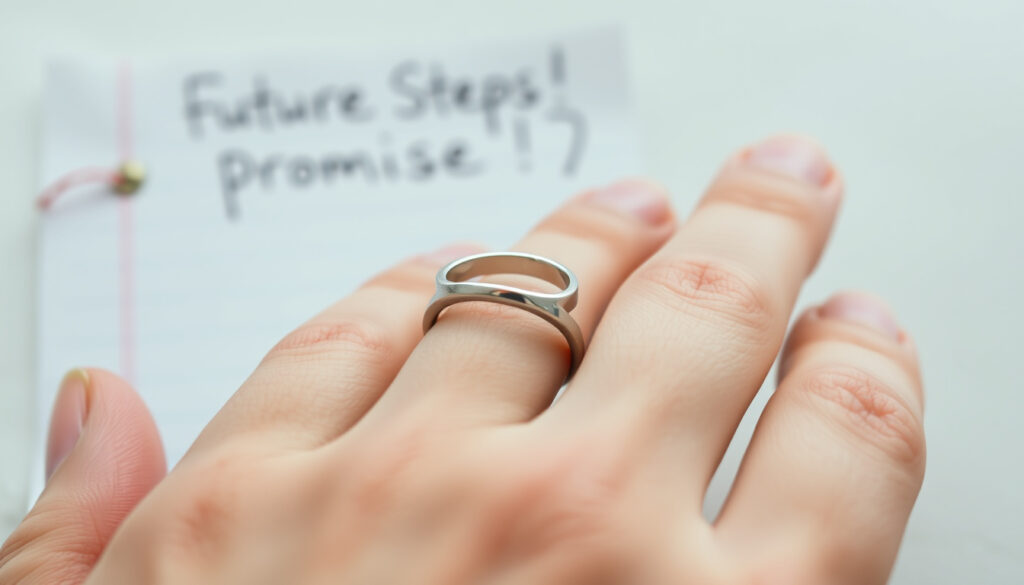
Promise Ring Meaning: Finger, Rules, and Next Steps
Few jewelry items carry as much emotional weight with as little definition as the promise ring, a token of love that sits somewhere between a casual gift and an engagement ring, and its meaning is entirely up to the couple. Whether you’re thinking of giving one or just curious about the tradition, this guide walks through the unwritten rules, cultural variations, and what actually happens after the ring goes on.
Primary meaning: Symbol of commitment and love ·
Typical placement: Left ring finger (or right ring finger) ·
Common timing: Given before engagement, often 1–2 years into relationship ·
Kneeling practice: Sometimes done, not required
Quick snapshot
- Token of love and commitment (Brilliant Earth (jewelry educator))
- Often given before engagement (Pandora US (jewelry brand))
- Can be any style or material (Gabriel & Co. (jewelry designer))
- Left ring finger is traditional (The Knot (wedding planning resource))
- Right hand used to avoid confusion (JCPenney Editorial (retail guide))
- Kneeling is optional (LoveToKnow (relationship advice platform))
- No strict rules, but common customs exist (LoveToKnow (relationship advice platform))
- Timing: usually 1–2 years into relationship (Pandora US (jewelry brand))
- Cost varies widely (Whiteflash (diamond retailer))
- Often leads to engagement (Gabriel & Co. (jewelry designer))
- Not a guarantee of marriage (Brilliant Earth (jewelry educator))
- Cringey factor depends on maturity (LoveToKnow (relationship advice platform))
Five key facts about promise rings at a glance:
| Meaning | Symbol of commitment and love |
|---|---|
| Typical finger | Left ring finger |
| Common timing | 1–2 years before engagement |
| Cost range | $100 – $500 (varies) |
| Kneeling | Sometimes done, not required |
What is the meaning of a promise ring?
Symbol of commitment
A promise ring is a token of love and commitment given in a romantic relationship, often before an engagement. According to Brilliant Earth (jewelry educator), there is no universal definition—the meaning is defined by the couple. It can symbolize loyalty, devotion, exclusivity, or a promise to marry someday, without the immediate expectation of wedding planning.
Pre-engagement versus friendship
While many couples use promise rings as a pre-engagement milestone, the symbol isn’t limited to romance. Gabriel & Co. (jewelry designer) notes that promise rings are sometimes chosen for personal vows unrelated to marriage, including friendship commitments or self-promises. The key is that the meaning is socially negotiated rather than fixed.
Cultural variations (e.g., Claddagh ring)
In Irish culture, the Claddagh ring serves as a promise ring of sorts—its orientation (heart facing toward or away from the body) indicates relationship status. The Knot (wedding planning resource) explains that promise rings can be exchanged by either partner, not only by men proposing to women, which adds to their flexibility as a symbol.
A promise ring’s meaning is as broad as the couple’s agreement. That flexibility makes it a powerful milestone—but it also means the ring’s significance must be explicitly discussed, not assumed.
The implication: A promise ring is not a legally binding contract, it’s a personal declaration. Its power comes from the conversation, not the ring itself.
Which finger gets a promise ring?
Left ring finger tradition
The most common placement for a promise ring is the left ring finger—the same finger as an engagement ring. Brilliant Earth (jewelry educator) states that many couples choose this finger to signal seriousness without jumping to an engagement.
Right hand alternatives
To avoid confusion with an engagement ring, some people wear the promise ring on the right hand. Pandora US (jewelry brand) notes that the ring can be moved to the left hand later if an engagement follows. This practical approach keeps the promise ring distinct from a formal engagement ring.
Finger choice based on culture
In some cultures, the right hand is the traditional side for commitment rings. For example, in many Eastern European countries, wedding rings are worn on the right hand, so a promise ring there might also go on the right. JCPenney Editorial (retail guide) explains that the choice is personal and should reflect the couple’s comfort.
What this means: There is no wrong finger, but the left ring finger carries the strongest signal of romantic intent. If you want to avoid raising eyebrows, consider the right hand or a different finger.
What are the rules for a promise ring?
When to give
There is no fixed timeline, but common practice suggests giving a promise ring after the relationship has matured—typically 1–2 years in. Pandora US (jewelry brand) notes that promise rings are often given earlier in a relationship than engagement rings, but still after a serious commitment has been established.
How to give (kneeling? mid-sentence?)
Kneeling is optional. LoveToKnow (relationship advice platform) describes promise ring etiquette as informal because the symbol depends on the couple’s agreement rather than a fixed tradition. Some people kneel, others give the ring in a casual conversation. The gesture should match the tone of the relationship.
Cost expectations
Promise rings are generally less expensive than engagement rings. Whiteflash (diamond retailer) notes that there is no single universal rule for what promise rings must mean, and the same applies to cost—most fall between $100 and $500, but some spend more for sentimental reasons.
Etiquette
No strict rules, but common customs exist: the ring should be given with a clear explanation of what it means, and both partners should agree on the symbolism. The Knot (wedding planning resource) emphasizes that the true meaning of a promise ring is commitment, so the conversation matters more than the ring itself.
Because promise rings have no standardized rules, they can be misinterpreted. A partner who expects a proposal may be disappointed, while a partner who sees the ring as a casual gift may feel pressured. Clear communication is the only rule that matters.
The trade-off: The lack of rules gives couples freedom, but it also means they must define the ring’s meaning together—or risk mismatched expectations.
What comes next after a promise ring?
Engagement
For many couples, the promise ring is a stepping stone to an engagement. Brilliant Earth (jewelry educator) explains that an engagement ring is a formal declaration of intent to marry, while a promise ring is a less binding commitment. The transition often happens when the couple feels ready to plan a wedding.
Marriage
A promise ring does not guarantee marriage. Gabriel & Co. (jewelry designer) notes that the meaning of a promise ring can range from love and loyalty to a promise to marry someday, but it’s not a contract. Some couples move from promise ring to marriage without a formal engagement ring.
Other outcomes (breakup, upgrade)
If the relationship ends, the promise ring is typically returned or kept as a sentimental item. Some couples upgrade the ring to an engagement ring later, swapping it for a more traditional diamond. JCPenney Editorial (retail guide) describes the promise ring as a pre-engagement symbol, but not a universal one.
Is it cringey?
The perception of promise rings varies by age and context. LoveToKnow (relationship advice platform) suggests that the promise ring is often seen as a sweet gesture in younger relationships, but can feel juvenile in more mature ones. The “cringey” factor usually depends on how seriously the couple treats the symbol.
Why this matters: The promise ring is what you make of it. If both partners see it as a meaningful step, it works. If one person sees it as a placeholder, tensions can arise. The next step—engagement or otherwise—should be discussed openly. The trade-off is that the lack of rules gives couples freedom, but it also means they must define the ring’s meaning together—or risk mismatched expectations.
What is the 3 6 9 rule in dating?
Explanation of the rule
The 3-6-9 rule is a dating guideline that suggests a timeline of 3 dates, 6 weeks, and 9 months before making a serious commitment. Pandora US (jewelry brand) notes that promise rings are often given earlier in a relationship than engagement rings, and some couples use the 3-6-9 rule as a loose framework for when to introduce a promise ring.
Relevance to promise rings
Some dating coaches apply the 3-6-9 rule to promise rings, suggesting that the ring should be given after the 9-month mark if the relationship is progressing. LoveToKnow (relationship advice platform) explains that promise ring etiquette is informal, so the rule is not a requirement but a reference point for couples who want structure.
Criticism
The 3-6-9 rule is not universally accepted. Critics argue that relationships don’t follow rigid timelines and that a promise ring should be given when it feels right, not when a formula dictates. Whiteflash (diamond retailer) emphasizes that there is no single universal rule for what promise rings must mean, which applies to timing as well.
The pattern: The 3-6-9 rule is a popular online concept, but it has no authoritative backing. Use it as a conversation starter, not a rulebook.
Promise Ring vs. Engagement Ring: Key Differences
Three contrasts, one pattern: promise rings are about intention, engagement rings are about declaration.
| Feature | Promise Ring | Engagement Ring |
|---|---|---|
| Primary meaning | Symbol of commitment, love, or future intent | Formal declaration of intent to marry |
| Legal binding | Not legally binding | Often considered a contract (varies by jurisdiction) |
| Public announcement | Usually private | Typically public |
| Typical timing | 1–2 years into relationship | After decision to marry, 1–2 years before wedding |
| Cost range | $100–$500 | $1,000–$10,000+ |
| Kneeling expected | Optional | Common but not required |
| Upgrade potential | Often upgraded to engagement ring | Usually kept as wedding ring |
The implication: The promise ring is a lower-stakes, more flexible symbol. If you’re unsure about marriage but want to show serious commitment, a promise ring is a honest intermediate step.
Pros and Cons of Giving a Promise Ring
Upsides
- Shows commitment without the pressure of engagement
- Can be customized to fit any budget
- Works for any relationship stage (including long-distance)
- No legal or social obligations
Downsides
- May be misinterpreted as a half-hearted gesture
- Can create confusion about the relationship’s seriousness
- Some people find it “cringey” or juvenile
- No standardized meaning — requires explicit conversation
If you give a promise ring without discussing its meaning, you risk mismatched expectations. The upside is that it’s a low-pressure way to test commitment. The downside is that it can feel like a placeholder.
How to Give a Promise Ring: A Step-by-Step Guide
- Talk about it first. Before buying the ring, discuss what the promise ring will mean to both of you. The Knot (wedding planning resource) stresses that the true meaning is commitment, so both partners should agree.
- Choose a ring that fits your relationship. Gabriel & Co. (jewelry designer) notes that promise rings can be any style — from simple bands to gemstone designs. Pick something that reflects your partner’s taste.
- Decide on the moment. Kneeling is optional. Some people go all out with a romantic dinner; others give it during a casual conversation. LoveToKnow (relationship advice platform) says the etiquette is informal, so the setting should match your relationship.
- Explain what the ring means. When you give it, say clearly: “This is a promise that I am committed to you, and I see a future with us.” Brilliant Earth (jewelry educator) emphasizes that the ring’s meaning is defined by the couple, so your words matter.
- Plan for the future. Discuss what happens next — whether it leads to engagement, marriage, or simply continued commitment. Pandora US (jewelry brand) notes that the promise ring is often a milestone, not the final destination.
The pattern: A promise ring given without conversation is a gamble; one given with clear intent is a bond.
Confirmed Facts and What Remains Unclear
Confirmed facts
- Promise rings are given as a symbol of commitment. (Brilliant Earth)
- The ring finger is commonly used. (The Knot)
- Promise rings are not legally binding. (Whiteflash)
- They can be exchanged by either partner. (The Knot)
What’s unclear
- Whether kneeling is expected. (LoveToKnow notes that etiquette is informal, but no standard exists)
- The exact meaning of the 3-6-9 rule in relation to promise rings. (Whiteflash emphasizes no universal rule)
- How serious the promise ring is considered across different cultures. (Varies by region and relationship context)
- Whether the promise ring is appropriate for long-distance relationships. (Brilliant Earth mentions it as a use case, but no firm documentation)
The bottom line: The facts are clear on basic meaning and placement; the gray areas require couples to negotiate their own norms.
Expert Perspectives on Promise Rings
“A promise ring is a token of love you give to your partner.”
— Fallers.com (jewelry retailer)
“The promise ring is a symbol of love and commitment.”
— Pandora IE (jewelry brand)
“The true meaning of a promise ring is commitment. It’s a promise to stay together and build a future.”
— The Knot (wedding planning resource)
“There is no single universal rule for what promise rings must mean, which makes them more customizable than engagement rings.”
— Whiteflash (diamond retailer)
For couples navigating the promise ring decision, the common thread is clear: the ring is a tool for communication, not a substitute for it. As Gabriel & Co. (jewelry designer) puts it, the meaning can range from love and loyalty to a promise to marry someday — but it’s always defined by the couple.
mirojewelers.com, us.darryring.com, reddit.com, sarahojewelry.com, truenorthbrief.com
Frequently Asked Questions
Can a promise ring be worn on the right hand?
Yes. Many people choose the right hand to avoid confusion with an engagement ring. JCPenney Editorial notes that the choice is personal and should reflect the couple’s comfort.
Should a promise ring be expensive?
No. Promise rings are typically less expensive than engagement rings, with most falling between $100 and $500. Whiteflash emphasizes that there is no universal rule for cost.
Is a promise ring the same as a purity ring?
No. A purity ring is a specific type of promise ring that symbolizes a vow to abstain from sex until marriage. The Knot explains that promise rings have a broader range of meanings.
Do men wear promise rings?
Yes. Promise rings can be worn by anyone, regardless of gender. Gabriel & Co. notes that the exchange is not limited to one partner.
How to explain a promise ring to parents?
Be honest about the relationship stage and the ring’s meaning. LoveToKnow suggests framing it as a serious commitment without the immediate expectation of marriage.
What is the difference between a promise ring and a friendship ring?
A friendship ring is a token of platonic affection, while a promise ring usually implies romantic commitment. Brilliant Earth notes that promise rings are often pre-engagement symbols.
Can a promise ring be upgraded to an engagement ring?
Yes. Some couples replace the promise ring with a new engagement ring, while others keep the same ring and treat it as the engagement ring. Pandora US notes that the ring can be moved to the left hand later.
For those in the middle of a relationship milestone, the promise ring is a flexible tool. Justin Hartley: Biography, Marriages, and Net Worth shows how relationship symbols evolve over time, and Mindy Kaling: Marriage, Children, Ethnicity, and Net Worth offers a celebrity perspective on commitment traditions. The promise ring is what you make of it — a stepping stone, a statement, or simply a promise.
More related posts
 Booster Seat Age & Height: When to Switch and Stop
 Best Winter Jackets 2025: Expert Buying Guide & Top Brand Comparisons
 Best Xmas Jumpers in Ireland: Prices, Styles, Retailers
 Edexcel 2023 Grade Boundaries: GCSE, A Level & More
 Anil Kapoor: Health, Family, and Net Worth
 David Coote sentenced for indecent images of child
 Charlotte Rampling: Biography, Films & Career Profile
 Charlotte Coleman: Life, Death, and Olivia Colman Confusion